
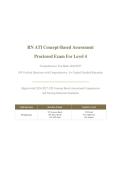
RN ATI Concept-Based Assessment
Proctored Exam For Level 4
Comprehensive Test Bank 2026/2027
100 Verified Questions with Comprehensive, A+ Graded Detailed Rationales
Aligned with 2026-2027 ATI Concept-Based Assessment Competencies
and Nursing Education Standards
Total Questions Question Format Cognitive Levels
70% Scenario-Based 25% Recall
100 Questions 20% Direct Recall 55% Application
10% NGN-Style 20% Analysis
,RN ATI Concept-Based Assessment Level 4 | Test Bank 2026/2027
Table of Contents
Section 1: Patient-Centered Care (Comfort, End-of-Life, Diversity, Communication, Health
Promotion) 3
Section 2: Evidence-Based Practice, Quality Improvement, and Informatics 7
Section 3: Safety and Infection Control 10
Section 4: Clinical Decision-Making, Prioritization, and Clinical Judgment 14
Section 5: Healthcare Systems, Policy, Ethics, and Interprofessional Collaboration 16
Section 6: Delegation and Teamwork 18
Section 7: Complex Medical-Surgical Concepts (Cardiovascular, Respiratory) 19
Section 8: Complex Medical-Surgical Concepts (GI, Renal, Endocrine, Neuro, Immune) 23
Section 9: Mental Health and Psychiatric Nursing 28
Section 10: Maternal-Newborn and Pediatric Nursing 31
Section 11: Integrated NGN-Style Clinical Scenarios 33
Z.ai Page 2
,RN ATI Concept-Based Assessment Level 4 | Test Bank 2026/2027
Section 1: Patient-Centered Care (Comfort, End-of-Life, Diversity,
Communication, Health Promotion)
Q1. A nurse is caring for a patient with terminal cancer who has a prognosis of less than 6 months. The patient
expresses a desire to focus on comfort rather than curative treatment. Which type of care should the nurse
anticipate facilitating?
A. Rehabilitation care
B. Palliative care [CORRECT]
C. Restorative care
D. Acute care
Correct Answer: B
Rationale: Palliative care is the correct answer because it focuses on improving quality of life for patients with life-threatening
illnesses through symptom management and psychosocial support. The patient's prognosis of less than 6 months and desire for
comfort over curative treatment align with the hospice and palliative care philosophy. Rehabilitation care (A) focuses on restoring
function after injury or illness, which is not the priority here. Restorative care (C) aims to return the patient to their previous level
of functioning and does not apply to terminal conditions. Acute care (D) is focused on treating active, urgent medical conditions,
which contradicts the patient's wish for comfort-focused care.
Q2. A nurse is assessing a patient's pain using the Numeric 0-10 scale. The patient reports a pain level of 7. Which
of the following is the priority nursing intervention based on the WHO Pain Ladder?
A. Administer acetaminophen 650 mg orally
B. Apply a warm compress to the affected area
C. Administer morphine 2 mg IV as prescribed [CORRECT]
D. Use guided imagery and relaxation techniques
Correct Answer: C
Rationale: A pain level of 7 on the Numeric 0-10 scale indicates severe pain (7-10 range). According to the WHO Pain Ladder,
Step 3 (strong opioids +/- non-opioids +/- adjuvants) is appropriate for moderate to severe pain. Morphine is a strong opioid and
is the correct choice for this level of pain. Acetaminophen (A) is a Step 1 non-opioid appropriate for mild pain (1-3). Warm
compress (B) and guided imagery (D) are non-pharmacological interventions that may complement but do not adequately address
severe pain as the primary intervention. The nurse should follow the WHO ladder escalation principle and treat severe pain with
strong opioids.
Q3. A patient who is dying is experiencing dyspnea. Which of the following interventions should the nurse
implement first?
A. Administer supplemental oxygen as prescribed
B. Position the patient upright with pillows [CORRECT]
C. Administer morphine 2-4 mg IV as prescribed
D. Reduce noisy stimuli in the room
Correct Answer: B
Rationale: Positioning the patient upright with pillows (B) is the first intervention because it is a non-pharmacological, immediate
action that uses gravity to reduce pressure on the diaphragm and improve lung expansion. This should be attempted before
pharmacological interventions per the least invasive approach principle. While oxygen (A) and morphine (C) are appropriate
pharmacological interventions for dyspnea in end-of-life care, positioning should be implemented first as it requires no order and
Z.ai Page 3
, RN ATI Concept-Based Assessment Level 4 | Test Bank 2026/2027
provides immediate relief. Reducing stimuli (D) is a comfort measure but does not directly address the physiological cause of
dyspnea. The ABC framework prioritizes airway and breathing, and positioning is the most immediate, least invasive intervention.
Q4. A nurse is caring for a patient from a different cultural background who refuses a blood transfusion due to
religious beliefs. Which response by the nurse demonstrates cultural competence using the LEARN model?
A. Explain that the transfusion is medically necessary and must be done
B. Listen to the patient's concerns, explain the risks of refusal, acknowledge their beliefs, recommend
alternatives, and negotiate a plan [CORRECT]
C. Tell the patient that their religious beliefs are not supported by medical evidence
D. Document the refusal and proceed with the transfusion under implied consent
Correct Answer: B
Rationale: The LEARN model stands for Listen, Explain, Acknowledge, Recommend, Negotiate. Option B follows this framework
by listening to the patient's concerns, explaining the medical risks, acknowledging the patient's religious beliefs without judgment,
recommending alternative treatments, and negotiating a mutually acceptable plan. This respects patient autonomy and cultural
differences. Option A and C are coercive and dismissive of the patient's cultural beliefs, violating the ethical principle of
autonomy. Option D violates informed consent requirements and could constitute battery. The LEARN model is the
ATI-recommended approach to culturally competent care.
Q5. A nurse is providing discharge teaching to a patient with limited health literacy. Which teaching strategy is
most effective?
A. Provide detailed written materials at a 12th-grade reading level
B. Use medical terminology to ensure accuracy of information
C. Ask the patient to explain the information back to the nurse in their own words [CORRECT]
D. Give the patient a list of websites to research at home
Correct Answer: C
Rationale: The teach-back method (C) is the most effective strategy for patients with limited health literacy. It involves asking the
patient to explain or demonstrate the information in their own words to confirm understanding. This allows the nurse to identify
and correct misunderstandings. Materials should be at a 5th-6th grade reading level (A is wrong at 12th grade). Medical
terminology (B) should be avoided as it increases confusion for patients with low health literacy. Websites (D) may not be
accessible or understandable. ATI emphasizes teach-back as the gold standard for confirming patient comprehension.
Q6. A nurse is caring for an elderly patient with dementia who is nonverbal and appears to be in distress. Which
pain assessment tool is most appropriate?
A. Numeric 0-10 scale
B. Visual Analog Scale (VAS)
C. PAINAD scale [CORRECT]
D. Wong-Baker FACES Pain Scale
Correct Answer: C
Rationale: The PAINAD (Pain Assessment in Advanced Dementia) scale (C) is specifically designed for elderly patients who are
nonverbal or have advanced dementia. It assesses breathing, negative vocalization, facial expression, body language, and
consolability. The Numeric scale (A) and VAS (B) require self-report which the nonverbal patient cannot provide. The
Wong-Baker FACES scale (D) may be attempted but is less validated for advanced dementia compared to PAINAD. ATI
recommends PAINAD as the gold standard for nonverbal elderly patients.
Z.ai Page 4
Proctored Exam For Level 4
Comprehensive Test Bank 2026/2027
100 Verified Questions with Comprehensive, A+ Graded Detailed Rationales
Aligned with 2026-2027 ATI Concept-Based Assessment Competencies
and Nursing Education Standards
Total Questions Question Format Cognitive Levels
70% Scenario-Based 25% Recall
100 Questions 20% Direct Recall 55% Application
10% NGN-Style 20% Analysis
,RN ATI Concept-Based Assessment Level 4 | Test Bank 2026/2027
Table of Contents
Section 1: Patient-Centered Care (Comfort, End-of-Life, Diversity, Communication, Health
Promotion) 3
Section 2: Evidence-Based Practice, Quality Improvement, and Informatics 7
Section 3: Safety and Infection Control 10
Section 4: Clinical Decision-Making, Prioritization, and Clinical Judgment 14
Section 5: Healthcare Systems, Policy, Ethics, and Interprofessional Collaboration 16
Section 6: Delegation and Teamwork 18
Section 7: Complex Medical-Surgical Concepts (Cardiovascular, Respiratory) 19
Section 8: Complex Medical-Surgical Concepts (GI, Renal, Endocrine, Neuro, Immune) 23
Section 9: Mental Health and Psychiatric Nursing 28
Section 10: Maternal-Newborn and Pediatric Nursing 31
Section 11: Integrated NGN-Style Clinical Scenarios 33
Z.ai Page 2
,RN ATI Concept-Based Assessment Level 4 | Test Bank 2026/2027
Section 1: Patient-Centered Care (Comfort, End-of-Life, Diversity,
Communication, Health Promotion)
Q1. A nurse is caring for a patient with terminal cancer who has a prognosis of less than 6 months. The patient
expresses a desire to focus on comfort rather than curative treatment. Which type of care should the nurse
anticipate facilitating?
A. Rehabilitation care
B. Palliative care [CORRECT]
C. Restorative care
D. Acute care
Correct Answer: B
Rationale: Palliative care is the correct answer because it focuses on improving quality of life for patients with life-threatening
illnesses through symptom management and psychosocial support. The patient's prognosis of less than 6 months and desire for
comfort over curative treatment align with the hospice and palliative care philosophy. Rehabilitation care (A) focuses on restoring
function after injury or illness, which is not the priority here. Restorative care (C) aims to return the patient to their previous level
of functioning and does not apply to terminal conditions. Acute care (D) is focused on treating active, urgent medical conditions,
which contradicts the patient's wish for comfort-focused care.
Q2. A nurse is assessing a patient's pain using the Numeric 0-10 scale. The patient reports a pain level of 7. Which
of the following is the priority nursing intervention based on the WHO Pain Ladder?
A. Administer acetaminophen 650 mg orally
B. Apply a warm compress to the affected area
C. Administer morphine 2 mg IV as prescribed [CORRECT]
D. Use guided imagery and relaxation techniques
Correct Answer: C
Rationale: A pain level of 7 on the Numeric 0-10 scale indicates severe pain (7-10 range). According to the WHO Pain Ladder,
Step 3 (strong opioids +/- non-opioids +/- adjuvants) is appropriate for moderate to severe pain. Morphine is a strong opioid and
is the correct choice for this level of pain. Acetaminophen (A) is a Step 1 non-opioid appropriate for mild pain (1-3). Warm
compress (B) and guided imagery (D) are non-pharmacological interventions that may complement but do not adequately address
severe pain as the primary intervention. The nurse should follow the WHO ladder escalation principle and treat severe pain with
strong opioids.
Q3. A patient who is dying is experiencing dyspnea. Which of the following interventions should the nurse
implement first?
A. Administer supplemental oxygen as prescribed
B. Position the patient upright with pillows [CORRECT]
C. Administer morphine 2-4 mg IV as prescribed
D. Reduce noisy stimuli in the room
Correct Answer: B
Rationale: Positioning the patient upright with pillows (B) is the first intervention because it is a non-pharmacological, immediate
action that uses gravity to reduce pressure on the diaphragm and improve lung expansion. This should be attempted before
pharmacological interventions per the least invasive approach principle. While oxygen (A) and morphine (C) are appropriate
pharmacological interventions for dyspnea in end-of-life care, positioning should be implemented first as it requires no order and
Z.ai Page 3
, RN ATI Concept-Based Assessment Level 4 | Test Bank 2026/2027
provides immediate relief. Reducing stimuli (D) is a comfort measure but does not directly address the physiological cause of
dyspnea. The ABC framework prioritizes airway and breathing, and positioning is the most immediate, least invasive intervention.
Q4. A nurse is caring for a patient from a different cultural background who refuses a blood transfusion due to
religious beliefs. Which response by the nurse demonstrates cultural competence using the LEARN model?
A. Explain that the transfusion is medically necessary and must be done
B. Listen to the patient's concerns, explain the risks of refusal, acknowledge their beliefs, recommend
alternatives, and negotiate a plan [CORRECT]
C. Tell the patient that their religious beliefs are not supported by medical evidence
D. Document the refusal and proceed with the transfusion under implied consent
Correct Answer: B
Rationale: The LEARN model stands for Listen, Explain, Acknowledge, Recommend, Negotiate. Option B follows this framework
by listening to the patient's concerns, explaining the medical risks, acknowledging the patient's religious beliefs without judgment,
recommending alternative treatments, and negotiating a mutually acceptable plan. This respects patient autonomy and cultural
differences. Option A and C are coercive and dismissive of the patient's cultural beliefs, violating the ethical principle of
autonomy. Option D violates informed consent requirements and could constitute battery. The LEARN model is the
ATI-recommended approach to culturally competent care.
Q5. A nurse is providing discharge teaching to a patient with limited health literacy. Which teaching strategy is
most effective?
A. Provide detailed written materials at a 12th-grade reading level
B. Use medical terminology to ensure accuracy of information
C. Ask the patient to explain the information back to the nurse in their own words [CORRECT]
D. Give the patient a list of websites to research at home
Correct Answer: C
Rationale: The teach-back method (C) is the most effective strategy for patients with limited health literacy. It involves asking the
patient to explain or demonstrate the information in their own words to confirm understanding. This allows the nurse to identify
and correct misunderstandings. Materials should be at a 5th-6th grade reading level (A is wrong at 12th grade). Medical
terminology (B) should be avoided as it increases confusion for patients with low health literacy. Websites (D) may not be
accessible or understandable. ATI emphasizes teach-back as the gold standard for confirming patient comprehension.
Q6. A nurse is caring for an elderly patient with dementia who is nonverbal and appears to be in distress. Which
pain assessment tool is most appropriate?
A. Numeric 0-10 scale
B. Visual Analog Scale (VAS)
C. PAINAD scale [CORRECT]
D. Wong-Baker FACES Pain Scale
Correct Answer: C
Rationale: The PAINAD (Pain Assessment in Advanced Dementia) scale (C) is specifically designed for elderly patients who are
nonverbal or have advanced dementia. It assesses breathing, negative vocalization, facial expression, body language, and
consolability. The Numeric scale (A) and VAS (B) require self-report which the nonverbal patient cannot provide. The
Wong-Baker FACES scale (D) may be attempted but is less validated for advanced dementia compared to PAINAD. ATI
recommends PAINAD as the gold standard for nonverbal elderly patients.
Z.ai Page 4

