

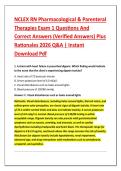
NCLEX RN Pharmacological & Parenteral
Therapies Exam 1 Questions And
Correct Answers (Verified Answers) Plus
Rationales 2026 Q&A | Instant
Download Pdf
1. A client with heart failure is prescribed digoxin. Which finding would indicate
to the nurse that the client is experiencing digoxin toxicity?
A. Heart rate of 72 beats per minute
B. Serum potassium level of 4.0 mEq/L
C. Visual disturbances such as halos around lights
D. Blood pressure of 130/80 mmHg
Answer: C. Visual disturbances such as halos around lights
Rationale: Visual disturbances, including halos around lights, blurred vision, and
yellow-green color perception, are classic signs of digoxin toxicity. A heart rate
of 72 is within normal limits and does not indicate toxicity. A serum potassium
level of 4.0 mEq/L is normal. Blood pressure of 130/80 mmHg is within
acceptable range. Digoxin toxicity can also present with gastrointestinal
symptoms such as nausea, vomiting, and anorexia, as well as cardiac
dysrhythmias including bradycardia and heart block. The therapeutic range for
digoxin is 0.8-2.0 ng/mL, and levels above this range increase the risk of toxicity.
Risk factors for digoxin toxicity include hypokalemia, renal impairment,
advanced age, and drug interactions with medications such as amiodarone,
verapamil, and quinidine.
,2. A client is receiving heparin infusion for treatment of deep vein thrombosis.
Which laboratory value would the nurse monitor most closely?
A. Prothrombin time
B. Activated partial thromboplastin time
C. International normalized ratio
D. Platelet count
Answer: B. Activated partial thromboplastin time
Rationale: Heparin therapy is monitored using activated partial thromboplastin
time (aPTT). The therapeutic goal for heparin is to maintain the aPTT at 1.5 to
2.5 times the normal control value. Prothrombin time and INR are used to
monitor warfarin therapy, not heparin. Platelet count is monitored for heparin-
induced thrombocytopenia (HIT), but aPTT is the primary monitoring parameter
for anticoagulation effect. HIT is a serious complication of heparin therapy
characterized by a decrease in platelet count by 50% or more, typically occurring
5-10 days after initiation of therapy. If HIT is suspected, heparin should be
discontinued immediately and alternative anticoagulation therapy initiated. The
normal aPTT value ranges from 25-35 seconds, and therapeutic levels typically
target 60-80 seconds.
3. A client with type 1 diabetes mellitus is experiencing nausea and vomiting
and unable to eat. Which instruction should the nurse provide regarding insulin
administration?
A. Skip the insulin dose until able to eat
B. Take the usual insulin dose
C. Take half the usual insulin dose
D. Take the insulin and consume clear liquids
Answer: D. Take the insulin and consume clear liquids
Rationale: Clients with type 1 diabetes should never skip insulin doses, even
when unable to eat, as this can lead to diabetic ketoacidosis (DKA). The nurse
,should instruct the client to take the usual insulin dose and consume clear liquids
containing carbohydrates to prevent hypoglycemia. Skipping insulin (A) can lead
to hyperglycemia and ketosis. Taking the usual dose without carbohydrates (B)
can cause hypoglycemia. Taking half the dose (C) may result in inadequate
glucose control and potential hyperglycemia. Sick day management for clients
with diabetes includes continuing insulin therapy, monitoring blood glucose
more frequently, testing urine for ketones, and maintaining hydration. Clear
liquids such as broth, gelatin, and juice can provide necessary calories and fluids
during illness.
4. A nurse is preparing to administer potassium chloride IV to a client with
hypokalemia. Which action is most appropriate?
A. Administer as a rapid IV push
B. Dilute the medication and administer as a slow infusion
C. Administer through a peripheral IV site
D. Administer undiluted through a central line
Answer: B. Dilute the medication and administer as a slow infusion
Rationale: Potassium chloride must be diluted and administered as a slow
infusion to prevent cardiac arrest and tissue necrosis. Rapid IV push
administration (A) can cause fatal hyperkalemia and cardiac arrhythmias. While
administering through a peripheral IV site (C) is acceptable, the medication must
be diluted and infused at a rate not exceeding 10-20 mEq/hour through a
peripheral site and up to 40 mEq/hour through a central line. Administering
undiluted (D) can cause severe tissue damage, necrosis, and cardiac arrest. The
maximum concentration for peripheral administration is 40-60 mEq/L, and for
central line administration is up to 80 mEq/L. The infusion should be
administered using an infusion pump to ensure accurate rate control. Clients
receiving IV potassium should have continuous cardiac monitoring due to the
risk of arrhythmias.
, 5. A client is prescribed warfarin for prevention of stroke. Which dietary
instruction should the nurse include in the teaching plan?
A. Increase intake of green leafy vegetables
B. Maintain consistent intake of vitamin K-rich foods
C. Avoid all foods containing vitamin K
D. Take the medication with dairy products
Answer: B. Maintain consistent intake of vitamin K-rich foods
Rationale: Clients taking warfarin should maintain a consistent daily intake of
vitamin K-rich foods to maintain stable INR levels. Vitamin K is the antidote for
warfarin and acts as a competitive inhibitor, so sudden changes in vitamin K
intake can alter the anticoagulant effect. Increasing intake of green leafy
vegetables (A) can decrease the effectiveness of warfarin. Avoiding all vitamin K
foods (C) is unnecessary and impractical; consistency is key rather than
elimination. Taking warfarin with dairy products (D) is not necessary and dairy
products do not significantly affect warfarin absorption. Warfarin inhibits
vitamin K-dependent clotting factors II, VII, IX, and X. Clients should be educated
to recognize signs of bleeding such as easy bruising, prolonged bleeding from
cuts, and dark tarry stools. The therapeutic INR range for most indications is 2.0-
3.0.
6. A client is receiving vancomycin IV for a methicillin-resistant Staphylococcus
aureus (MRSA) infection. Which adverse effect should the nurse monitor for
specifically related to this medication?
A. Nephrotoxicity and ototoxicity
B. Hepatotoxicity
C. Cardiotoxicity
D. Pulmonary toxicity
Answer: A. Nephrotoxicity and ototoxicity
Therapies Exam 1 Questions And
Correct Answers (Verified Answers) Plus
Rationales 2026 Q&A | Instant
Download Pdf
1. A client with heart failure is prescribed digoxin. Which finding would indicate
to the nurse that the client is experiencing digoxin toxicity?
A. Heart rate of 72 beats per minute
B. Serum potassium level of 4.0 mEq/L
C. Visual disturbances such as halos around lights
D. Blood pressure of 130/80 mmHg
Answer: C. Visual disturbances such as halos around lights
Rationale: Visual disturbances, including halos around lights, blurred vision, and
yellow-green color perception, are classic signs of digoxin toxicity. A heart rate
of 72 is within normal limits and does not indicate toxicity. A serum potassium
level of 4.0 mEq/L is normal. Blood pressure of 130/80 mmHg is within
acceptable range. Digoxin toxicity can also present with gastrointestinal
symptoms such as nausea, vomiting, and anorexia, as well as cardiac
dysrhythmias including bradycardia and heart block. The therapeutic range for
digoxin is 0.8-2.0 ng/mL, and levels above this range increase the risk of toxicity.
Risk factors for digoxin toxicity include hypokalemia, renal impairment,
advanced age, and drug interactions with medications such as amiodarone,
verapamil, and quinidine.
,2. A client is receiving heparin infusion for treatment of deep vein thrombosis.
Which laboratory value would the nurse monitor most closely?
A. Prothrombin time
B. Activated partial thromboplastin time
C. International normalized ratio
D. Platelet count
Answer: B. Activated partial thromboplastin time
Rationale: Heparin therapy is monitored using activated partial thromboplastin
time (aPTT). The therapeutic goal for heparin is to maintain the aPTT at 1.5 to
2.5 times the normal control value. Prothrombin time and INR are used to
monitor warfarin therapy, not heparin. Platelet count is monitored for heparin-
induced thrombocytopenia (HIT), but aPTT is the primary monitoring parameter
for anticoagulation effect. HIT is a serious complication of heparin therapy
characterized by a decrease in platelet count by 50% or more, typically occurring
5-10 days after initiation of therapy. If HIT is suspected, heparin should be
discontinued immediately and alternative anticoagulation therapy initiated. The
normal aPTT value ranges from 25-35 seconds, and therapeutic levels typically
target 60-80 seconds.
3. A client with type 1 diabetes mellitus is experiencing nausea and vomiting
and unable to eat. Which instruction should the nurse provide regarding insulin
administration?
A. Skip the insulin dose until able to eat
B. Take the usual insulin dose
C. Take half the usual insulin dose
D. Take the insulin and consume clear liquids
Answer: D. Take the insulin and consume clear liquids
Rationale: Clients with type 1 diabetes should never skip insulin doses, even
when unable to eat, as this can lead to diabetic ketoacidosis (DKA). The nurse
,should instruct the client to take the usual insulin dose and consume clear liquids
containing carbohydrates to prevent hypoglycemia. Skipping insulin (A) can lead
to hyperglycemia and ketosis. Taking the usual dose without carbohydrates (B)
can cause hypoglycemia. Taking half the dose (C) may result in inadequate
glucose control and potential hyperglycemia. Sick day management for clients
with diabetes includes continuing insulin therapy, monitoring blood glucose
more frequently, testing urine for ketones, and maintaining hydration. Clear
liquids such as broth, gelatin, and juice can provide necessary calories and fluids
during illness.
4. A nurse is preparing to administer potassium chloride IV to a client with
hypokalemia. Which action is most appropriate?
A. Administer as a rapid IV push
B. Dilute the medication and administer as a slow infusion
C. Administer through a peripheral IV site
D. Administer undiluted through a central line
Answer: B. Dilute the medication and administer as a slow infusion
Rationale: Potassium chloride must be diluted and administered as a slow
infusion to prevent cardiac arrest and tissue necrosis. Rapid IV push
administration (A) can cause fatal hyperkalemia and cardiac arrhythmias. While
administering through a peripheral IV site (C) is acceptable, the medication must
be diluted and infused at a rate not exceeding 10-20 mEq/hour through a
peripheral site and up to 40 mEq/hour through a central line. Administering
undiluted (D) can cause severe tissue damage, necrosis, and cardiac arrest. The
maximum concentration for peripheral administration is 40-60 mEq/L, and for
central line administration is up to 80 mEq/L. The infusion should be
administered using an infusion pump to ensure accurate rate control. Clients
receiving IV potassium should have continuous cardiac monitoring due to the
risk of arrhythmias.
, 5. A client is prescribed warfarin for prevention of stroke. Which dietary
instruction should the nurse include in the teaching plan?
A. Increase intake of green leafy vegetables
B. Maintain consistent intake of vitamin K-rich foods
C. Avoid all foods containing vitamin K
D. Take the medication with dairy products
Answer: B. Maintain consistent intake of vitamin K-rich foods
Rationale: Clients taking warfarin should maintain a consistent daily intake of
vitamin K-rich foods to maintain stable INR levels. Vitamin K is the antidote for
warfarin and acts as a competitive inhibitor, so sudden changes in vitamin K
intake can alter the anticoagulant effect. Increasing intake of green leafy
vegetables (A) can decrease the effectiveness of warfarin. Avoiding all vitamin K
foods (C) is unnecessary and impractical; consistency is key rather than
elimination. Taking warfarin with dairy products (D) is not necessary and dairy
products do not significantly affect warfarin absorption. Warfarin inhibits
vitamin K-dependent clotting factors II, VII, IX, and X. Clients should be educated
to recognize signs of bleeding such as easy bruising, prolonged bleeding from
cuts, and dark tarry stools. The therapeutic INR range for most indications is 2.0-
3.0.
6. A client is receiving vancomycin IV for a methicillin-resistant Staphylococcus
aureus (MRSA) infection. Which adverse effect should the nurse monitor for
specifically related to this medication?
A. Nephrotoxicity and ototoxicity
B. Hepatotoxicity
C. Cardiotoxicity
D. Pulmonary toxicity
Answer: A. Nephrotoxicity and ototoxicity

