

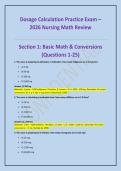
Dosage Calculation Practice Exam –
2026 Nursing Math Review
Section 1: Basic Math & Conversions
(Questions 1-25)
1. The nurse is preparing to administer a medication. How many milligrams are in 0.5 grams?
A) 5 mg
B) 50 mg
C) 500 mg
D) 5,000 mg
Answer: C) 500 mg
Rationale: 1 gram = 1000 milligrams. Therefore, 0.5 grams = 0.5 × 1000 = 500 mg. Remember the metric
conversions: kg → g → mg → mcg (each multiplied by 1000).
2. The nurse is calculating a medication dose. How many milliliters are in 2.5 liters?
A) 25 mL
B) 250 mL
C) 2,500 mL
D) 25,000 mL
Answer: C) 2,500 mL
Rationale: 1 liter = 1000 milliliters. Therefore, 2.5 liters = 2.5 × 1000 = 2,500 mL. Remember the metric
conversions: L → mL (multiply by 1000).
3. The nurse is preparing an IV infusion. How many micrograms are in 0.25 mg?
A) 25 mcg
B) 250 mcg
C) 2,500 mcg
D) 25,000 mcg
,Answer: B) 250 mcg
Rationale: 1 mg = 1000 micrograms. Therefore, 0.25 mg = 0.25 × 1000 = 250 mcg. Remember the metric
conversions: mg → mcg (multiply by 1000).
4. The nurse is calculating a patient's intake. How many ounces are in 240 mL?
A) 4 oz
B) 6 oz
C) 8 oz
D) 10 oz
Answer: C) 8 oz
Rationale: 1 ounce = 30 mL (approximately). 240 mL ÷ 30 = 8 ounces. This is a standard conversion used
in clinical settings.
5. The nurse is converting pounds to kilograms. A patient weighs 154 pounds. What is the weight in
kilograms?
A) 60 kg
B) 65 kg
C) 70 kg
D) 75 kg
Answer: C) 70 kg
Rationale: 1 kg = 2.2 pounds. Therefore, 154 lb ÷ 2.2 = 70 kg. Remember the conversion: weight in
pounds ÷ 2.2 = weight in kilograms.
6. The nurse is calculating a medication dose using the ratio and proportion method. The order is for
250 mg of a medication. The available concentration is 500 mg per 5 mL. How many milliliters should
the nurse administer?
A) 1.5 mL
B) 2.0 mL
C) 2.5 mL
D) 3.0 mL
Answer: C) 2.5 mL
Rationale: Using ratio and proportion: 500 mg / 5 mL = 250 mg / x mL. Cross multiply: 500x = 1250. x =
= 2.5 mL.
7. The nurse is preparing an IV infusion of 1,000 mL of normal saline to be infused over 8 hours. What
is the infusion rate in mL/hour?
A) 100 mL/hour
, B) 125 mL/hour
C) 150 mL/hour
D) 200 mL/hour
Answer: B) 125 mL/hour
Rationale: Infusion rate = Total volume ÷ Time. 1,000 mL ÷ 8 hours = 125 mL/hour.
8. The nurse is calculating the drop rate for an IV infusion. The order is for 1,000 mL of D5W over 6
hours. The drop factor is 15 gtt/mL. What is the infusion rate in gtt/min?
A) 30 gtt/min
B) 35 gtt/min
C) 40 gtt/min
D) 42 gtt/min
Answer: D) 42 gtt/min
Rationale: Step 1: Calculate mL/hour: 1000 mL ÷ 6 hours = 166.67 mL/hour. Step 2: Calculate mL/min:
166.67 ÷ 60 = 2.78 mL/min. Step 3: Calculate gtt/min: 2.78 × 15 = 41.7 ≈ 42 gtt/min.
9. The nurse is administering a medication that is available as 250 mg/5 mL. The order is for 0.75 g.
How many milliliters should the nurse administer?
A) 10 mL
B) 12.5 mL
C) 15 mL
D) 17.5 mL
Answer: C) 15 mL
Rationale: Step 1: Convert 0.75 g to mg: 0.75 × 1000 = 750 mg. Step 2: Use ratio and proportion: 250 mg
/ 5 mL = 750 mg / x mL. 250x = 3750. x = = 15 mL.
10. The nurse is calculating the daily fluid requirement for a pediatric patient using the Holliday-Segar
method. A child weighs 22 kg. What is the daily maintenance fluid requirement?
A) 1,500 mL
B) 1,600 mL
C) 1,700 mL
D) 1,800 mL
Answer: B) 1,600 mL
Rationale: Holliday-Segar method: 100 mL/kg for first 10 kg, 50 mL/kg for next 10 kg, 20 mL/kg for each
additional kg. First 10 kg: 10 × 100 = 1000. Next 10 kg: 10 × 50 = 500. Remaining 2 kg: 2 × 20 = 40. Total
= 1000 + 500 + 40 = 1,540 mL ≈ 1,600 mL (or 1,540 mL).
, 11. The nurse is preparing to administer an IV push medication. The order is for 0.5 mg/kg of a
medication. The patient weighs 80 kg. The available concentration is 40 mg/mL. How many milliliters
should the nurse administer?
A) 0.5 mL
B) 1.0 mL
C) 1.5 mL
D) 2.0 mL
Answer: B) 1.0 mL
Rationale: Step 1: Calculate dose: 0.5 mg/kg × 80 kg = 40 mg. Step 2: Calculate volume: 40 mg ÷ 40
mg/mL = 1 mL.
12. The nurse is calculating the intake for a patient. The patient drank 6 oz of juice, 8 oz of water, and
4 oz of soup. What is the total intake in mL?
A) 360 mL
B) 480 mL
C) 540 mL
D) 600 mL
Answer: C) 540 mL
Rationale: 1 oz = 30 mL. Total ounces = 6 + 8 + 4 = 18 oz. 18 × 30 = 540 mL.
13. The nurse is preparing to administer a medication. The order is for 1.5 grams of a medication. The
available concentration is 500 mg per tablet. How many tablets should the nurse administer?
A) 1 tablet
B) 2 tablets
C) 3 tablets
D) 4 tablets
Answer: C) 3 tablets
Rationale: Step 1: Convert 1.5 g to mg: 1.5 × 1000 = 1,500 mg. Step 2: Calculate tablets: 1,500 mg ÷ 500
mg/tablet = 3 tablets.
14. The nurse is calculating an IV infusion rate. The order is for 500 mL of lactated Ringer's to be
infused over 4 hours. What is the infusion rate in mL/hour?
A) 100 mL/hour
B) 125 mL/hour
C) 150 mL/hour
2026 Nursing Math Review
Section 1: Basic Math & Conversions
(Questions 1-25)
1. The nurse is preparing to administer a medication. How many milligrams are in 0.5 grams?
A) 5 mg
B) 50 mg
C) 500 mg
D) 5,000 mg
Answer: C) 500 mg
Rationale: 1 gram = 1000 milligrams. Therefore, 0.5 grams = 0.5 × 1000 = 500 mg. Remember the metric
conversions: kg → g → mg → mcg (each multiplied by 1000).
2. The nurse is calculating a medication dose. How many milliliters are in 2.5 liters?
A) 25 mL
B) 250 mL
C) 2,500 mL
D) 25,000 mL
Answer: C) 2,500 mL
Rationale: 1 liter = 1000 milliliters. Therefore, 2.5 liters = 2.5 × 1000 = 2,500 mL. Remember the metric
conversions: L → mL (multiply by 1000).
3. The nurse is preparing an IV infusion. How many micrograms are in 0.25 mg?
A) 25 mcg
B) 250 mcg
C) 2,500 mcg
D) 25,000 mcg
,Answer: B) 250 mcg
Rationale: 1 mg = 1000 micrograms. Therefore, 0.25 mg = 0.25 × 1000 = 250 mcg. Remember the metric
conversions: mg → mcg (multiply by 1000).
4. The nurse is calculating a patient's intake. How many ounces are in 240 mL?
A) 4 oz
B) 6 oz
C) 8 oz
D) 10 oz
Answer: C) 8 oz
Rationale: 1 ounce = 30 mL (approximately). 240 mL ÷ 30 = 8 ounces. This is a standard conversion used
in clinical settings.
5. The nurse is converting pounds to kilograms. A patient weighs 154 pounds. What is the weight in
kilograms?
A) 60 kg
B) 65 kg
C) 70 kg
D) 75 kg
Answer: C) 70 kg
Rationale: 1 kg = 2.2 pounds. Therefore, 154 lb ÷ 2.2 = 70 kg. Remember the conversion: weight in
pounds ÷ 2.2 = weight in kilograms.
6. The nurse is calculating a medication dose using the ratio and proportion method. The order is for
250 mg of a medication. The available concentration is 500 mg per 5 mL. How many milliliters should
the nurse administer?
A) 1.5 mL
B) 2.0 mL
C) 2.5 mL
D) 3.0 mL
Answer: C) 2.5 mL
Rationale: Using ratio and proportion: 500 mg / 5 mL = 250 mg / x mL. Cross multiply: 500x = 1250. x =
= 2.5 mL.
7. The nurse is preparing an IV infusion of 1,000 mL of normal saline to be infused over 8 hours. What
is the infusion rate in mL/hour?
A) 100 mL/hour
, B) 125 mL/hour
C) 150 mL/hour
D) 200 mL/hour
Answer: B) 125 mL/hour
Rationale: Infusion rate = Total volume ÷ Time. 1,000 mL ÷ 8 hours = 125 mL/hour.
8. The nurse is calculating the drop rate for an IV infusion. The order is for 1,000 mL of D5W over 6
hours. The drop factor is 15 gtt/mL. What is the infusion rate in gtt/min?
A) 30 gtt/min
B) 35 gtt/min
C) 40 gtt/min
D) 42 gtt/min
Answer: D) 42 gtt/min
Rationale: Step 1: Calculate mL/hour: 1000 mL ÷ 6 hours = 166.67 mL/hour. Step 2: Calculate mL/min:
166.67 ÷ 60 = 2.78 mL/min. Step 3: Calculate gtt/min: 2.78 × 15 = 41.7 ≈ 42 gtt/min.
9. The nurse is administering a medication that is available as 250 mg/5 mL. The order is for 0.75 g.
How many milliliters should the nurse administer?
A) 10 mL
B) 12.5 mL
C) 15 mL
D) 17.5 mL
Answer: C) 15 mL
Rationale: Step 1: Convert 0.75 g to mg: 0.75 × 1000 = 750 mg. Step 2: Use ratio and proportion: 250 mg
/ 5 mL = 750 mg / x mL. 250x = 3750. x = = 15 mL.
10. The nurse is calculating the daily fluid requirement for a pediatric patient using the Holliday-Segar
method. A child weighs 22 kg. What is the daily maintenance fluid requirement?
A) 1,500 mL
B) 1,600 mL
C) 1,700 mL
D) 1,800 mL
Answer: B) 1,600 mL
Rationale: Holliday-Segar method: 100 mL/kg for first 10 kg, 50 mL/kg for next 10 kg, 20 mL/kg for each
additional kg. First 10 kg: 10 × 100 = 1000. Next 10 kg: 10 × 50 = 500. Remaining 2 kg: 2 × 20 = 40. Total
= 1000 + 500 + 40 = 1,540 mL ≈ 1,600 mL (or 1,540 mL).
, 11. The nurse is preparing to administer an IV push medication. The order is for 0.5 mg/kg of a
medication. The patient weighs 80 kg. The available concentration is 40 mg/mL. How many milliliters
should the nurse administer?
A) 0.5 mL
B) 1.0 mL
C) 1.5 mL
D) 2.0 mL
Answer: B) 1.0 mL
Rationale: Step 1: Calculate dose: 0.5 mg/kg × 80 kg = 40 mg. Step 2: Calculate volume: 40 mg ÷ 40
mg/mL = 1 mL.
12. The nurse is calculating the intake for a patient. The patient drank 6 oz of juice, 8 oz of water, and
4 oz of soup. What is the total intake in mL?
A) 360 mL
B) 480 mL
C) 540 mL
D) 600 mL
Answer: C) 540 mL
Rationale: 1 oz = 30 mL. Total ounces = 6 + 8 + 4 = 18 oz. 18 × 30 = 540 mL.
13. The nurse is preparing to administer a medication. The order is for 1.5 grams of a medication. The
available concentration is 500 mg per tablet. How many tablets should the nurse administer?
A) 1 tablet
B) 2 tablets
C) 3 tablets
D) 4 tablets
Answer: C) 3 tablets
Rationale: Step 1: Convert 1.5 g to mg: 1.5 × 1000 = 1,500 mg. Step 2: Calculate tablets: 1,500 mg ÷ 500
mg/tablet = 3 tablets.
14. The nurse is calculating an IV infusion rate. The order is for 500 mL of lactated Ringer's to be
infused over 4 hours. What is the infusion rate in mL/hour?
A) 100 mL/hour
B) 125 mL/hour
C) 150 mL/hour

