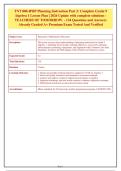
TNT 800.4PBP Planning Instruction Part 2: Complete Grade 9
Algebra 1 Lesson Plan | 2026 Update with complete solutions -
TEACHERS OF TOMORROW. - 134 Questions and Answers
Already Graded A+ Premium Exam Tested And Verified
Subject Area Education / Mathematics Education
Description This exam assesses deep understanding of planning instruction for Grade 9
Algebra 1, including lesson design, learning objectives, assessment strategies,
differentiation, technology integration, and alignment with Common Core State
Standards. It reflects the 2026 update of the Teachers of Tomorrow course.
Expected Grade A+
Total Questions 134
Duration 3 hours
Learning Outcomes 1. Design measurable learning objectives aligned to CCSS for Algebra 1
2. Select and justify formative and summative assessment methods
3. Analyze and address common student misconceptions in algebra
4. Integrate technology and real-world contexts to enhance algebraic reasoning
5. Differentiate instruction to meet diverse learner needs
Accreditation Meets standards for US university teacher preparation programs (CAEP/NCATE)
Page 1
,Question 1 of 134
A lesson objective states: 'Students will be able to solve linear equations with variables on both sides.'
This objective falls under which level of Bloom's Revised Taxonomy?
A. Remember
B. Understand
C. Apply
D. Analyze
The correct answer is:
Correct Action: Apply
Rationales
• Apply (Correct):
This is the correct action. Applying involves using procedures to solve problems. Solving equations requires executing a
multi-step process, which is Apply. Remember is recall, Understand is explaining, Analyze is differentiating or organizing.
• Remember (Incorrect):
This option is not appropriate. Solving equations requires executing a multi-step process, which is Apply. Remember is
recall, Understand is explaining, Analyze is differentiating or organizing
• Understand (Incorrect):
This option is not appropriate. Solving equations requires executing a multi-step process, which is Apply. Remember is
recall, Understand is explaining, Analyze is differentiating or organizing
• Analyze (Incorrect):
This option is not appropriate. Solving equations requires executing a multi-step process, which is Apply. Remember is
recall, Understand is explaining, Analyze is differentiating or organizing
Page 2
,Question 2 of 134
During a lesson on systems of equations, a student writes: y = 2x + 3 and y = 2x - 1. They claim there
is one solution because both lines have the same slope. Which misconception is demonstrated?
A. Confusing slope with y-intercept
B. Assuming same slope implies intersection
C. Thinking parallel lines intersect
D. Misinterpreting the substitution method
The correct answer is:
Correct Action: Assuming same slope implies intersection
Rationales
• Assuming same slope implies intersection (Correct):
This is the correct action. The student correctly notes same slope but incorrectly concludes there is one solution. In reality,
lines with same slope are parallel (distinct y-intercepts) and have no solution. This reflects a misconception about when
systems have unique, infinite, or no solutions.
• Confusing slope with y-intercept (Incorrect):
This option is not appropriate. In reality, lines with same slope are parallel (distinct y-intercepts) and have no solution. This
reflects a misconception about when systems have unique, infinite, or no solutions
• Thinking parallel lines intersect (Incorrect):
This option is not appropriate. In reality, lines with same slope are parallel (distinct y-intercepts) and have no solution. This
reflects a misconception about when systems have unique, infinite, or no solutions
• Misinterpreting the substitution method (Incorrect):
This option is not appropriate. In reality, lines with same slope are parallel (distinct y-intercepts) and have no solution. This
reflects a misconception about when systems have unique, infinite, or no solutions
Page 3
, Question 3 of 134
A teacher has a class with varied readiness: some students can solve multi-step equations fluently,
while others struggle with one-step equations. Which differentiation strategy best addresses this
range during a lesson on solving inequalities?
A. Provide all students with the same set of leveled problems, allowing choice
B. Group students homogeneously and assign tiered tasks based on readiness
C. Use heterogeneous groups and assign each group the same complex problem
D. Replace the inequality lesson with review of equations for the whole class
The correct answer is:
Correct Action: Group students homogeneously and assign tiered tasks based on readiness
Rationales
• Group students homogeneously and assign tiered tasks based on readiness (Correct):
This is the correct action. Tiered tasks by readiness allow each group to work at an appropriate challenge level.
Homogeneous grouping enables targeted instruction. Option A may not provide sufficient challenge or support; option C
may frustrate struggling students; option D neglects the curriculum goal.
• Provide all students with the same set of leveled problems, allowing choice (Incorrect):
This option is not appropriate. Homogeneous grouping enables targeted instruction. Option A may not provide sufficient
challenge or support; option C may frustrate struggling students; option D neglects the curriculum goal
• Use heterogeneous groups and assign each group the same complex problem (Incorrect):
This option is not appropriate. Homogeneous grouping enables targeted instruction. Option A may not provide sufficient
challenge or support; option C may frustrate struggling students; option D neglects the curriculum goal
• Replace the inequality lesson with review of equations for the whole class (Incorrect):
This option is not appropriate. Homogeneous grouping enables targeted instruction. Option A may not provide sufficient
challenge or support; option C may frustrate struggling students; option D neglects the curriculum goal
Page 4
Algebra 1 Lesson Plan | 2026 Update with complete solutions -
TEACHERS OF TOMORROW. - 134 Questions and Answers
Already Graded A+ Premium Exam Tested And Verified
Subject Area Education / Mathematics Education
Description This exam assesses deep understanding of planning instruction for Grade 9
Algebra 1, including lesson design, learning objectives, assessment strategies,
differentiation, technology integration, and alignment with Common Core State
Standards. It reflects the 2026 update of the Teachers of Tomorrow course.
Expected Grade A+
Total Questions 134
Duration 3 hours
Learning Outcomes 1. Design measurable learning objectives aligned to CCSS for Algebra 1
2. Select and justify formative and summative assessment methods
3. Analyze and address common student misconceptions in algebra
4. Integrate technology and real-world contexts to enhance algebraic reasoning
5. Differentiate instruction to meet diverse learner needs
Accreditation Meets standards for US university teacher preparation programs (CAEP/NCATE)
Page 1
,Question 1 of 134
A lesson objective states: 'Students will be able to solve linear equations with variables on both sides.'
This objective falls under which level of Bloom's Revised Taxonomy?
A. Remember
B. Understand
C. Apply
D. Analyze
The correct answer is:
Correct Action: Apply
Rationales
• Apply (Correct):
This is the correct action. Applying involves using procedures to solve problems. Solving equations requires executing a
multi-step process, which is Apply. Remember is recall, Understand is explaining, Analyze is differentiating or organizing.
• Remember (Incorrect):
This option is not appropriate. Solving equations requires executing a multi-step process, which is Apply. Remember is
recall, Understand is explaining, Analyze is differentiating or organizing
• Understand (Incorrect):
This option is not appropriate. Solving equations requires executing a multi-step process, which is Apply. Remember is
recall, Understand is explaining, Analyze is differentiating or organizing
• Analyze (Incorrect):
This option is not appropriate. Solving equations requires executing a multi-step process, which is Apply. Remember is
recall, Understand is explaining, Analyze is differentiating or organizing
Page 2
,Question 2 of 134
During a lesson on systems of equations, a student writes: y = 2x + 3 and y = 2x - 1. They claim there
is one solution because both lines have the same slope. Which misconception is demonstrated?
A. Confusing slope with y-intercept
B. Assuming same slope implies intersection
C. Thinking parallel lines intersect
D. Misinterpreting the substitution method
The correct answer is:
Correct Action: Assuming same slope implies intersection
Rationales
• Assuming same slope implies intersection (Correct):
This is the correct action. The student correctly notes same slope but incorrectly concludes there is one solution. In reality,
lines with same slope are parallel (distinct y-intercepts) and have no solution. This reflects a misconception about when
systems have unique, infinite, or no solutions.
• Confusing slope with y-intercept (Incorrect):
This option is not appropriate. In reality, lines with same slope are parallel (distinct y-intercepts) and have no solution. This
reflects a misconception about when systems have unique, infinite, or no solutions
• Thinking parallel lines intersect (Incorrect):
This option is not appropriate. In reality, lines with same slope are parallel (distinct y-intercepts) and have no solution. This
reflects a misconception about when systems have unique, infinite, or no solutions
• Misinterpreting the substitution method (Incorrect):
This option is not appropriate. In reality, lines with same slope are parallel (distinct y-intercepts) and have no solution. This
reflects a misconception about when systems have unique, infinite, or no solutions
Page 3
, Question 3 of 134
A teacher has a class with varied readiness: some students can solve multi-step equations fluently,
while others struggle with one-step equations. Which differentiation strategy best addresses this
range during a lesson on solving inequalities?
A. Provide all students with the same set of leveled problems, allowing choice
B. Group students homogeneously and assign tiered tasks based on readiness
C. Use heterogeneous groups and assign each group the same complex problem
D. Replace the inequality lesson with review of equations for the whole class
The correct answer is:
Correct Action: Group students homogeneously and assign tiered tasks based on readiness
Rationales
• Group students homogeneously and assign tiered tasks based on readiness (Correct):
This is the correct action. Tiered tasks by readiness allow each group to work at an appropriate challenge level.
Homogeneous grouping enables targeted instruction. Option A may not provide sufficient challenge or support; option C
may frustrate struggling students; option D neglects the curriculum goal.
• Provide all students with the same set of leveled problems, allowing choice (Incorrect):
This option is not appropriate. Homogeneous grouping enables targeted instruction. Option A may not provide sufficient
challenge or support; option C may frustrate struggling students; option D neglects the curriculum goal
• Use heterogeneous groups and assign each group the same complex problem (Incorrect):
This option is not appropriate. Homogeneous grouping enables targeted instruction. Option A may not provide sufficient
challenge or support; option C may frustrate struggling students; option D neglects the curriculum goal
• Replace the inequality lesson with review of equations for the whole class (Incorrect):
This option is not appropriate. Homogeneous grouping enables targeted instruction. Option A may not provide sufficient
challenge or support; option C may frustrate struggling students; option D neglects the curriculum goal
Page 4