

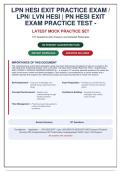
LPN HESI EXIT PRACTICE EXAM /
LPN/ LVN HESI | PN HESI EXIT
EXAM PRACTICE TEST -
LATEST MOCK PRACTICE SET
127 Questions with Answers and Detailed Rationales
100 PERCENT GUARANTEED PASS
INSTANT DOWNLOAD ANSWERS INCLUDED
IMPORTANCE OF THIS DOCUMENT
This comprehensive examination preparation guide has been meticulously developed to help you succeed in the
LPN HESI EXIT PRACTICE EXAM / LPN/ LVN HESI | PN HESI EXIT EXAM PRACTICE TEST - QUESTIONS
AND CORRECT VERIFIED ANSWERS GRADED A+.. It contains 127 carefully selected questions that reflect the
most current exam content and testing strategies. Each question is accompanied by a correct answer and a
detailed rationale that explains the underlying concepts and reasoning required to master the material.
Self-Assessment – Test your knowledge and Exam Preparation – Familiarize yourself with the
identify areas requiring further question format and content
study areas
Concept Reinforcement – Deepen your Confidence Building – Develop test-taking
understanding through strategies and reduce
evidence-based exam anxiety
rationales
Time Management – Practice answering questions
under simulated exam
conditions
Review Summary 127 Questions
Foundations - Application - LPN HESI EXIT / Lpn/ LVN HESI PN HESI EXIT AND Correct A Practical
Nursing LPN Comprehensive EXIT Examination Undergraduate YEAR 3 Lpn/ LVN Program
All answers with rationales
,Table of Contents
Section A - Management OF CARE Section B - Safety AND Infection
Questions 1 to 32 Control
Questions 33 to 64
Section C - Health Promotion AND Section D - Psychosocial Integrity
Maintenance Questions 97 to 127
Questions 65 to 96
,Section A - Management OF CARE
Q1.
A provider orders a continuous IV infusion of heparin at 18 units/kg/hour for a patient
weighing 187 lb. The pharmacy supplies heparin 25,000 units in 250 mL of D5W. At what
rate (mL/hr) should the infusion pump be set?
A. 12.6 mL/hr B. 15.3 mL/hr
C. 18.0 mL/hr D. 21.0 mL/hr
Correct: B - 15.3 mL/hr
Rationale:
Convert weight: 187 lb / 2.2 = 85 kg. Dose: 18 units/kg/hr × 85 kg = 1530 units/hr.
Concentration: 25,000 units/250 mL = 100 units/mL. Rate: 1530 units/hr / 100 units/mL = 15.3
mL/hr. Option A results from using 13 instead of 18 units/kg/hr; C from incorrect conversion;
D from omitting weight conversion.
Q2.
A multiparous patient in active labor presents with a non-reassuring fetal heart rate
pattern characterized by late decelerations. The nurse notes that the patient is lying
supine. After repositioning to the left lateral position, the decelerations persist. What
should the nurse do next?
A. Increase the oxytocin infusion rate to B. Administer oxygen via non-rebreather
accelerate labor mask at 10 L/min
C. Prepare the patient for immediate D. Discontinue oxytocin and administer a
cesarean section tocolytic
Correct: B - Administer oxygen via non-rebreather mask at 10 L/min
Rationale:
Late decelerations indicate uteroplacental insufficiency. After repositioning, persistent
decelerations require increased oxygenation. Administer O2 to improve fetal oxygen supply.
Increasing oxytocin (A) worsens hypoxia; immediate cesarean (C) is not the first action;
tocolytics (D) are for tachysystole, not initially indicated.
Q3.
A patient has a chest tube connected to a water-seal drainage system at -20 cm H2O
suction. The nurse observes intermittent bubbling in the water-seal chamber when the
patient coughs. The drainage from the past 2 hours is 75 mL of serosanguinous fluid.
Which of the following actions should the nurse take?
Page 3
, Section A - Management OF CARE
A. Increase suction until bubbling is B. Clamp the chest tube immediately
continuous
C. Document the findings as expected D. Replace the drainage system due to an
air leak
Correct: C - Document the findings as expected
Rationale:
Intermittent bubbling in the water-seal chamber with cough or exhalation is normal (air
evacuation from pleural space). Serosanguinous drainage <100 mL/hr is expected
post-insertion. Intervention is not required (A would create excessive suction; B could cause
tension pneumothorax; D is unnecessary).
Q4.
A nurse is obtaining consent for a minor's surgical procedure. The minor's parents are
divorced, but both have legal custody. The father consents verbally, but the mother is
unavailable and has not provided consent. What is the nurse's best action?
A. Proceed with the consent from the father B. Delay the procedure until both parents
only provide written consent
C. Obtain consent from the minor after D. Contact the hospital's risk management
explaining the procedure department
Correct: A - Proceed with the consent from the father only
Rationale:
When parents have joint legal custody, consent from one parent is legally sufficient for
medical treatment unless a court order specifies otherwise. Delaying (B) is unnecessary;
minors cannot legally consent for themselves (C); risk management (D) is not needed as
consent from one parent is valid.
Q5.
A patient with obsessive-compulsive disorder (OCD) spends 45 minutes performing hand
hygiene rituals before meals. The nurse plans an intervention using response prevention.
Which statement by the nurse best reflects this technique?
A. "Please try to wash your hands for only 5 B. "You may wash your hands once, then
minutes before dinner tonight." immediately proceed to the dining room."
C. "Let's discuss why you feel the need to D. "I will help you limit hand washing to 10
wash your hands for so long." minutes and then we will eat together."
Correct: B - "You may wash your hands once, then immediately proceed to the dining
room."
Page 4
LPN/ LVN HESI | PN HESI EXIT
EXAM PRACTICE TEST -
LATEST MOCK PRACTICE SET
127 Questions with Answers and Detailed Rationales
100 PERCENT GUARANTEED PASS
INSTANT DOWNLOAD ANSWERS INCLUDED
IMPORTANCE OF THIS DOCUMENT
This comprehensive examination preparation guide has been meticulously developed to help you succeed in the
LPN HESI EXIT PRACTICE EXAM / LPN/ LVN HESI | PN HESI EXIT EXAM PRACTICE TEST - QUESTIONS
AND CORRECT VERIFIED ANSWERS GRADED A+.. It contains 127 carefully selected questions that reflect the
most current exam content and testing strategies. Each question is accompanied by a correct answer and a
detailed rationale that explains the underlying concepts and reasoning required to master the material.
Self-Assessment – Test your knowledge and Exam Preparation – Familiarize yourself with the
identify areas requiring further question format and content
study areas
Concept Reinforcement – Deepen your Confidence Building – Develop test-taking
understanding through strategies and reduce
evidence-based exam anxiety
rationales
Time Management – Practice answering questions
under simulated exam
conditions
Review Summary 127 Questions
Foundations - Application - LPN HESI EXIT / Lpn/ LVN HESI PN HESI EXIT AND Correct A Practical
Nursing LPN Comprehensive EXIT Examination Undergraduate YEAR 3 Lpn/ LVN Program
All answers with rationales
,Table of Contents
Section A - Management OF CARE Section B - Safety AND Infection
Questions 1 to 32 Control
Questions 33 to 64
Section C - Health Promotion AND Section D - Psychosocial Integrity
Maintenance Questions 97 to 127
Questions 65 to 96
,Section A - Management OF CARE
Q1.
A provider orders a continuous IV infusion of heparin at 18 units/kg/hour for a patient
weighing 187 lb. The pharmacy supplies heparin 25,000 units in 250 mL of D5W. At what
rate (mL/hr) should the infusion pump be set?
A. 12.6 mL/hr B. 15.3 mL/hr
C. 18.0 mL/hr D. 21.0 mL/hr
Correct: B - 15.3 mL/hr
Rationale:
Convert weight: 187 lb / 2.2 = 85 kg. Dose: 18 units/kg/hr × 85 kg = 1530 units/hr.
Concentration: 25,000 units/250 mL = 100 units/mL. Rate: 1530 units/hr / 100 units/mL = 15.3
mL/hr. Option A results from using 13 instead of 18 units/kg/hr; C from incorrect conversion;
D from omitting weight conversion.
Q2.
A multiparous patient in active labor presents with a non-reassuring fetal heart rate
pattern characterized by late decelerations. The nurse notes that the patient is lying
supine. After repositioning to the left lateral position, the decelerations persist. What
should the nurse do next?
A. Increase the oxytocin infusion rate to B. Administer oxygen via non-rebreather
accelerate labor mask at 10 L/min
C. Prepare the patient for immediate D. Discontinue oxytocin and administer a
cesarean section tocolytic
Correct: B - Administer oxygen via non-rebreather mask at 10 L/min
Rationale:
Late decelerations indicate uteroplacental insufficiency. After repositioning, persistent
decelerations require increased oxygenation. Administer O2 to improve fetal oxygen supply.
Increasing oxytocin (A) worsens hypoxia; immediate cesarean (C) is not the first action;
tocolytics (D) are for tachysystole, not initially indicated.
Q3.
A patient has a chest tube connected to a water-seal drainage system at -20 cm H2O
suction. The nurse observes intermittent bubbling in the water-seal chamber when the
patient coughs. The drainage from the past 2 hours is 75 mL of serosanguinous fluid.
Which of the following actions should the nurse take?
Page 3
, Section A - Management OF CARE
A. Increase suction until bubbling is B. Clamp the chest tube immediately
continuous
C. Document the findings as expected D. Replace the drainage system due to an
air leak
Correct: C - Document the findings as expected
Rationale:
Intermittent bubbling in the water-seal chamber with cough or exhalation is normal (air
evacuation from pleural space). Serosanguinous drainage <100 mL/hr is expected
post-insertion. Intervention is not required (A would create excessive suction; B could cause
tension pneumothorax; D is unnecessary).
Q4.
A nurse is obtaining consent for a minor's surgical procedure. The minor's parents are
divorced, but both have legal custody. The father consents verbally, but the mother is
unavailable and has not provided consent. What is the nurse's best action?
A. Proceed with the consent from the father B. Delay the procedure until both parents
only provide written consent
C. Obtain consent from the minor after D. Contact the hospital's risk management
explaining the procedure department
Correct: A - Proceed with the consent from the father only
Rationale:
When parents have joint legal custody, consent from one parent is legally sufficient for
medical treatment unless a court order specifies otherwise. Delaying (B) is unnecessary;
minors cannot legally consent for themselves (C); risk management (D) is not needed as
consent from one parent is valid.
Q5.
A patient with obsessive-compulsive disorder (OCD) spends 45 minutes performing hand
hygiene rituals before meals. The nurse plans an intervention using response prevention.
Which statement by the nurse best reflects this technique?
A. "Please try to wash your hands for only 5 B. "You may wash your hands once, then
minutes before dinner tonight." immediately proceed to the dining room."
C. "Let's discuss why you feel the need to D. "I will help you limit hand washing to 10
wash your hands for so long." minutes and then we will eat together."
Correct: B - "You may wash your hands once, then immediately proceed to the dining
room."
Page 4

