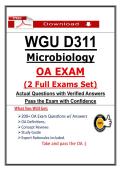
WGU D311
Microbiology
OA EXAM
(2 Full Exams Set)
Actual Questions with Verified Answers
Pass the Exam with Confidence
What You Will Get:
➢200+ OA Exam Questions w/ Answers
➢ OA Definitions,
➢ Concept Reviews
➢ Study Guide
➢ Expert Rationales included.
Take and pass the OA :)
, Preview Pages Below
Get the Complete PDF After Purchase
"If you require further clarification or in need of any study resources, feel
free to Message me."
Digital preview sample
,Table of Contents
D311 Microbiology OA Exam 1 ......................................................... 2
D311 Microbiology OA Exam 2 ....................................................... 39
D311 OA Definitions, Concept Reviews & Study Guide ................. 96
D311 Microbiology OA Exam 1
1. Which type of organism would be most likely to grow on food stored in a
refrigerator or freezer?
A. Thermophile
B. Mesophile
C. Psychrophile
D. Acidophile
Correct Answer: C. Psychrophile
Expert Rationale: Psychrophiles (cold-loving organisms) thrive at temperatures of 0–
15°C, with optimal growth around 10°C. They produce cold-adapted enzymes with high
catalytic efficiency at low temperatures. Common psychrotrophic pathogens include
Listeria monocytogenes and Yersinia enterocolitica, which can proliferate in refrigerated
foods and cause foodborne illness if contaminated products are consumed without
adequate heating.
2. Staphylococcus epidermidis is a member of the human resident microbiota and
considered part of the human innate immune system. S. epidermidis uses our
dead skin cells as a source of nutrients. What type of relationship between S.
epidermidis and humans is described above?
,A. Mutualism
B. Parasitism
C. Commensalism
D. Competition
Correct Answer: C. Commensalism
Expert Rationale: Commensalism is a symbiotic relationship in which one organism
benefits while the other is neither harmed nor benefited. Staphylococcus epidermidis
colonizes human skin, obtaining nutrients from dead keratinocytes and sebaceous
secretions without causing disease in immunocompetent hosts. In fact, it contributes to
innate immunity by producing antimicrobial peptides that inhibit pathogen colonization.
3. Why is the production of lactic acid by the resident microbe Lactobacillus
important to human health?
A. It enhances viral replication in the gut
B. It inhibits the growth of pathogenic microbes
C. It degrades the intestinal mucosal barrier
D. It neutralizes stomach acid completely
Correct Answer: B. It inhibits the growth of pathogenic microbes
Expert Rationale: Lactobacillus species ferment carbohydrates to produce lactic acid,
lowering the pH of the vaginal canal and gastrointestinal tract. This acidic environment
inhibits colonization by pathogenic bacteria and yeast by disrupting their metabolic
enzymes and membrane integrity. Additionally, Lactobacillus produces bacteriocins and
competes for epithelial adhesion sites, providing colonization resistance against
uropathogens and enteric pathogens.
4. Which type of infections are prevented by proper sterilization of hospital
equipment and healthcare worker handwashing?
A. Community-acquired infections
B. Nosocomial infections
C. Vector-borne infections
D. Zoonotic infections
Correct Answer: B. Nosocomial infections
,Expert Rationale: Nosocomial (healthcare-associated) infections are acquired in
hospital or clinical settings, often through contact with contaminated equipment,
surfaces, or the hands of healthcare personnel. Proper sterilization of surgical
instruments, disinfection of high-touch surfaces, and rigorous hand hygiene (CDC/WHO
guidelines) are the primary evidence-based interventions for preventing transmission of
Clostridioides difficile, MRSA, VRE, and multidrug-resistant organisms.
5. A patient is determined to have contracted Lyme disease after being bit by an
infected tick. What type of transmission is described in this scenario?
A. Direct contact transmission
B. Droplet transmission
C. Vector transmission
D. Vehicle transmission
Correct Answer: C. Vector transmission
Expert Rationale: Vector transmission involves the transfer of an infectious agent by an
arthropod or animal vector that harbors the pathogen. Ixodes ticks transmit Borrelia
burgdorferi, the spirochete causing Lyme disease, through infected saliva during blood
feeding. This is distinct from direct contact (person-to-person), droplet (respiratory), and
vehicle (contaminated food/water/fomites) transmission.
6. Which is a description of vehicle transmission?
A. A person is bitten by a mosquito and develops malaria
B. A person receives a blood transfusion contaminated with hepatitis C
C. A person drinks untreated water on vacation and later has diarrhea and nausea
D. A nurse contracts TB from a coughing patient in the same room
Correct Answer: C. A person drinks untreated water on vacation and later has diarrhea
and nausea
Expert Rationale: Vehicle transmission occurs when a pathogen is transmitted via a
contaminated inanimate substance (vehicle), including water, food, blood, or drugs.
Ingestion of water contaminated with enteric pathogens such as Vibrio cholerae, Giardia
lamblia, or enterotoxigenic E. coli exemplifies this mode. The vehicle carries the
pathogen from a source to a susceptible host.
,85. Which method of physical microbial control can be used to sterilize fresh
food?
A. Boiling at 100°C for 15 minutes
B. Refrigeration at 4°C
C. Radiation (food irradiation)
D. Filtration through 0.22 µm filters
Correct Answer: C. Radiation (food irradiation)
Expert Rationale: Ionizing radiation (gamma rays from cobalt-60, electron beams, X-
rays) effectively kills bacteria, parasites, and insects in fresh and packaged foods
without significantly raising temperature. It is approved by the FDA for spices, poultry,
red meat, and produce to reduce Salmonella, E. coli O157:H7, and parasites. It does
not make food radioactive but may cause minor vitamin degradation and texture
changes. Boiling and refrigeration do not sterilize; filtration is impractical for solid foods.
, D311 Microbiology OA Exam 2
1. Which type of microscopy produces highly detailed three-dimensional images
of a specimen?
A. Transmission electron microscopy
B. Phase-contrast microscopy
C. Scanning electron microscopy
D. Bright-field microscopy
Correct Answer: C
Expert Rationale: Scanning electron microscopy (SEM) scans the specimen surface
with a focused electron beam, producing detailed topographical images with a three-
dimensional appearance. It is excellent for visualizing surface structures such as
bacterial morphology, spores, and biofilm architecture. TEM (A) provides 2D internal
views.
2. Which method of microscopy uses a laser to scan multiple planes and
produces a three-dimensional image that can be used to visualize the internal
structure of a biofilm?
A. Bright-field microscopy
B. Fluorescence microscopy
C. Confocal microscopy
D. Dark-field microscopy
Correct Answer: C
Expert Rationale: Confocal laser scanning microscopy (CLSM) uses a laser to
illuminate focal planes sequentially, eliminating out-of-focus light. By stacking optical
sections, it reconstructs 3D images of thick specimens like biofilms, revealing internal
architecture, channels, and cell distribution without physical sectioning.
3. Which technique uses a single dye to emphasize particular structures in the
specimen?
, D311 OA Definitions, Concept Reviews & Study Guide
Differentiate Prokaryotic and Eukaryotic Cells
Prokaryotic Cells No true nucleus ( nucleoid region )
Differentiate Prokaryotic and Eukaryotic Cells
Prokaryotic Cells Organelles No membrane - bound organelles Ribosomes Smaller (
70S )
Differentiate Prokaryotic and Eukaryotic Cells
Prokaryotic Cells Cell Wall Present ( contains peptidoglycan in bacteria )
Differentiate Prokaryotic and Eukaryotic Cells
Eukaryotic Cells Membrane - bound organelles present
Differentiate Prokaryotic and Eukaryotic Cells
Eukaryotic Cells True nucleus enclosed in a membrane
Differentiate Prokaryotic and Eukaryotic Cells
Cell Wall May or may not be present , composition varies
Prokaryotic Cells Examples
Bacteria , Archaea
Eukaryotic Cells Examples
Animals plants , fungi , protists
Bacteria
Found in various environments ; cell walls often contain peptidoglycan .
Archaea
,Found in extreme environments e.g. , hot springs , salt lakes ) ; cell walls lack
peptidoglycan but contain unique lipids .
Bacteria cell walls often contain
peptidoglycan
Archaea cell walls lack
peptidoglycan but contain unique lipids .
Structures Only Found in Eukaryotic Cells
Nucleus Mitochondria Endoplasmic Golgi Apparatus Lysosomes Chloroplasts
Cytoskeleton
Structures Only Found in Prokaryotic Cells
Structures Nucleoid Plasmids Capsule Fimbriae Pili Flagella
Stores DNA and controls cellular activities .
Nucleus
Produces ATP through cellular respiration .
Mitochondria
Synthesizes lipids and proteins .
Endoplasmic Reticulum ( Smooth and Rough
Modifies , sorts , and packages proteins .
Golgi Apparatus
Breaks down waste and cellular debris
Lysosomes
Site of photosynthesis
Chloroplasts ( in plants and algae
Provides structure and facilitates intracellular transport .
, Cytoskeleton ( complex network )
Region where the circular DNA is located , not enclosed by a membrane .
Nucleoid
Small , circular DNA molecules providing additional genetic traits , such as
antibiotic resistance .
Plasmids
A gelatinous outer layer that protects against desiccation and immune attack .
Capsule
Short , hair - like structures for adhesion to surfaces .
Fimbriae
Involved in DNA transfer during conjugation
Pili
Long , whip - like structures for movement
Flagella
Difference Between Gram - Positive and Gram - Negative Cell Walls
Gram - positive Peptidoglycan Layer Thick
Difference Between Gram - Positive and Gram - Negative Cell Walls
Gram - positive Outer Membrane Absent
Difference Between Gram - Positive and Gram - Negative Cell Walls
Gram - positive Staining Retains crystal violet ( purple )
Difference Between Gram - Positive and Gram - Negative Cell Walls
Gram - Negative Staining Does not retain crystal violet , stains pink / red
highly durable , dormant structures with a tough outer coating of keratin ,
dehydrated cytoplasm , and DNA surrounded by protective layers . Function :
Microbiology
OA EXAM
(2 Full Exams Set)
Actual Questions with Verified Answers
Pass the Exam with Confidence
What You Will Get:
➢200+ OA Exam Questions w/ Answers
➢ OA Definitions,
➢ Concept Reviews
➢ Study Guide
➢ Expert Rationales included.
Take and pass the OA :)
, Preview Pages Below
Get the Complete PDF After Purchase
"If you require further clarification or in need of any study resources, feel
free to Message me."
Digital preview sample
,Table of Contents
D311 Microbiology OA Exam 1 ......................................................... 2
D311 Microbiology OA Exam 2 ....................................................... 39
D311 OA Definitions, Concept Reviews & Study Guide ................. 96
D311 Microbiology OA Exam 1
1. Which type of organism would be most likely to grow on food stored in a
refrigerator or freezer?
A. Thermophile
B. Mesophile
C. Psychrophile
D. Acidophile
Correct Answer: C. Psychrophile
Expert Rationale: Psychrophiles (cold-loving organisms) thrive at temperatures of 0–
15°C, with optimal growth around 10°C. They produce cold-adapted enzymes with high
catalytic efficiency at low temperatures. Common psychrotrophic pathogens include
Listeria monocytogenes and Yersinia enterocolitica, which can proliferate in refrigerated
foods and cause foodborne illness if contaminated products are consumed without
adequate heating.
2. Staphylococcus epidermidis is a member of the human resident microbiota and
considered part of the human innate immune system. S. epidermidis uses our
dead skin cells as a source of nutrients. What type of relationship between S.
epidermidis and humans is described above?
,A. Mutualism
B. Parasitism
C. Commensalism
D. Competition
Correct Answer: C. Commensalism
Expert Rationale: Commensalism is a symbiotic relationship in which one organism
benefits while the other is neither harmed nor benefited. Staphylococcus epidermidis
colonizes human skin, obtaining nutrients from dead keratinocytes and sebaceous
secretions without causing disease in immunocompetent hosts. In fact, it contributes to
innate immunity by producing antimicrobial peptides that inhibit pathogen colonization.
3. Why is the production of lactic acid by the resident microbe Lactobacillus
important to human health?
A. It enhances viral replication in the gut
B. It inhibits the growth of pathogenic microbes
C. It degrades the intestinal mucosal barrier
D. It neutralizes stomach acid completely
Correct Answer: B. It inhibits the growth of pathogenic microbes
Expert Rationale: Lactobacillus species ferment carbohydrates to produce lactic acid,
lowering the pH of the vaginal canal and gastrointestinal tract. This acidic environment
inhibits colonization by pathogenic bacteria and yeast by disrupting their metabolic
enzymes and membrane integrity. Additionally, Lactobacillus produces bacteriocins and
competes for epithelial adhesion sites, providing colonization resistance against
uropathogens and enteric pathogens.
4. Which type of infections are prevented by proper sterilization of hospital
equipment and healthcare worker handwashing?
A. Community-acquired infections
B. Nosocomial infections
C. Vector-borne infections
D. Zoonotic infections
Correct Answer: B. Nosocomial infections
,Expert Rationale: Nosocomial (healthcare-associated) infections are acquired in
hospital or clinical settings, often through contact with contaminated equipment,
surfaces, or the hands of healthcare personnel. Proper sterilization of surgical
instruments, disinfection of high-touch surfaces, and rigorous hand hygiene (CDC/WHO
guidelines) are the primary evidence-based interventions for preventing transmission of
Clostridioides difficile, MRSA, VRE, and multidrug-resistant organisms.
5. A patient is determined to have contracted Lyme disease after being bit by an
infected tick. What type of transmission is described in this scenario?
A. Direct contact transmission
B. Droplet transmission
C. Vector transmission
D. Vehicle transmission
Correct Answer: C. Vector transmission
Expert Rationale: Vector transmission involves the transfer of an infectious agent by an
arthropod or animal vector that harbors the pathogen. Ixodes ticks transmit Borrelia
burgdorferi, the spirochete causing Lyme disease, through infected saliva during blood
feeding. This is distinct from direct contact (person-to-person), droplet (respiratory), and
vehicle (contaminated food/water/fomites) transmission.
6. Which is a description of vehicle transmission?
A. A person is bitten by a mosquito and develops malaria
B. A person receives a blood transfusion contaminated with hepatitis C
C. A person drinks untreated water on vacation and later has diarrhea and nausea
D. A nurse contracts TB from a coughing patient in the same room
Correct Answer: C. A person drinks untreated water on vacation and later has diarrhea
and nausea
Expert Rationale: Vehicle transmission occurs when a pathogen is transmitted via a
contaminated inanimate substance (vehicle), including water, food, blood, or drugs.
Ingestion of water contaminated with enteric pathogens such as Vibrio cholerae, Giardia
lamblia, or enterotoxigenic E. coli exemplifies this mode. The vehicle carries the
pathogen from a source to a susceptible host.
,85. Which method of physical microbial control can be used to sterilize fresh
food?
A. Boiling at 100°C for 15 minutes
B. Refrigeration at 4°C
C. Radiation (food irradiation)
D. Filtration through 0.22 µm filters
Correct Answer: C. Radiation (food irradiation)
Expert Rationale: Ionizing radiation (gamma rays from cobalt-60, electron beams, X-
rays) effectively kills bacteria, parasites, and insects in fresh and packaged foods
without significantly raising temperature. It is approved by the FDA for spices, poultry,
red meat, and produce to reduce Salmonella, E. coli O157:H7, and parasites. It does
not make food radioactive but may cause minor vitamin degradation and texture
changes. Boiling and refrigeration do not sterilize; filtration is impractical for solid foods.
, D311 Microbiology OA Exam 2
1. Which type of microscopy produces highly detailed three-dimensional images
of a specimen?
A. Transmission electron microscopy
B. Phase-contrast microscopy
C. Scanning electron microscopy
D. Bright-field microscopy
Correct Answer: C
Expert Rationale: Scanning electron microscopy (SEM) scans the specimen surface
with a focused electron beam, producing detailed topographical images with a three-
dimensional appearance. It is excellent for visualizing surface structures such as
bacterial morphology, spores, and biofilm architecture. TEM (A) provides 2D internal
views.
2. Which method of microscopy uses a laser to scan multiple planes and
produces a three-dimensional image that can be used to visualize the internal
structure of a biofilm?
A. Bright-field microscopy
B. Fluorescence microscopy
C. Confocal microscopy
D. Dark-field microscopy
Correct Answer: C
Expert Rationale: Confocal laser scanning microscopy (CLSM) uses a laser to
illuminate focal planes sequentially, eliminating out-of-focus light. By stacking optical
sections, it reconstructs 3D images of thick specimens like biofilms, revealing internal
architecture, channels, and cell distribution without physical sectioning.
3. Which technique uses a single dye to emphasize particular structures in the
specimen?
, D311 OA Definitions, Concept Reviews & Study Guide
Differentiate Prokaryotic and Eukaryotic Cells
Prokaryotic Cells No true nucleus ( nucleoid region )
Differentiate Prokaryotic and Eukaryotic Cells
Prokaryotic Cells Organelles No membrane - bound organelles Ribosomes Smaller (
70S )
Differentiate Prokaryotic and Eukaryotic Cells
Prokaryotic Cells Cell Wall Present ( contains peptidoglycan in bacteria )
Differentiate Prokaryotic and Eukaryotic Cells
Eukaryotic Cells Membrane - bound organelles present
Differentiate Prokaryotic and Eukaryotic Cells
Eukaryotic Cells True nucleus enclosed in a membrane
Differentiate Prokaryotic and Eukaryotic Cells
Cell Wall May or may not be present , composition varies
Prokaryotic Cells Examples
Bacteria , Archaea
Eukaryotic Cells Examples
Animals plants , fungi , protists
Bacteria
Found in various environments ; cell walls often contain peptidoglycan .
Archaea
,Found in extreme environments e.g. , hot springs , salt lakes ) ; cell walls lack
peptidoglycan but contain unique lipids .
Bacteria cell walls often contain
peptidoglycan
Archaea cell walls lack
peptidoglycan but contain unique lipids .
Structures Only Found in Eukaryotic Cells
Nucleus Mitochondria Endoplasmic Golgi Apparatus Lysosomes Chloroplasts
Cytoskeleton
Structures Only Found in Prokaryotic Cells
Structures Nucleoid Plasmids Capsule Fimbriae Pili Flagella
Stores DNA and controls cellular activities .
Nucleus
Produces ATP through cellular respiration .
Mitochondria
Synthesizes lipids and proteins .
Endoplasmic Reticulum ( Smooth and Rough
Modifies , sorts , and packages proteins .
Golgi Apparatus
Breaks down waste and cellular debris
Lysosomes
Site of photosynthesis
Chloroplasts ( in plants and algae
Provides structure and facilitates intracellular transport .
, Cytoskeleton ( complex network )
Region where the circular DNA is located , not enclosed by a membrane .
Nucleoid
Small , circular DNA molecules providing additional genetic traits , such as
antibiotic resistance .
Plasmids
A gelatinous outer layer that protects against desiccation and immune attack .
Capsule
Short , hair - like structures for adhesion to surfaces .
Fimbriae
Involved in DNA transfer during conjugation
Pili
Long , whip - like structures for movement
Flagella
Difference Between Gram - Positive and Gram - Negative Cell Walls
Gram - positive Peptidoglycan Layer Thick
Difference Between Gram - Positive and Gram - Negative Cell Walls
Gram - positive Outer Membrane Absent
Difference Between Gram - Positive and Gram - Negative Cell Walls
Gram - positive Staining Retains crystal violet ( purple )
Difference Between Gram - Positive and Gram - Negative Cell Walls
Gram - Negative Staining Does not retain crystal violet , stains pink / red
highly durable , dormant structures with a tough outer coating of keratin ,
dehydrated cytoplasm , and DNA surrounded by protective layers . Function :