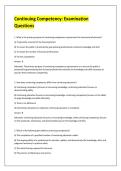
Continuing Competency: Examination
Questions
1. What is the primary purpose of continuing competency requirements for licensed professionals?
A) To generate revenue for the licensing board
B) To ensure the public is protected by guaranteeing professionals maintain knowledge and skills
C) To reduce the number of licensed professionals
D) To limit competition
Answer: B
Rationale: The primary purpose of continuing competency requirements is to ensure the public is
protected by guaranteeing that licensed professionals maintain the knowledge and skills necessary to
practice their profession competently.
2. How does continuing competency differ from continuing education?
A) Continuing competency focuses on increasing knowledge; continuing education focuses on
demonstrating ability
B) Continuing education focuses on increasing knowledge; continuing competency focuses on the ability
to apply knowledge and skills effectively
C) There is no difference
D) Continuing competency is optional; continuing education is mandatory
Answer: B
Rationale: Continuing education focuses on increasing knowledge, while continuing competency focuses
on the systematic, intentional, and demonstrable pursuit of knowledge and skills.
3. Which of the following best defines continuing competency?
A) The completion of a specified number of continuing education credits
B) The ongoing ability of a professional to maintain, update, and demonstrate the knowledge, skills, and
judgment necessary to practice safely
C) The initial training required for licensure
D) The process of obtaining a new license
,Answer: B
Rationale: Continuing competency is the ongoing ability of a professional to maintain, update, and
demonstrate the knowledge, skills, judgment, and qualifications necessary to practice safely and
ethically.
4. What is the relationship between continuing competency and public protection?
A) Continuing competency has no relationship to public protection
B) Continuing competency ensures professionals remain competent, thereby protecting the public
C) Continuing competency reduces public protection
D) Continuing competency only applies to new professionals
Answer: B
Rationale: Continuing competency requirements ensure the public is protected by guaranteeing that
licensed professionals maintain the knowledge and skills necessary to practice their profession
competently.
5. Which of the following is a common method of demonstrating continuing competency?
A) Completing a specified number of continuing competency units
B) Retaking the licensing examination
C) Submitting a new application
D) Paying an additional fee
Answer: A
Rationale: Common methods of demonstrating continuing competency include earning a specified
number of continuing competency units or hours during a renewal period.
6. What is the purpose of requiring professionals to maintain a professional portfolio?
A) To generate revenue for the licensing board
B) To document continuing competency activities and demonstrate ongoing professional development
C) To reduce the number of licensed professionals
D) To limit competition
Answer: B
, Rationale: A professional portfolio is used to document continuing competency activities and
demonstrate ongoing professional development.
7. How is continuing competency typically measured?
A) By the number of years in practice
B) By the ability to apply knowledge and skills effectively in practice
C) By the amount of fees paid
D) By the number of clients served
Answer: B
Rationale: Continuing competency is measured by the ability to apply knowledge and skills effectively in
practice, not just by accumulating education credits.
8. Which of the following activities can count toward continuing competency?
A) Engaging in paid, unpaid, or volunteer activities requiring substantial professional knowledge
B) Completing structured courses
C) Participating in peer review
D) All of the above
Answer: D
Rationale: Continuing competency can be achieved through a wide variety of activities, including
continuing education, active practice, professional certification, peer review, self-assessment, and
clinical privileging.
9. What is the difference between continuing competency and continuing education in terms of
measurement?
A) Continuing education is measured by credits earned; continuing competency is measured by the
ability to apply knowledge
B) Continuing competency is measured by credits earned; continuing education is measured by the
ability to apply knowledge
C) Both are measured the same way
D) Neither is measured
Answer: A
Questions
1. What is the primary purpose of continuing competency requirements for licensed professionals?
A) To generate revenue for the licensing board
B) To ensure the public is protected by guaranteeing professionals maintain knowledge and skills
C) To reduce the number of licensed professionals
D) To limit competition
Answer: B
Rationale: The primary purpose of continuing competency requirements is to ensure the public is
protected by guaranteeing that licensed professionals maintain the knowledge and skills necessary to
practice their profession competently.
2. How does continuing competency differ from continuing education?
A) Continuing competency focuses on increasing knowledge; continuing education focuses on
demonstrating ability
B) Continuing education focuses on increasing knowledge; continuing competency focuses on the ability
to apply knowledge and skills effectively
C) There is no difference
D) Continuing competency is optional; continuing education is mandatory
Answer: B
Rationale: Continuing education focuses on increasing knowledge, while continuing competency focuses
on the systematic, intentional, and demonstrable pursuit of knowledge and skills.
3. Which of the following best defines continuing competency?
A) The completion of a specified number of continuing education credits
B) The ongoing ability of a professional to maintain, update, and demonstrate the knowledge, skills, and
judgment necessary to practice safely
C) The initial training required for licensure
D) The process of obtaining a new license
,Answer: B
Rationale: Continuing competency is the ongoing ability of a professional to maintain, update, and
demonstrate the knowledge, skills, judgment, and qualifications necessary to practice safely and
ethically.
4. What is the relationship between continuing competency and public protection?
A) Continuing competency has no relationship to public protection
B) Continuing competency ensures professionals remain competent, thereby protecting the public
C) Continuing competency reduces public protection
D) Continuing competency only applies to new professionals
Answer: B
Rationale: Continuing competency requirements ensure the public is protected by guaranteeing that
licensed professionals maintain the knowledge and skills necessary to practice their profession
competently.
5. Which of the following is a common method of demonstrating continuing competency?
A) Completing a specified number of continuing competency units
B) Retaking the licensing examination
C) Submitting a new application
D) Paying an additional fee
Answer: A
Rationale: Common methods of demonstrating continuing competency include earning a specified
number of continuing competency units or hours during a renewal period.
6. What is the purpose of requiring professionals to maintain a professional portfolio?
A) To generate revenue for the licensing board
B) To document continuing competency activities and demonstrate ongoing professional development
C) To reduce the number of licensed professionals
D) To limit competition
Answer: B
, Rationale: A professional portfolio is used to document continuing competency activities and
demonstrate ongoing professional development.
7. How is continuing competency typically measured?
A) By the number of years in practice
B) By the ability to apply knowledge and skills effectively in practice
C) By the amount of fees paid
D) By the number of clients served
Answer: B
Rationale: Continuing competency is measured by the ability to apply knowledge and skills effectively in
practice, not just by accumulating education credits.
8. Which of the following activities can count toward continuing competency?
A) Engaging in paid, unpaid, or volunteer activities requiring substantial professional knowledge
B) Completing structured courses
C) Participating in peer review
D) All of the above
Answer: D
Rationale: Continuing competency can be achieved through a wide variety of activities, including
continuing education, active practice, professional certification, peer review, self-assessment, and
clinical privileging.
9. What is the difference between continuing competency and continuing education in terms of
measurement?
A) Continuing education is measured by credits earned; continuing competency is measured by the
ability to apply knowledge
B) Continuing competency is measured by credits earned; continuing education is measured by the
ability to apply knowledge
C) Both are measured the same way
D) Neither is measured
Answer: A