
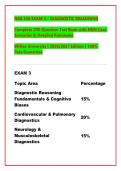
NSG 550 EXAM 3 – DIAGNOSTIC REASONING
Complete 200-Question Test Bank with NGN Case
Scenarios & Detailed Rationales
Wilkes University | 2026/2027 Edition | 100%
Pass Guarantee
EXAM 3
Topic Area Percentage
Diagnostic Reasoning
Fundamentals & Cognitive 15%
Biases
Cardiovascular & Pulmonary
20%
Diagnostics
Neurology &
Musculoskeletal 15%
Diagnostics
,Topic Area Percentage
Gastrointestinal &
10%
Hepatobiliary Diagnostics
Genitourinary & Renal
10%
Diagnostics
Infectious Disease &
10%
Hematology Diagnostics
Endocrine & Metabolic
10%
Diagnostics
NGN Case Scenarios
10%
(Integrated)
SECTION 1: DIAGNOSTIC REASONING
FUNDAMENTALS & COGNITIVE BIASES
(Questions 1–30)
,1. A nurse practitioner uses a dual-process model of
reasoning. Which scenario best describes the
intuitive (Type 1) process?
A) Calculating pre-test probability for pulmonary
embolism using the Wells score
B) Recognizing "sick vs. not sick" within seconds of
entering a patient's room
C) Listing all possible causes of fatigue and ruling
each out systematically
D) Using a clinical decision rule to decide on imaging
for ankle trauma
Answer: B) Recognizing "sick vs. not sick" within
seconds of entering a patient's room
Rationale: Type 1 (intuitive) reasoning is rapid,
subconscious, and pattern-based. Recognizing
illness severity instantly is a hallmark of intuitive
processing. Options A, C, and D involve deliberate,
analytical (Type 2) reasoning.
2. A 45-year-old presents with epigastric pain. You
generate a differential that includes GERD, peptic
ulcer disease, biliary colic, and cardiac ischemia. This
, list represents the:
A) Working diagnosis
B) Anatomical differential
C) Exhaustive differential
D) Pathophysiologic cascade
Answer: C) Exhaustive differential
Rationale: An exhaustive differential includes all
reasonable possibilities beforenarrowing. The working
diagnosis is the most likely after reasoning. Anatomical
differential organizes by organ system.
3. The "sensitivity" ofa diagnostic test refers to its
ability to:
A) Correctly identify those without the disease
B) Correctly identify those with the disease
C) Rule in disease
D) Determine disease severity
Answer: B) Correctly identify those with the disease
Rationale: Sensitivity =true positives / (true positives
+ false negatives). A highly sensitivetest rules out
Complete 200-Question Test Bank with NGN Case
Scenarios & Detailed Rationales
Wilkes University | 2026/2027 Edition | 100%
Pass Guarantee
EXAM 3
Topic Area Percentage
Diagnostic Reasoning
Fundamentals & Cognitive 15%
Biases
Cardiovascular & Pulmonary
20%
Diagnostics
Neurology &
Musculoskeletal 15%
Diagnostics
,Topic Area Percentage
Gastrointestinal &
10%
Hepatobiliary Diagnostics
Genitourinary & Renal
10%
Diagnostics
Infectious Disease &
10%
Hematology Diagnostics
Endocrine & Metabolic
10%
Diagnostics
NGN Case Scenarios
10%
(Integrated)
SECTION 1: DIAGNOSTIC REASONING
FUNDAMENTALS & COGNITIVE BIASES
(Questions 1–30)
,1. A nurse practitioner uses a dual-process model of
reasoning. Which scenario best describes the
intuitive (Type 1) process?
A) Calculating pre-test probability for pulmonary
embolism using the Wells score
B) Recognizing "sick vs. not sick" within seconds of
entering a patient's room
C) Listing all possible causes of fatigue and ruling
each out systematically
D) Using a clinical decision rule to decide on imaging
for ankle trauma
Answer: B) Recognizing "sick vs. not sick" within
seconds of entering a patient's room
Rationale: Type 1 (intuitive) reasoning is rapid,
subconscious, and pattern-based. Recognizing
illness severity instantly is a hallmark of intuitive
processing. Options A, C, and D involve deliberate,
analytical (Type 2) reasoning.
2. A 45-year-old presents with epigastric pain. You
generate a differential that includes GERD, peptic
ulcer disease, biliary colic, and cardiac ischemia. This
, list represents the:
A) Working diagnosis
B) Anatomical differential
C) Exhaustive differential
D) Pathophysiologic cascade
Answer: C) Exhaustive differential
Rationale: An exhaustive differential includes all
reasonable possibilities beforenarrowing. The working
diagnosis is the most likely after reasoning. Anatomical
differential organizes by organ system.
3. The "sensitivity" ofa diagnostic test refers to its
ability to:
A) Correctly identify those without the disease
B) Correctly identify those with the disease
C) Rule in disease
D) Determine disease severity
Answer: B) Correctly identify those with the disease
Rationale: Sensitivity =true positives / (true positives
+ false negatives). A highly sensitivetest rules out

