

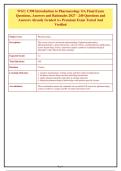
WGU C398 Introduction to Pharmacology OA Final Exam
Questions, Answers and Rationales 2027 - 240 Questions and
Answers Already Graded A+ Premium Exam Tested And
Verified
Subject Area Pharmacology
Description This exam assesses advanced understanding of pharmacodynamics,
pharmacokinetics, drug interactions, adverse effects, and therapeutic applications
across major drug classes. Questions require synthesis of pharmacological
principles with clinical decision-making.
Expected Grade A+
Total Questions 240
Duration 3 hours
Learning Outcomes 1. Analyze mechanisms of drug action and their clinical implications
2. Evaluate adverse drug reactions and drug interactions
3. Apply pharmacokinetic principles to dosing regimens
4. Integrate pharmacological knowledge with patient-specific factors
Accreditation This examination meets the standards of accredited US university pharmacology
courses at the Ivy League and R1 research university level.
Page 1
,1. A drug has a volume of distribution of 500 L and a clearance of 50 L/h. Which of
the following best represents its elimination half-life?
A. 3.5 h
B. 6.9 h
C. 10.0 h
D. 13.9 h
Answer: B. 6.9 h
Half-life = (0.693 × Vd) / Cl = (0.693 × 500) / 50 = 6.93 h, approximately 6.9 h. The other
options result from incorrect calculations.
2. A drug that is a weak acid (pKa 4.5) is administered orally. In which of the
following gastrointestinal pH environments would the drug be most rapidly
absorbed?
A. Stomach (pH 1.5)
B. Duodenum (pH 5.5)
C. Jejunum (pH 6.5)
D. Ileum (pH 7.5)
Answer: B. Duodenum (pH 5.5)
Weak acids are absorbed best where they are non-ionized. At pH 5.5 (close to pKa),
about 50% is non-ionized, but the duodenum has a large surface area and blood flow,
maximizing absorption. At pH 1.5, the drug is fully non-ionized but gastric emptying
slows absorption; at higher pH, ionization increases.
3. A patient on warfarin requires an antibiotic for a urinary tract infection. Which of
the following antibiotics would be LEAST likely to potentiate warfarin's effect?
A. Ciprofloxacin
B. Trimethoprim-sulfamethoxazole
C. Metronidazole
D. Ceftriaxone
Answer: D. Ceftriaxone
Ceftriaxone is a cephalosporin with minimal effect on warfarin metabolism or gut flora.
Ciprofloxacin and trimethoprim-sulfamethoxazole inhibit CYP1A2 and CYP2C9,
respectively, while metronidazole inhibits warfarin clearance, all potentiating warfarin.
Page 2
,4. A patient develops severe hypertension and tachycardia after ingestion of a
substance. Which of the following mechanisms is most consistent with a
tyramine-induced hypertensive crisis in a patient taking a monoamine oxidase
inhibitor (MAOI)?
A. Direct activation of alpha-1 receptors by tyramine
B. Inhibition of norepinephrine reuptake by tyramine
C. Displacement of norepinephrine from presynaptic vesicles
D. Stimulation of dopamine release in the periphery
Answer: C. Displacement of norepinephrine from presynaptic vesicles
Tyramine is taken up into adrenergic neurons and displaces norepinephrine from
storage vesicles, causing massive release. MAOIs prevent tyramine metabolism and
norepinephrine breakdown, leading to hypertensive crisis. Direct activation (A) and
reuptake inhibition (B) are not primary mechanisms.
5. Which of the following drug classes is associated with a 'first-dose' orthostatic
hypotension that is most pronounced in patients with renin-dependent hypertension?
A. Beta-blockers
B. Angiotensin-converting enzyme inhibitors
C. Alpha-1 receptor antagonists
D. Calcium channel blockers
Answer: C. Alpha-1 receptor antagonists
Alpha-1 antagonists (e.g., prazosin) cause marked first-dose orthostatic hypotension
due to blockade of sympathetic vasoconstriction. This effect is exaggerated in patients
with high renin states who rely on sympathetic tone. ACE inhibitors (B) cause
hypotension but not typically first-dose orthostasis.
6. A patient with heart failure is prescribed digoxin. Which of the following
concurrent conditions would most significantly increase the risk of digoxin toxicity?
A. Hyperkalemia
B. Hypokalemia
C. Hypercalcemia
D. Hypomagnesemia
Answer: B. Hypokalemia
Hypokalemia increases the binding of digoxin to Na+/K+ ATPase, potentiating toxicity.
Hyperkalemia decreases binding. Hypercalcemia and hypomagnesemia also increase
toxicity but hypokalemia is the most potent and common risk factor.
Page 3
, 7. A patient receiving morphine for severe pain exhibits respiratory depression.
Which of the following best describes the mechanism by which naloxone reverses
this effect?
A. Competitive antagonism at mu-opioid receptors
B. Allosteric modulation of the opioid receptor complex
C. Inhibition of opioid-induced histamine release
D. Enhancement of GABAergic transmission in the brainstem
Answer: A. Competitive antagonism at mu-opioid receptors
Naloxone is a competitive antagonist at mu-opioid receptors, displacing morphine and
reversing respiratory depression. Allosteric modulation (B) is not its mechanism;
histamine release (C) is not primarily responsible for respiratory depression; GABA
enhancement (D) is not relevant.
8. Which of the following best explains why the total clearance of a drug that is
primarily eliminated by the liver can be reduced in a patient with cirrhosis?
A. Decreased hepatic blood flow
B. Reduced intrinsic clearance (enzyme activity)
C. Increased plasma protein binding
D. Increased volume of distribution
Answer: B. Reduced intrinsic clearance (enzyme activity)
Cirrhosis reduces hepatocyte function and enzyme activity, decreasing intrinsic
clearance. Hepatic blood flow (A) may be preserved or altered but is not the primary
cause. Protein binding (C) often decreases, not increases. Volume of distribution (D)
may increase but does not directly reduce clearance.
Page 4
Questions, Answers and Rationales 2027 - 240 Questions and
Answers Already Graded A+ Premium Exam Tested And
Verified
Subject Area Pharmacology
Description This exam assesses advanced understanding of pharmacodynamics,
pharmacokinetics, drug interactions, adverse effects, and therapeutic applications
across major drug classes. Questions require synthesis of pharmacological
principles with clinical decision-making.
Expected Grade A+
Total Questions 240
Duration 3 hours
Learning Outcomes 1. Analyze mechanisms of drug action and their clinical implications
2. Evaluate adverse drug reactions and drug interactions
3. Apply pharmacokinetic principles to dosing regimens
4. Integrate pharmacological knowledge with patient-specific factors
Accreditation This examination meets the standards of accredited US university pharmacology
courses at the Ivy League and R1 research university level.
Page 1
,1. A drug has a volume of distribution of 500 L and a clearance of 50 L/h. Which of
the following best represents its elimination half-life?
A. 3.5 h
B. 6.9 h
C. 10.0 h
D. 13.9 h
Answer: B. 6.9 h
Half-life = (0.693 × Vd) / Cl = (0.693 × 500) / 50 = 6.93 h, approximately 6.9 h. The other
options result from incorrect calculations.
2. A drug that is a weak acid (pKa 4.5) is administered orally. In which of the
following gastrointestinal pH environments would the drug be most rapidly
absorbed?
A. Stomach (pH 1.5)
B. Duodenum (pH 5.5)
C. Jejunum (pH 6.5)
D. Ileum (pH 7.5)
Answer: B. Duodenum (pH 5.5)
Weak acids are absorbed best where they are non-ionized. At pH 5.5 (close to pKa),
about 50% is non-ionized, but the duodenum has a large surface area and blood flow,
maximizing absorption. At pH 1.5, the drug is fully non-ionized but gastric emptying
slows absorption; at higher pH, ionization increases.
3. A patient on warfarin requires an antibiotic for a urinary tract infection. Which of
the following antibiotics would be LEAST likely to potentiate warfarin's effect?
A. Ciprofloxacin
B. Trimethoprim-sulfamethoxazole
C. Metronidazole
D. Ceftriaxone
Answer: D. Ceftriaxone
Ceftriaxone is a cephalosporin with minimal effect on warfarin metabolism or gut flora.
Ciprofloxacin and trimethoprim-sulfamethoxazole inhibit CYP1A2 and CYP2C9,
respectively, while metronidazole inhibits warfarin clearance, all potentiating warfarin.
Page 2
,4. A patient develops severe hypertension and tachycardia after ingestion of a
substance. Which of the following mechanisms is most consistent with a
tyramine-induced hypertensive crisis in a patient taking a monoamine oxidase
inhibitor (MAOI)?
A. Direct activation of alpha-1 receptors by tyramine
B. Inhibition of norepinephrine reuptake by tyramine
C. Displacement of norepinephrine from presynaptic vesicles
D. Stimulation of dopamine release in the periphery
Answer: C. Displacement of norepinephrine from presynaptic vesicles
Tyramine is taken up into adrenergic neurons and displaces norepinephrine from
storage vesicles, causing massive release. MAOIs prevent tyramine metabolism and
norepinephrine breakdown, leading to hypertensive crisis. Direct activation (A) and
reuptake inhibition (B) are not primary mechanisms.
5. Which of the following drug classes is associated with a 'first-dose' orthostatic
hypotension that is most pronounced in patients with renin-dependent hypertension?
A. Beta-blockers
B. Angiotensin-converting enzyme inhibitors
C. Alpha-1 receptor antagonists
D. Calcium channel blockers
Answer: C. Alpha-1 receptor antagonists
Alpha-1 antagonists (e.g., prazosin) cause marked first-dose orthostatic hypotension
due to blockade of sympathetic vasoconstriction. This effect is exaggerated in patients
with high renin states who rely on sympathetic tone. ACE inhibitors (B) cause
hypotension but not typically first-dose orthostasis.
6. A patient with heart failure is prescribed digoxin. Which of the following
concurrent conditions would most significantly increase the risk of digoxin toxicity?
A. Hyperkalemia
B. Hypokalemia
C. Hypercalcemia
D. Hypomagnesemia
Answer: B. Hypokalemia
Hypokalemia increases the binding of digoxin to Na+/K+ ATPase, potentiating toxicity.
Hyperkalemia decreases binding. Hypercalcemia and hypomagnesemia also increase
toxicity but hypokalemia is the most potent and common risk factor.
Page 3
, 7. A patient receiving morphine for severe pain exhibits respiratory depression.
Which of the following best describes the mechanism by which naloxone reverses
this effect?
A. Competitive antagonism at mu-opioid receptors
B. Allosteric modulation of the opioid receptor complex
C. Inhibition of opioid-induced histamine release
D. Enhancement of GABAergic transmission in the brainstem
Answer: A. Competitive antagonism at mu-opioid receptors
Naloxone is a competitive antagonist at mu-opioid receptors, displacing morphine and
reversing respiratory depression. Allosteric modulation (B) is not its mechanism;
histamine release (C) is not primarily responsible for respiratory depression; GABA
enhancement (D) is not relevant.
8. Which of the following best explains why the total clearance of a drug that is
primarily eliminated by the liver can be reduced in a patient with cirrhosis?
A. Decreased hepatic blood flow
B. Reduced intrinsic clearance (enzyme activity)
C. Increased plasma protein binding
D. Increased volume of distribution
Answer: B. Reduced intrinsic clearance (enzyme activity)
Cirrhosis reduces hepatocyte function and enzyme activity, decreasing intrinsic
clearance. Hepatic blood flow (A) may be preserved or altered but is not the primary
cause. Protein binding (C) often decreases, not increases. Volume of distribution (D)
may increase but does not directly reduce clearance.
Page 4

