

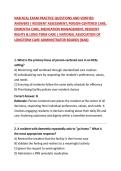
NAB RCAL EXAM PRACTICE QUESTIONS AND VERIFIED
ANSWERS | RESIDENT ASSESSMENT, PERSON-CENTERED CARE,
DEMENTIA CARE, MEDICATION MANAGEMENT, RESIDENT
RIGHTS & LONG-TERM CARE | NATIONAL ASSOCIATION OF
LONGTERM CARE ADMINISTRATOR BOARDS (NAB)
1. What is the primary focus of person-centered care in an RCAL
setting?
A) Minimizing staff workload through standardized care routines
B) Individualizing care by respecting the resident's preferences, values,
and needs
C) Ensuring all residents follow the same daily schedule for efficiency
D) Prioritizing facility policies over resident choices
Correct Answer: B
Rationale: Person-centered care places the resident at the center of all
decisions, respecting their individual preferences, values, and needs. It
involves engaging residents in decision-making about their daily life and
care, fostering autonomy and dignity within a homelike environment.
2. A resident with dementia repeatedly asks to "go home." What is
the most appropriate response?
A) Remind the resident that this facility is their home now
B) Validate the feeling and redirect to a meaningful activity
C) Ignore the request to avoid agitation
D) Administer a PRN anxiolytic medication
,Correct Answer: B
Rationale: Validation and redirection are person-centered approaches
that acknowledge the resident's emotions without increasing confusion.
Reminding the resident may cause distress, and medications should not
be the first-line response for this behavior.
3. When is a resident assessment update needed?
A) Only during the annual comprehensive review
B) Upon return from hospital stay, weight loss, change in cognitive
impairment, falls, change in ambulation, breakdown of skin, or erratic
behaviors
C) Every 6 months regardless of condition
D) Only when the family requests a change
Correct Answer: B
Rationale: A resident assessment update is required whenever there is
a significant change in condition, including return from hospital stay,
weight loss, change in cognitive impairment, falls, change in
ambulation, breakdown of skin, or erratic behaviors.
4. What is the purpose of an Individualized Service Plan (ISP)?
A) To provide a generic template for all residents
B) To translate assessment data into an actionable, personalized care
plan
C) To satisfy state documentation requirements only
D) To replace the need for ongoing resident assessments
,Correct Answer: B
Rationale: The ISP translates assessment data into an actionable,
personalized care plan. Its purpose is to outline specific, measurable
goals for the resident and detail the staff interventions required to meet
their physical, psychosocial, and functional needs.
5. A resident falls and sustains a hip fracture. What is the
administrator's priority action?
A) Complete an incident report immediately
B) Notify the resident's family
C) Ensure immediate medical assessment and transfer to a hospital
D) Review staff training records to determine fault
Correct Answer: C
Rationale: Resident safety is paramount. Immediate medical care takes
precedence over documentation or notification. The fall investigation
occurs after stabilizing the resident.
6. Which federal law governs residents' rights in assisted living
facilities?
A) HIPAA
B) OSHA
C) Nursing Home Reform Act (part of OBRA 1987)
D) Americans with Disabilities Act (ADA)
Correct Answer: C
Rationale: The Nursing Home Reform Act, part of OBRA 1987, sets
resident rights standards that apply even in residential care settings.
, 7. A resident refuses medication. The administrator should:
A) Force the medication to ensure compliance
B) Document the refusal and inform the healthcare provider
C) Punish the resident for non-compliance
D) Ignore the refusal and proceed with administration
Correct Answer: B
Rationale: Respecting resident autonomy while documenting refusals is
compliant with professional and legal standards. Staff should document
the refusal, notify the prescriber, and attempt to understand the reason
for refusal.
8. What are Pressure Ulcers/Pressure Injuries (PU/PI)?
A) A rash caused by allergic reactions to laundry detergent
B) Localized damage to the skin and/or underlying soft tissue usually
over a bony prominence
C) A contagious skin infection requiring isolation
D) Bruising from accidental falls
Correct Answer: B
Rationale: Pressure ulcers are localized damage to the skin and/or
underlying soft tissue, usually over a bony prominence or related to a
medical condition or other device. The injury occurs as a result of
intense and/or prolonged pressure or pressure combined with shear.
9. What is the minimum number of days for which a facility must keep
an accident/incident report?
ANSWERS | RESIDENT ASSESSMENT, PERSON-CENTERED CARE,
DEMENTIA CARE, MEDICATION MANAGEMENT, RESIDENT
RIGHTS & LONG-TERM CARE | NATIONAL ASSOCIATION OF
LONGTERM CARE ADMINISTRATOR BOARDS (NAB)
1. What is the primary focus of person-centered care in an RCAL
setting?
A) Minimizing staff workload through standardized care routines
B) Individualizing care by respecting the resident's preferences, values,
and needs
C) Ensuring all residents follow the same daily schedule for efficiency
D) Prioritizing facility policies over resident choices
Correct Answer: B
Rationale: Person-centered care places the resident at the center of all
decisions, respecting their individual preferences, values, and needs. It
involves engaging residents in decision-making about their daily life and
care, fostering autonomy and dignity within a homelike environment.
2. A resident with dementia repeatedly asks to "go home." What is
the most appropriate response?
A) Remind the resident that this facility is their home now
B) Validate the feeling and redirect to a meaningful activity
C) Ignore the request to avoid agitation
D) Administer a PRN anxiolytic medication
,Correct Answer: B
Rationale: Validation and redirection are person-centered approaches
that acknowledge the resident's emotions without increasing confusion.
Reminding the resident may cause distress, and medications should not
be the first-line response for this behavior.
3. When is a resident assessment update needed?
A) Only during the annual comprehensive review
B) Upon return from hospital stay, weight loss, change in cognitive
impairment, falls, change in ambulation, breakdown of skin, or erratic
behaviors
C) Every 6 months regardless of condition
D) Only when the family requests a change
Correct Answer: B
Rationale: A resident assessment update is required whenever there is
a significant change in condition, including return from hospital stay,
weight loss, change in cognitive impairment, falls, change in
ambulation, breakdown of skin, or erratic behaviors.
4. What is the purpose of an Individualized Service Plan (ISP)?
A) To provide a generic template for all residents
B) To translate assessment data into an actionable, personalized care
plan
C) To satisfy state documentation requirements only
D) To replace the need for ongoing resident assessments
,Correct Answer: B
Rationale: The ISP translates assessment data into an actionable,
personalized care plan. Its purpose is to outline specific, measurable
goals for the resident and detail the staff interventions required to meet
their physical, psychosocial, and functional needs.
5. A resident falls and sustains a hip fracture. What is the
administrator's priority action?
A) Complete an incident report immediately
B) Notify the resident's family
C) Ensure immediate medical assessment and transfer to a hospital
D) Review staff training records to determine fault
Correct Answer: C
Rationale: Resident safety is paramount. Immediate medical care takes
precedence over documentation or notification. The fall investigation
occurs after stabilizing the resident.
6. Which federal law governs residents' rights in assisted living
facilities?
A) HIPAA
B) OSHA
C) Nursing Home Reform Act (part of OBRA 1987)
D) Americans with Disabilities Act (ADA)
Correct Answer: C
Rationale: The Nursing Home Reform Act, part of OBRA 1987, sets
resident rights standards that apply even in residential care settings.
, 7. A resident refuses medication. The administrator should:
A) Force the medication to ensure compliance
B) Document the refusal and inform the healthcare provider
C) Punish the resident for non-compliance
D) Ignore the refusal and proceed with administration
Correct Answer: B
Rationale: Respecting resident autonomy while documenting refusals is
compliant with professional and legal standards. Staff should document
the refusal, notify the prescriber, and attempt to understand the reason
for refusal.
8. What are Pressure Ulcers/Pressure Injuries (PU/PI)?
A) A rash caused by allergic reactions to laundry detergent
B) Localized damage to the skin and/or underlying soft tissue usually
over a bony prominence
C) A contagious skin infection requiring isolation
D) Bruising from accidental falls
Correct Answer: B
Rationale: Pressure ulcers are localized damage to the skin and/or
underlying soft tissue, usually over a bony prominence or related to a
medical condition or other device. The injury occurs as a result of
intense and/or prolonged pressure or pressure combined with shear.
9. What is the minimum number of days for which a facility must keep
an accident/incident report?

