
Escrito por estudiantes que aprobaron Inmediatamente disponible después del pago Leer en línea o como PDF ¿Documento equivocado? Cámbialo gratis 4,6 TrustPilot
logo-home
Document preview thumbnail
Vista previa 3 fuera de 29 páginas
Examen

NR 226 Exam 1 2026 | Chamberlain University | 180+ Exam Questions & Correct Answers | Nursing Ethics, Legal Issues, Pain Management, Delegation & Patient Safety

Document preview thumbnail
Vista previa 3 fuera de 29 páginas

Prepare for NR 226 Exam 1 with this comprehensive study guide featuring 180+ exam-style questions and verified correct answers designed for Chamberlain University nursing students. This resource provides an in-depth review of the foundational concepts tested in NR 226: Fundamentals of Nursing, including nursing ethics, legal responsibilities, professional accountability, delegation, patient rights, informed consent, pain assessment and management, patient safety, quality improvement, and professional nursing standards. The organized question-and-answer format helps reinforce classroom concepts, strengthen clinical judgment, and prepare students for unit exams, ATI assessments, HESI testing, NCLEX-style questions, and clinical practice. The study guide thoroughly reviews ethical theories such as deontology, utilitarianism, ethics of care, and feminist ethics; the ANA Code of Ethics; principles of autonomy, beneficence, nonmaleficence, justice, fidelity, advocacy, confidentiality, accountability, and responsibility; ethical decision-making and ethics committee roles; nursing care delivery models; delegation and the five rights of delegation; legal concepts including negligence, malpractice, assault, battery, false imprisonment, informed consent, Good Samaritan laws, EMTALA, the Patient Self-Determination Act, the Americans with Disabilities Act (ADA), advance directives, incident reporting, restraint guidelines, and nursing licensure. It also provides detailed coverage of pain physiology, acute versus chronic pain, gate control theory, pain assessment, opioid and non-opioid analgesics, adjuvant medications, breakthrough pain, palliative and hospice care, opioid safety, naloxone administration, pharmacologic and nonpharmacologic pain management strategies, and common barriers to effective pain control. This comprehensive review serves as an excellent resource for mastering essential nursing concepts while improving confidence and exam performance. The content is consistent with foundational nursing concepts presented in leading evidence-based nursing references, including: Potter, P. A., Perry, A. G., Stockert, P. A., & Hall, A. M. Fundamentals of Nursing. Elsevier. Hinkle, J. L., & Cheever, K. H. Brunner & Suddarth's Textbook of Medical-Surgical Nursing. Wolters Kluwer. American Nurses Association (ANA). Code of Ethics for Nurses with Interpretive Statements. National Council of State Boards of Nursing (NCSBN). Delegation and Nursing Practice Guidelines. The Joint Commission. National Patient Safety Goals and Accreditation Standards. Relevant Students: Chamberlain University NR 226 students Bachelor of Science in Nursing (BSN) students Associate Degree in Nursing (ADN) students Practical Nursing (PN/LPN/LVN) students Fundamentals of Nursing students Nursing Ethics students Professional Nursing Practice students ATI Fundamentals students HESI Nursing students NCLEX-RN candidates Nursing students preparing for exams, clinical check-offs, and competency assessments Keywords: NR 226 Exam 1, NR226, Chamberlain University, nursing ethics, legal issues in nursing, professional nursing practice, ANA Code of Ethics, ethical principles, deontology, utilitarianism, ethics of care, feminist ethics, autonomy, beneficence, nonmaleficence, justice, fidelity, advocacy, accountability, confidentiality, ethical dilemmas, ethics committee, delegation, five rights of delegation, nursing leadership, nursing management, informed consent, patient rights, negligence, malpractice, assault, battery, false imprisonment, slander, libel, Good Samaritan Law, Nurse Practice Act, nursing licensure, EMTALA, Patient Self-Determination Act, advance directives, durable power of attorney, living will, incident reports, restraints, Joint Commission, pain assessment, acute pain, chronic pain, breakthrough pain, gate control theory, pain management, opioid analgesics, non-opioid analgesics, adjuvant analgesics, naloxone, Narcan, palliative care, hospice care, opioid safety, patient safety, ATI preparation, HESI preparation, NCLEX preparation, nursing exam questions, nursing study guide

Vista previa del contenido

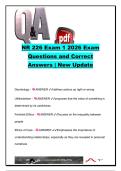
NR 226 Exam 1 2026 Exam
Questions and Correct
Answers | New Update


Deontology - ANSWER ✔✔defines actions as right or wrong


Utilitarianism - ANSWER ✔✔proposes that the value of something is

determined by its usefulness


Feminist Ethics - ANSWER ✔✔focuses on the inequality between

people


Ethics of Care - ANSWER ✔✔Emphasizes the importance of

understanding relationships, especially as they are revealed in personal

narratives

,Professional Nursing Code of Ethics - ANSWER ✔✔A set of guiding

principles that all members of a profession accept


Autonomy - ANSWER ✔✔commitment to include patients in their

decisions


Beneficence - ANSWER ✔✔taking positive actions to help others


Nonmaleficence - ANSWER ✔✔avoidance of harm or hurt


Justice - ANSWER ✔✔being fair


Fidelity - ANSWER ✔✔agreement to keep promises


How to process an ethical dilemma (7 steps) - ANSWER ✔✔Step 1:

Ask if this is an ethical dilemma.

Step 2: Gather all relevant information.

Step 3: Clarify your own values/opinons.

Step 4: Verbalize the problem.

Step 5: Identify possible courses of action.

Step 6: Negotiate a plan.

Step 7: Evaluate the plan.

, Who can request access to an ethical committee? - ANSWER

✔✔Any person involved in an ethical dilemma


(including nurses, physicians, health care providers, patients, and family

members)


Issues in healthcare ethics - ANSWER ✔✔quality of care


genetic screening

care at the end of life

access to care


4 basic principles in the Code of Ethics - ANSWER ✔✔1. advocacy


2. confidentiality

3. responsibility

4. accountability


an ethical problem has at least one of the following.. (3) - ANSWER

✔✔1. unable to resolve solely on scientific data


2. perplexing- cannot easily make decision

3. answer will have a profound relevance for areas of human concern


COPYRIGHT©NINJANERD 2025/2026. YEAR PUBLISHED 2026. COMPANY REGISTRATION NUMBER: 619652435. TERMS OF USE. PRIVACY
STATEMENT. ALL RIGHTS RESERVED
3


Información del documento

Subido en
22 de julio de 2026
Número de páginas
29
Escrito en
2025/2026
Tipo
Examen
Contiene
Preguntas y respuestas
$18.99

¿Documento equivocado? Cámbialo gratis Dentro de los 14 días posteriores a la compra y antes de descargarlo, puedes elegir otro documento. Puedes gastar el importe de nuevo.
Escrito por estudiantes que aprobaron
Inmediatamente disponible después del pago
Leer en línea o como PDF

Seller avatar
Los indicadores de reputación están sujetos a la cantidad de artículos vendidos por una tarifa y las reseñas que ha recibido por esos documentos. Hay tres niveles: Bronce, Plata y Oro. Cuanto mayor reputación, más podrás confiar en la calidad del trabajo del vendedor.
NinjaNerd
3.4
(76)
Vendido
401
Seguidores
6
Artículos
15348
Última venta
2 días hace


Por qué los estudiantes eligen Stuvia

Creado por compañeros estudiantes, verificado por reseñas

Calidad en la que puedes confiar: escrito por estudiantes que aprobaron y evaluado por otros que han usado estos resúmenes.

¿No estás satisfecho? Elige otro documento

¡No te preocupes! Puedes elegir directamente otro documento que se ajuste mejor a lo que buscas.

Paga como quieras, empieza a estudiar al instante

Sin suscripción, sin compromisos. Paga como estés acostumbrado con tarjeta de crédito y descarga tu documento PDF inmediatamente.

Student with book image

“Comprado, descargado y aprobado. Así de fácil puede ser.”

Alisha Student

Preguntas frecuentes