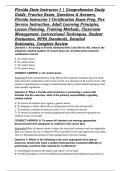
Florida State Instructor I | Comprehensive Study
Guide, Practice Exam, Questions & Answers,
Florida Instructor I Certification Exam Prep, Fire
Service Instruction, Adult Learning Principles,
Lesson Planning, Training Methods, Classroom
Management, Instructional Techniques, Student
Evaluation, NFPA Standards, Detailed
Rationales, Complete Review
Question 1: According to Florida Administrative Code 69A-62.003, what is the
minimum required number of contact hours for an initial state instructor
certification course?
A. 20 contact hours
B. 30 contact hours
C. 40 contact hours
D. 50 contact hours
CORRECT ANSWER: C. 40 contact hours
Rationale:Florida Administrative Code 69A-62.003 explicitly mandates that the initial
state instructor certification course must consist of a minimum of 40 contact hours. This
ensures comprehensive coverage of adult learning theory, instructional techniques, and
state-specific regulations.
Question 2: When a Florida state instructor is presenting a course that
includes live fire exercises, what is the primary responsibility regarding
student safety?
A. To ensure all students have signed a general waiver
B. To designate a safety officer who is independent of the instructional staff
C. To maintain a student-to-instructor ratio of 10:1 during the exercise
D. To ensure all students are wearing appropriate personal protective equipment as
outlined in the course plan
CORRECT ANSWER: D. To ensure all students are wearing appropriate
personal protective equipment as outlined in the course plan
Rationale:While all options relate to safety, the instructor's primary and non-negotiable
duty is to enforce the use of required PPE as specified in the state-approved course plan.
This is a foundational element of risk management in live fire training.
Question 3: Which of the following is the most appropriate first step an
instructor should take when a student demonstrates consistent difficulty in
performing a practical skill required for certification?
A. Immediately document the failure and report it to the state
B. Provide immediate corrective feedback and additional individualized instruction on
,the specific task
C. Allow the student to observe peers to learn through vicarious experience
D. Advance the student to the next skill to see if the difficulty resolves itself
CORRECT ANSWER: B. Provide immediate corrective feedback and additional
individualized instruction on the specific task
Rationale:The principle of immediate intervention in adult education dictates that an
instructor should first provide focused remediation. This aligns with the duty to assist
students in achieving mastery before resorting to formal documentation or remediation
plans.
Question 4: Under Florida law, which of the following acts would most likely
constitute grounds for the denial, suspension, or revocation of a state
instructor certification?
A. Using outdated teaching materials that are not state-approved
B. Failing to maintain a 100% pass rate on state examinations
C. Accepting a gift valued at less than $25 from a student
D. Teaching a course that is slightly outside the instructor's primary field of expertise
CORRECT ANSWER: A. Using outdated teaching materials that are not state-
approved
Rationale:Certification requires adherence to current standards. Using non-approved
materials violates the instructor's duty to provide current, accurate instruction, which is
a direct violation of certification standards and can lead to disciplinary action.
Question 5: What is the primary purpose of the 40-hour state instructor
certification course curriculum regarding ethics?
A. To teach instructors how to avoid lawsuits
B. To familiarize instructors with the ethical standards and code of conduct expected of
them by the state
C. To provide instructors with a scripted ethical dilemma response guide
D. To instruct instructors on how to report student misconduct to law enforcement
CORRECT ANSWER: B. To familiarize instructors with the ethical standards
and code of conduct expected of them by the state
Rationale:The ethics component is designed to ensure instructors understand their
professional obligations and the state's standards of conduct. This foundational
knowledge helps maintain the integrity of training and public trust.
Question 6: An instructor is evaluating a student's performance in a scenario-
based exercise. Which type of evaluation is the instructor primarily
conducting?
A. A summative evaluation of cognitive knowledge
B. A formative evaluation of psychomotor skills and decision-making
,C. A diagnostic evaluation of the student's learning style
D. A predictive evaluation of the student's future job performance
CORRECT ANSWER: B. A formative evaluation of psychomotor skills and
decision-making
Rationale:Scenario-based exercises are typical of formative assessments designed to
provide ongoing feedback. They evaluate the application of skills (psychomotor) and the
process of decision-making in a simulated environment.
Question 7: In the context of adult learning theory (andragogy), what is a key
characteristic that distinguishes adult learners from child learners (pedagogy)?
A. Adults require external motivation more than children do
B. Adults have a deeper reservoir of life experience that can be used as a learning
resource
C. Adults are generally less self-directed than children
D. Adults have a shorter attention span than children
CORRECT ANSWER: B. Adults have a deeper reservoir of life experience that
can be used as a learning resource
Rationale:Andragogy posits that adult learners are self-directed and bring a wealth of
experience to the learning environment. Utilizing this experience is a core strategy for
effective adult instruction.
Question 8: When preparing a lesson plan, which component is most critical
for ensuring the course meets state requirements?
A. The visual aids to be used in the presentation
B. The time allocated for student breaks
C. The method for evaluating student participation
D. The alignment of learning objectives with the state's course curriculum and
performance standards
CORRECT ANSWER: D. The alignment of learning objectives with the state's
course curriculum and performance standards
Rationale:The primary function of a lesson plan is to map instruction to required
outcomes. For a state-certified course, this alignment is mandatory to ensure students
are prepared for the state-administered examinations and job requirements.
Question 9: A student challenges an instructor's answer to a question, citing a
conflicting source. What is the most professional response for the instructor?
A. Inform the student that the instructor's answer is the only correct one for the exam
B. Acknowledge the conflict, promise to research both sources, and provide a definitive
answer at the next class session
C. Ask the student to leave the class if they are going to be disruptive
D. Ignore the comment to avoid losing instructional time
, CORRECT ANSWER: B. Acknowledge the conflict, promise to research both
sources, and provide a definitive answer at the next class session
Rationale:Professionalism involves validating student input, demonstrating intellectual
honesty, and maintaining credibility. Responding with a commitment to research
provides a resolution based on authoritative sources.
Question 10: Which of the following is the most effective method for
maintaining student engagement during a long, lecture-based session?
A. Avoiding any questions until the end of the session to prevent disruption
B. Using rhetorical questions throughout the lecture
C. Incorporating periodic activities that require active student participation, such as
think-pair-share
D. Speaking in a loud, monotone voice to command attention
CORRECT ANSWER: C. Incorporating periodic activities that require active
student participation, such as think-pair-share
Rationale:Active learning strategies are proven to re-engage adult learners. Techniques
like think-pair-share break the passive nature of lectures and require students to process
and apply the material.
Question 11: According to the Florida State Fire College, who is responsible for
the issuance of state instructor certifications?
A. The local fire chief in the county where the instructor resides
B. The Florida Bureau of Fire Standards and Training
C. The Florida Division of Emergency Management
D. The State Fire Marshal's Office
CORRECT ANSWER: D. The State Fire Marshal's Office
Rationale:The State Fire Marshal's Office, under the Department of Financial Services,
has the statutory authority to oversee and issue certifications for fire service instructors
in Florida.
Question 12: What is a primary objective of the lesson summary at the end of
a class period?
A. To introduce new material that will be covered in the next session
B. To allow the instructor to leave the classroom before students
C. To reinforce key concepts and provide closure for the day's learning
D. To collect student homework assignments
CORRECT ANSWER: C. To reinforce key concepts and provide closure for the
day's learning
Rationale:The lesson summary serves to consolidate information, highlight the main
takeaways, and bridge the day's learning to future topics, ensuring students leave with a
clear understanding of the core concepts.
Guide, Practice Exam, Questions & Answers,
Florida Instructor I Certification Exam Prep, Fire
Service Instruction, Adult Learning Principles,
Lesson Planning, Training Methods, Classroom
Management, Instructional Techniques, Student
Evaluation, NFPA Standards, Detailed
Rationales, Complete Review
Question 1: According to Florida Administrative Code 69A-62.003, what is the
minimum required number of contact hours for an initial state instructor
certification course?
A. 20 contact hours
B. 30 contact hours
C. 40 contact hours
D. 50 contact hours
CORRECT ANSWER: C. 40 contact hours
Rationale:Florida Administrative Code 69A-62.003 explicitly mandates that the initial
state instructor certification course must consist of a minimum of 40 contact hours. This
ensures comprehensive coverage of adult learning theory, instructional techniques, and
state-specific regulations.
Question 2: When a Florida state instructor is presenting a course that
includes live fire exercises, what is the primary responsibility regarding
student safety?
A. To ensure all students have signed a general waiver
B. To designate a safety officer who is independent of the instructional staff
C. To maintain a student-to-instructor ratio of 10:1 during the exercise
D. To ensure all students are wearing appropriate personal protective equipment as
outlined in the course plan
CORRECT ANSWER: D. To ensure all students are wearing appropriate
personal protective equipment as outlined in the course plan
Rationale:While all options relate to safety, the instructor's primary and non-negotiable
duty is to enforce the use of required PPE as specified in the state-approved course plan.
This is a foundational element of risk management in live fire training.
Question 3: Which of the following is the most appropriate first step an
instructor should take when a student demonstrates consistent difficulty in
performing a practical skill required for certification?
A. Immediately document the failure and report it to the state
B. Provide immediate corrective feedback and additional individualized instruction on
,the specific task
C. Allow the student to observe peers to learn through vicarious experience
D. Advance the student to the next skill to see if the difficulty resolves itself
CORRECT ANSWER: B. Provide immediate corrective feedback and additional
individualized instruction on the specific task
Rationale:The principle of immediate intervention in adult education dictates that an
instructor should first provide focused remediation. This aligns with the duty to assist
students in achieving mastery before resorting to formal documentation or remediation
plans.
Question 4: Under Florida law, which of the following acts would most likely
constitute grounds for the denial, suspension, or revocation of a state
instructor certification?
A. Using outdated teaching materials that are not state-approved
B. Failing to maintain a 100% pass rate on state examinations
C. Accepting a gift valued at less than $25 from a student
D. Teaching a course that is slightly outside the instructor's primary field of expertise
CORRECT ANSWER: A. Using outdated teaching materials that are not state-
approved
Rationale:Certification requires adherence to current standards. Using non-approved
materials violates the instructor's duty to provide current, accurate instruction, which is
a direct violation of certification standards and can lead to disciplinary action.
Question 5: What is the primary purpose of the 40-hour state instructor
certification course curriculum regarding ethics?
A. To teach instructors how to avoid lawsuits
B. To familiarize instructors with the ethical standards and code of conduct expected of
them by the state
C. To provide instructors with a scripted ethical dilemma response guide
D. To instruct instructors on how to report student misconduct to law enforcement
CORRECT ANSWER: B. To familiarize instructors with the ethical standards
and code of conduct expected of them by the state
Rationale:The ethics component is designed to ensure instructors understand their
professional obligations and the state's standards of conduct. This foundational
knowledge helps maintain the integrity of training and public trust.
Question 6: An instructor is evaluating a student's performance in a scenario-
based exercise. Which type of evaluation is the instructor primarily
conducting?
A. A summative evaluation of cognitive knowledge
B. A formative evaluation of psychomotor skills and decision-making
,C. A diagnostic evaluation of the student's learning style
D. A predictive evaluation of the student's future job performance
CORRECT ANSWER: B. A formative evaluation of psychomotor skills and
decision-making
Rationale:Scenario-based exercises are typical of formative assessments designed to
provide ongoing feedback. They evaluate the application of skills (psychomotor) and the
process of decision-making in a simulated environment.
Question 7: In the context of adult learning theory (andragogy), what is a key
characteristic that distinguishes adult learners from child learners (pedagogy)?
A. Adults require external motivation more than children do
B. Adults have a deeper reservoir of life experience that can be used as a learning
resource
C. Adults are generally less self-directed than children
D. Adults have a shorter attention span than children
CORRECT ANSWER: B. Adults have a deeper reservoir of life experience that
can be used as a learning resource
Rationale:Andragogy posits that adult learners are self-directed and bring a wealth of
experience to the learning environment. Utilizing this experience is a core strategy for
effective adult instruction.
Question 8: When preparing a lesson plan, which component is most critical
for ensuring the course meets state requirements?
A. The visual aids to be used in the presentation
B. The time allocated for student breaks
C. The method for evaluating student participation
D. The alignment of learning objectives with the state's course curriculum and
performance standards
CORRECT ANSWER: D. The alignment of learning objectives with the state's
course curriculum and performance standards
Rationale:The primary function of a lesson plan is to map instruction to required
outcomes. For a state-certified course, this alignment is mandatory to ensure students
are prepared for the state-administered examinations and job requirements.
Question 9: A student challenges an instructor's answer to a question, citing a
conflicting source. What is the most professional response for the instructor?
A. Inform the student that the instructor's answer is the only correct one for the exam
B. Acknowledge the conflict, promise to research both sources, and provide a definitive
answer at the next class session
C. Ask the student to leave the class if they are going to be disruptive
D. Ignore the comment to avoid losing instructional time
, CORRECT ANSWER: B. Acknowledge the conflict, promise to research both
sources, and provide a definitive answer at the next class session
Rationale:Professionalism involves validating student input, demonstrating intellectual
honesty, and maintaining credibility. Responding with a commitment to research
provides a resolution based on authoritative sources.
Question 10: Which of the following is the most effective method for
maintaining student engagement during a long, lecture-based session?
A. Avoiding any questions until the end of the session to prevent disruption
B. Using rhetorical questions throughout the lecture
C. Incorporating periodic activities that require active student participation, such as
think-pair-share
D. Speaking in a loud, monotone voice to command attention
CORRECT ANSWER: C. Incorporating periodic activities that require active
student participation, such as think-pair-share
Rationale:Active learning strategies are proven to re-engage adult learners. Techniques
like think-pair-share break the passive nature of lectures and require students to process
and apply the material.
Question 11: According to the Florida State Fire College, who is responsible for
the issuance of state instructor certifications?
A. The local fire chief in the county where the instructor resides
B. The Florida Bureau of Fire Standards and Training
C. The Florida Division of Emergency Management
D. The State Fire Marshal's Office
CORRECT ANSWER: D. The State Fire Marshal's Office
Rationale:The State Fire Marshal's Office, under the Department of Financial Services,
has the statutory authority to oversee and issue certifications for fire service instructors
in Florida.
Question 12: What is a primary objective of the lesson summary at the end of
a class period?
A. To introduce new material that will be covered in the next session
B. To allow the instructor to leave the classroom before students
C. To reinforce key concepts and provide closure for the day's learning
D. To collect student homework assignments
CORRECT ANSWER: C. To reinforce key concepts and provide closure for the
day's learning
Rationale:The lesson summary serves to consolidate information, highlight the main
takeaways, and bridge the day's learning to future topics, ensuring students leave with a
clear understanding of the core concepts.