

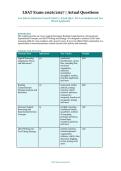
LSAT Exam 2026/2027 | Actual Questions
Law School Admission Council (LSAC) | Actual Q&A | Pre-Law Students and Law
School Applicants
Introduction
This original practice set covers Logical Reasoning, Reading Comprehension, Advanced and
Experimental Concepts, and LSAT Writing and Strategy. It is designed to reinforce LSAC-style
reasoning skills for exam readiness and a top-tier score. It is not an official LSAC examination or a
reproduction of secured questions; consult current LSAC policies and materials.
Content Area Overview
Content Area Questions Key Topics Weight
Logical Reasoning 50 conclusion 50%
(Arguments, Flaws, identification, causal
and Inferences) flaw, sampling flaw,
necessary
assumption,
sufficient
assumption,
strengthen, weaken,
principle application
and more
Reading 26 main point, author 26%
Comprehension attitude, passage
(Passage Analysis and structure, detail
Structure) retrieval, inference,
comparative
viewpoint, function of
paragraph, analogy
and more
Advanced Logical 15 parallel reasoning, 15%
Reasoning and conditional chains,
Experimental Section quantifiers, method
Concepts of reasoning,
principle questions,
formal logic,
exception questions
and more
LSAT Writing and 10 position selection, 10%
Test-Taking Strategy counterargument,
organization,
evidence, clarity, time
allocation, flagging,
review strategy and
more
LSAT Exam 2026/2027
,Domain: Logical Reasoning (Arguments, Flaws, and Inferences)
1. Stimulus 1: A commentator argues that a new policy will improve outcomes
because an organization using the policy reported better results than organizations
that did not. Which one of the following is most strongly supported by the stimulus?
A. The answer follows only after the argument’s key comparison is made fair.
B. It introduces a new issue not addressed by the stimulus.
C. It reverses the relationship between evidence and conclusion.
D. It reverses the relationship between evidence and conclusion.
E. It ignores an important qualification.
Answer: A
Rationale: Answer A is best because it applies the distinct skill of logical reasoning (arguments,
flaws, and inferences) at item 1. The remaining choices either overstate the evidence, introduce
an irrelevant claim, reverse the logic, or ignore a qualification. The correct LSAT method is to
identify the conclusion, track the support, and select only what the stimulus warrants.
2. Stimulus 2: A commentator argues that a new policy will improve outcomes
because an organization using the policy reported better results than organizations
that did not. Which one of the following, if true, most strengthens the argument?
A. It introduces a new issue not addressed by the stimulus.
B. The answer supplies the missing link between the evidence and the conclusion.
C. It treats a possibility as proof.
D. It treats a possibility as proof.
E. It introduces a new issue not addressed by the stimulus.
Answer: B
Rationale: Answer B is best because it applies the distinct skill of logical reasoning (arguments,
flaws, and inferences) at item 2. The remaining choices either overstate the evidence, introduce
an irrelevant claim, reverse the logic, or ignore a qualification. The correct LSAT method is to
identify the conclusion, track the support, and select only what the stimulus warrants.
3. Stimulus 3: A commentator argues that a new policy will improve outcomes
because an organization using the policy reported better results than organizations
that did not. Which one of the following identifies a flaw in the reasoning?
A. It reverses the relationship between evidence and conclusion.
B. It treats a possibility as proof.
C. The answer correctly distinguishes what the stimulus establishes from what it merely suggests.
D. It ignores an important qualification.
E. It reverses the relationship between evidence and conclusion.
Answer: C
Rationale: Answer C is best because it applies the distinct skill of logical reasoning (arguments,
flaws, and inferences) at item 3. The remaining choices either overstate the evidence, introduce
an irrelevant claim, reverse the logic, or ignore a qualification. The correct LSAT method is to
identify the conclusion, track the support, and select only what the stimulus warrants.
LSAT Exam 2026/2027
,4. Stimulus 4: A commentator argues that a new policy will improve outcomes
because an organization using the policy reported better results than organizations
that did not. Which one of the following is an assumption required by the
argument?
A. It treats a possibility as proof.
B. It ignores an important qualification.
C. It introduces a new issue not addressed by the stimulus.
D. The answer matches the structure and scope of the reasoning without adding an unsupported
premise.
E. It treats a possibility as proof.
Answer: D
Rationale: Answer D is best because it applies the distinct skill of logical reasoning (arguments,
flaws, and inferences) at item 4. The remaining choices either overstate the evidence, introduce
an irrelevant claim, reverse the logic, or ignore a qualification. The correct LSAT method is to
identify the conclusion, track the support, and select only what the stimulus warrants.
5. Stimulus 5: A commentator argues that a new policy will improve outcomes
because an organization using the policy reported better results than organizations
that did not. Which one of the following best states the main point?
A. It ignores an important qualification.
B. It introduces a new issue not addressed by the stimulus.
C. It reverses the relationship between evidence and conclusion.
D. It reverses the relationship between evidence and conclusion.
E. The answer preserves the passage’s qualification and avoids an overbroad interpretation.
Answer: E
Rationale: Answer E is best because it applies the distinct skill of logical reasoning (arguments,
flaws, and inferences) at item 5. The remaining choices either overstate the evidence, introduce
an irrelevant claim, reverse the logic, or ignore a qualification. The correct LSAT method is to
identify the conclusion, track the support, and select only what the stimulus warrants.
6. Stimulus 6: A commentator argues that a new policy will improve outcomes
because an organization using the policy reported better results than organizations
that did not. Which one of the following is most strongly supported by the stimulus?
A. The answer follows only after the argument’s key comparison is made fair.
B. It reverses the relationship between evidence and conclusion.
C. It treats a possibility as proof.
D. It treats a possibility as proof.
E. It introduces a new issue not addressed by the stimulus.
Answer: A
Rationale: Answer A is best because it applies the distinct skill of logical reasoning (arguments,
flaws, and inferences) at item 6. The remaining choices either overstate the evidence, introduce
an irrelevant claim, reverse the logic, or ignore a qualification. The correct LSAT method is to
identify the conclusion, track the support, and select only what the stimulus warrants.
LSAT Exam 2026/2027
, 7. Stimulus 7: A commentator argues that a new policy will improve outcomes
because an organization using the policy reported better results than organizations
that did not. Which one of the following, if true, most strengthens the argument?
A. It reverses the relationship between evidence and conclusion.
B. The answer supplies the missing link between the evidence and the conclusion.
C. It ignores an important qualification.
D. It ignores an important qualification.
E. It reverses the relationship between evidence and conclusion.
Answer: B
Rationale: Answer B is best because it applies the distinct skill of logical reasoning (arguments,
flaws, and inferences) at item 7. The remaining choices either overstate the evidence, introduce
an irrelevant claim, reverse the logic, or ignore a qualification. The correct LSAT method is to
identify the conclusion, track the support, and select only what the stimulus warrants.
8. Stimulus 8: A commentator argues that a new policy will improve outcomes
because an organization using the policy reported better results than organizations
that did not. Which one of the following identifies a flaw in the reasoning?
A. It treats a possibility as proof.
B. It ignores an important qualification.
C. The answer correctly distinguishes what the stimulus establishes from what it merely suggests.
D. It introduces a new issue not addressed by the stimulus.
E. It treats a possibility as proof.
Answer: C
Rationale: Answer C is best because it applies the distinct skill of logical reasoning (arguments,
flaws, and inferences) at item 8. The remaining choices either overstate the evidence, introduce
an irrelevant claim, reverse the logic, or ignore a qualification. The correct LSAT method is to
identify the conclusion, track the support, and select only what the stimulus warrants.
9. Stimulus 9: A commentator argues that a new policy will improve outcomes
because an organization using the policy reported better results than organizations
that did not. Which one of the following is an assumption required by the
argument?
A. It ignores an important qualification.
B. It introduces a new issue not addressed by the stimulus.
C. It reverses the relationship between evidence and conclusion.
D. The answer matches the structure and scope of the reasoning without adding an unsupported
premise.
E. It ignores an important qualification.
Answer: D
Rationale: Answer D is best because it applies the distinct skill of logical reasoning (arguments,
flaws, and inferences) at item 9. The remaining choices either overstate the evidence, introduce
an irrelevant claim, reverse the logic, or ignore a qualification. The correct LSAT method is to
identify the conclusion, track the support, and select only what the stimulus warrants.
LSAT Exam 2026/2027
Law School Admission Council (LSAC) | Actual Q&A | Pre-Law Students and Law
School Applicants
Introduction
This original practice set covers Logical Reasoning, Reading Comprehension, Advanced and
Experimental Concepts, and LSAT Writing and Strategy. It is designed to reinforce LSAC-style
reasoning skills for exam readiness and a top-tier score. It is not an official LSAC examination or a
reproduction of secured questions; consult current LSAC policies and materials.
Content Area Overview
Content Area Questions Key Topics Weight
Logical Reasoning 50 conclusion 50%
(Arguments, Flaws, identification, causal
and Inferences) flaw, sampling flaw,
necessary
assumption,
sufficient
assumption,
strengthen, weaken,
principle application
and more
Reading 26 main point, author 26%
Comprehension attitude, passage
(Passage Analysis and structure, detail
Structure) retrieval, inference,
comparative
viewpoint, function of
paragraph, analogy
and more
Advanced Logical 15 parallel reasoning, 15%
Reasoning and conditional chains,
Experimental Section quantifiers, method
Concepts of reasoning,
principle questions,
formal logic,
exception questions
and more
LSAT Writing and 10 position selection, 10%
Test-Taking Strategy counterargument,
organization,
evidence, clarity, time
allocation, flagging,
review strategy and
more
LSAT Exam 2026/2027
,Domain: Logical Reasoning (Arguments, Flaws, and Inferences)
1. Stimulus 1: A commentator argues that a new policy will improve outcomes
because an organization using the policy reported better results than organizations
that did not. Which one of the following is most strongly supported by the stimulus?
A. The answer follows only after the argument’s key comparison is made fair.
B. It introduces a new issue not addressed by the stimulus.
C. It reverses the relationship between evidence and conclusion.
D. It reverses the relationship between evidence and conclusion.
E. It ignores an important qualification.
Answer: A
Rationale: Answer A is best because it applies the distinct skill of logical reasoning (arguments,
flaws, and inferences) at item 1. The remaining choices either overstate the evidence, introduce
an irrelevant claim, reverse the logic, or ignore a qualification. The correct LSAT method is to
identify the conclusion, track the support, and select only what the stimulus warrants.
2. Stimulus 2: A commentator argues that a new policy will improve outcomes
because an organization using the policy reported better results than organizations
that did not. Which one of the following, if true, most strengthens the argument?
A. It introduces a new issue not addressed by the stimulus.
B. The answer supplies the missing link between the evidence and the conclusion.
C. It treats a possibility as proof.
D. It treats a possibility as proof.
E. It introduces a new issue not addressed by the stimulus.
Answer: B
Rationale: Answer B is best because it applies the distinct skill of logical reasoning (arguments,
flaws, and inferences) at item 2. The remaining choices either overstate the evidence, introduce
an irrelevant claim, reverse the logic, or ignore a qualification. The correct LSAT method is to
identify the conclusion, track the support, and select only what the stimulus warrants.
3. Stimulus 3: A commentator argues that a new policy will improve outcomes
because an organization using the policy reported better results than organizations
that did not. Which one of the following identifies a flaw in the reasoning?
A. It reverses the relationship between evidence and conclusion.
B. It treats a possibility as proof.
C. The answer correctly distinguishes what the stimulus establishes from what it merely suggests.
D. It ignores an important qualification.
E. It reverses the relationship between evidence and conclusion.
Answer: C
Rationale: Answer C is best because it applies the distinct skill of logical reasoning (arguments,
flaws, and inferences) at item 3. The remaining choices either overstate the evidence, introduce
an irrelevant claim, reverse the logic, or ignore a qualification. The correct LSAT method is to
identify the conclusion, track the support, and select only what the stimulus warrants.
LSAT Exam 2026/2027
,4. Stimulus 4: A commentator argues that a new policy will improve outcomes
because an organization using the policy reported better results than organizations
that did not. Which one of the following is an assumption required by the
argument?
A. It treats a possibility as proof.
B. It ignores an important qualification.
C. It introduces a new issue not addressed by the stimulus.
D. The answer matches the structure and scope of the reasoning without adding an unsupported
premise.
E. It treats a possibility as proof.
Answer: D
Rationale: Answer D is best because it applies the distinct skill of logical reasoning (arguments,
flaws, and inferences) at item 4. The remaining choices either overstate the evidence, introduce
an irrelevant claim, reverse the logic, or ignore a qualification. The correct LSAT method is to
identify the conclusion, track the support, and select only what the stimulus warrants.
5. Stimulus 5: A commentator argues that a new policy will improve outcomes
because an organization using the policy reported better results than organizations
that did not. Which one of the following best states the main point?
A. It ignores an important qualification.
B. It introduces a new issue not addressed by the stimulus.
C. It reverses the relationship between evidence and conclusion.
D. It reverses the relationship between evidence and conclusion.
E. The answer preserves the passage’s qualification and avoids an overbroad interpretation.
Answer: E
Rationale: Answer E is best because it applies the distinct skill of logical reasoning (arguments,
flaws, and inferences) at item 5. The remaining choices either overstate the evidence, introduce
an irrelevant claim, reverse the logic, or ignore a qualification. The correct LSAT method is to
identify the conclusion, track the support, and select only what the stimulus warrants.
6. Stimulus 6: A commentator argues that a new policy will improve outcomes
because an organization using the policy reported better results than organizations
that did not. Which one of the following is most strongly supported by the stimulus?
A. The answer follows only after the argument’s key comparison is made fair.
B. It reverses the relationship between evidence and conclusion.
C. It treats a possibility as proof.
D. It treats a possibility as proof.
E. It introduces a new issue not addressed by the stimulus.
Answer: A
Rationale: Answer A is best because it applies the distinct skill of logical reasoning (arguments,
flaws, and inferences) at item 6. The remaining choices either overstate the evidence, introduce
an irrelevant claim, reverse the logic, or ignore a qualification. The correct LSAT method is to
identify the conclusion, track the support, and select only what the stimulus warrants.
LSAT Exam 2026/2027
, 7. Stimulus 7: A commentator argues that a new policy will improve outcomes
because an organization using the policy reported better results than organizations
that did not. Which one of the following, if true, most strengthens the argument?
A. It reverses the relationship between evidence and conclusion.
B. The answer supplies the missing link between the evidence and the conclusion.
C. It ignores an important qualification.
D. It ignores an important qualification.
E. It reverses the relationship between evidence and conclusion.
Answer: B
Rationale: Answer B is best because it applies the distinct skill of logical reasoning (arguments,
flaws, and inferences) at item 7. The remaining choices either overstate the evidence, introduce
an irrelevant claim, reverse the logic, or ignore a qualification. The correct LSAT method is to
identify the conclusion, track the support, and select only what the stimulus warrants.
8. Stimulus 8: A commentator argues that a new policy will improve outcomes
because an organization using the policy reported better results than organizations
that did not. Which one of the following identifies a flaw in the reasoning?
A. It treats a possibility as proof.
B. It ignores an important qualification.
C. The answer correctly distinguishes what the stimulus establishes from what it merely suggests.
D. It introduces a new issue not addressed by the stimulus.
E. It treats a possibility as proof.
Answer: C
Rationale: Answer C is best because it applies the distinct skill of logical reasoning (arguments,
flaws, and inferences) at item 8. The remaining choices either overstate the evidence, introduce
an irrelevant claim, reverse the logic, or ignore a qualification. The correct LSAT method is to
identify the conclusion, track the support, and select only what the stimulus warrants.
9. Stimulus 9: A commentator argues that a new policy will improve outcomes
because an organization using the policy reported better results than organizations
that did not. Which one of the following is an assumption required by the
argument?
A. It ignores an important qualification.
B. It introduces a new issue not addressed by the stimulus.
C. It reverses the relationship between evidence and conclusion.
D. The answer matches the structure and scope of the reasoning without adding an unsupported
premise.
E. It ignores an important qualification.
Answer: D
Rationale: Answer D is best because it applies the distinct skill of logical reasoning (arguments,
flaws, and inferences) at item 9. The remaining choices either overstate the evidence, introduce
an irrelevant claim, reverse the logic, or ignore a qualification. The correct LSAT method is to
identify the conclusion, track the support, and select only what the stimulus warrants.
LSAT Exam 2026/2027

