

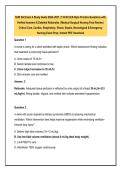
NUR 242 Exam 4 Study Guide 2026–2027 | 116 NCLEX-Style Practice Questions with
Verified Answers & Detailed Rationales | Medical-Surgical Nursing Final Review |
Critical Care, Cardiac, Respiratory, Shock, Sepsis, Neurological & Emergency
Nursing Exam Prep | Instant PDF Download
Question 1
A nurse is caring for a client admitted with septic shock. Which assessment finding indicates
that treatment is improving tissue perfusion?
A. Urine output of 15 mL/hr
B. Serum lactate level continues to rise
C. Urine output increases to 35 mL/hr
D. Skin remains cool and mottled
Answer: C
Rationale: Adequate tissue perfusion is reflected by urine output of at least 30 mL/hr (0.5
mL/kg/hr). Rising lactate, oliguria, and mottled skin indicate persistent hypoperfusion.
Question 2
A client with acute respiratory distress syndrome (ARDS) is receiving mechanical
ventilation. Which intervention best helps improve oxygenation while minimizing ventilator-
induced lung injury?
A. Deliver high tidal volumes (10–12 mL/kg).
B. Use low tidal volume ventilation (about 6 mL/kg ideal body weight).
C. Limit PEEP to zero.
D. Administer 100% oxygen continuously.
,Answer: B
Rationale: Lung-protective ventilation with low tidal volumes and appropriate PEEP
reduces alveolar overdistention and improves outcomes in ARDS.
Question 3
A nurse notes a client's central venous pressure (CVP) has decreased from 8 mm Hg to 2
mm Hg. Which condition is most likely responsible?
A. Fluid overload
B. Hypovolemia
C. Left ventricular failure
D. Pulmonary edema
Answer: B
Rationale: A low CVP commonly indicates decreased intravascular volume, often caused
by hemorrhage, dehydration, or third-spacing.
Question 4
A client with cardiogenic shock suddenly develops crackles throughout both lung fields.
Which action should the nurse perform first?
A. Increase IV fluid infusion.
B. Raise the head of the bed and assess oxygenation.
C. Encourage oral fluids.
D. Place the client flat.
Answer: B
,Rationale: Crackles suggest pulmonary edema. Improving oxygenation and reducing
venous return by elevating the head of the bed is the priority.
Question 5
Which laboratory value is most concerning in a client receiving IV heparin therapy?
A. INR 1.0
B. Platelets 180,000/mm³
C. aPTT 120 seconds
D. Potassium 4.0 mEq/L
Answer: C
Rationale: An excessively prolonged aPTT increases bleeding risk and may require
adjustment or temporary discontinuation of heparin.
Question 6
A client with diabetic ketoacidosis (DKA) is receiving insulin therapy. Which laboratory value
requires immediate nursing intervention?
A. Glucose 250 mg/dL
B. Potassium 2.9 mEq/L
C. Sodium 138 mEq/L
D. BUN 18 mg/dL
Answer: B
Rationale: Insulin drives potassium into cells, worsening hypokalemia and increasing the
risk of life-threatening dysrhythmias.
, Question 7
A client with increased intracranial pressure (ICP) suddenly develops unequal pupils. What
is the nurse's priority action?
A. Document the finding.
B. Reassess in one hour.
C. Notify the healthcare provider immediately.
D. Encourage coughing.
Answer: C
Rationale: Unequal pupils may indicate brain herniation, a neurologic emergency requiring
immediate intervention.
Question 8
A nurse is caring for a client experiencing a tension pneumothorax. Which assessment
finding is expected?
A. Bilateral crackles
B. Bradycardia
C. Tracheal deviation with absent breath sounds on one side
D. Hyperactive bowel sounds
Answer: C
Rationale: Tension pneumothorax causes collapsed lung, mediastinal shift, tracheal
deviation, hypotension, and absent unilateral breath sounds.
Verified Answers & Detailed Rationales | Medical-Surgical Nursing Final Review |
Critical Care, Cardiac, Respiratory, Shock, Sepsis, Neurological & Emergency
Nursing Exam Prep | Instant PDF Download
Question 1
A nurse is caring for a client admitted with septic shock. Which assessment finding indicates
that treatment is improving tissue perfusion?
A. Urine output of 15 mL/hr
B. Serum lactate level continues to rise
C. Urine output increases to 35 mL/hr
D. Skin remains cool and mottled
Answer: C
Rationale: Adequate tissue perfusion is reflected by urine output of at least 30 mL/hr (0.5
mL/kg/hr). Rising lactate, oliguria, and mottled skin indicate persistent hypoperfusion.
Question 2
A client with acute respiratory distress syndrome (ARDS) is receiving mechanical
ventilation. Which intervention best helps improve oxygenation while minimizing ventilator-
induced lung injury?
A. Deliver high tidal volumes (10–12 mL/kg).
B. Use low tidal volume ventilation (about 6 mL/kg ideal body weight).
C. Limit PEEP to zero.
D. Administer 100% oxygen continuously.
,Answer: B
Rationale: Lung-protective ventilation with low tidal volumes and appropriate PEEP
reduces alveolar overdistention and improves outcomes in ARDS.
Question 3
A nurse notes a client's central venous pressure (CVP) has decreased from 8 mm Hg to 2
mm Hg. Which condition is most likely responsible?
A. Fluid overload
B. Hypovolemia
C. Left ventricular failure
D. Pulmonary edema
Answer: B
Rationale: A low CVP commonly indicates decreased intravascular volume, often caused
by hemorrhage, dehydration, or third-spacing.
Question 4
A client with cardiogenic shock suddenly develops crackles throughout both lung fields.
Which action should the nurse perform first?
A. Increase IV fluid infusion.
B. Raise the head of the bed and assess oxygenation.
C. Encourage oral fluids.
D. Place the client flat.
Answer: B
,Rationale: Crackles suggest pulmonary edema. Improving oxygenation and reducing
venous return by elevating the head of the bed is the priority.
Question 5
Which laboratory value is most concerning in a client receiving IV heparin therapy?
A. INR 1.0
B. Platelets 180,000/mm³
C. aPTT 120 seconds
D. Potassium 4.0 mEq/L
Answer: C
Rationale: An excessively prolonged aPTT increases bleeding risk and may require
adjustment or temporary discontinuation of heparin.
Question 6
A client with diabetic ketoacidosis (DKA) is receiving insulin therapy. Which laboratory value
requires immediate nursing intervention?
A. Glucose 250 mg/dL
B. Potassium 2.9 mEq/L
C. Sodium 138 mEq/L
D. BUN 18 mg/dL
Answer: B
Rationale: Insulin drives potassium into cells, worsening hypokalemia and increasing the
risk of life-threatening dysrhythmias.
, Question 7
A client with increased intracranial pressure (ICP) suddenly develops unequal pupils. What
is the nurse's priority action?
A. Document the finding.
B. Reassess in one hour.
C. Notify the healthcare provider immediately.
D. Encourage coughing.
Answer: C
Rationale: Unequal pupils may indicate brain herniation, a neurologic emergency requiring
immediate intervention.
Question 8
A nurse is caring for a client experiencing a tension pneumothorax. Which assessment
finding is expected?
A. Bilateral crackles
B. Bradycardia
C. Tracheal deviation with absent breath sounds on one side
D. Hyperactive bowel sounds
Answer: C
Rationale: Tension pneumothorax causes collapsed lung, mediastinal shift, tracheal
deviation, hypotension, and absent unilateral breath sounds.

