

Escrito por estudiantes que aprobaron Inmediatamente disponible después del pago Leer en línea o como PDF ¿Documento equivocado? Cámbialo gratis 4,6 TrustPilot
logo-home
Document preview thumbnail
Vista previa 2 fuera de 14 páginas
Examen

AMCA Phlebotomy Technician Certification (PTC) 2026 | 90+ Exam Questions & Verified Answers | Key Topics: Venipuncture, Order of Draw, Infection Control, OSHA, CLSI & Specimen Collection | American Medical Certification Association (AMCA)

Document preview thumbnail
Vista previa 2 fuera de 14 páginas

Prepare with confidence for the American Medical Certification Association (AMCA) Phlebotomy Technician Certification (PTC) examination using this comprehensive 2026 exam preparation guide featuring 90+ expertly compiled practice questions and verified answers. This study resource thoroughly reviews the essential knowledge and practical competencies expected of entry-level phlebotomy technicians, including patient identification, informed consent, HIPAA compliance, OSHA regulations, CLSI standards, infection prevention, personal protective equipment (PPE), specimen collection and handling, venipuncture techniques, capillary puncture, order of draw, tube additives, quality assurance, laboratory departments, anatomy and physiology, medical terminology, emergency procedures, chain of custody, and specimen rejection criteria. The questions are structured to reinforce both theoretical understanding and clinical decision-making, allowing students to identify strengths and address knowledge gaps before sitting for the national certification examination. Coverage includes laboratory safety protocols, blood collection equipment, anticoagulants and additives, patient preparation, fasting requirements, quality control measures, blood culture collection, coagulation testing, specimen labeling, tourniquet application, infection transmission, CPR fundamentals, anatomical landmarks, common laboratory tests, and professional responsibilities. The material is ideal for classroom revision, self-paced study, mock examination practice, and final certification review. The content reflects nationally accepted phlebotomy competencies and aligns with evidence-based recommendations from the Clinical and Laboratory Standards Institute (CLSI), the Centers for Disease Control and Prevention (CDC), and the Occupational Safety and Health Administration (OSHA). It also reinforces the foundational principles presented in leading phlebotomy and laboratory medicine textbooks widely adopted by accredited allied health, nursing, and medical laboratory science programs. This makes the document an excellent companion for students seeking success in both academic coursework and professional certification. Relevant for Students: AMCA Phlebotomy Technician Certification (PTC) candidates Phlebotomy Technician students Medical Laboratory Technician (MLT) students Medical Laboratory Science (MLS) students Medical Assistant students Clinical Laboratory Assistant students Nursing students (LPN/LVN, ADN, BSN) Allied Health students Clinical Pathology students Healthcare Assistant trainees Vocational and Technical College healthcare students Laboratory Medicine students Healthcare certification candidates preparing for national phlebotomy examinations References: Clinical and Laboratory Standards Institute. (2017). Collection of Diagnostic Venous Blood Specimens (CLSI GP41, 7th ed.). CLSI. McCall, R. E., & Tankersley, C. M. (2020). Phlebotomy Essentials (8th ed.). Jones & Bartlett Learning. Garza, D., & Becan-McBride, K. (2020). Phlebotomy Handbook: Blood Specimen Collection from Basic to Advanced (10th ed.). Pearson. Rodak, B. F., Fritsma, G. A., & Keohane, E. M. (2020). Hematology: Clinical Principles and Applications (5th ed.). Elsevier. Centers for Disease Control and Prevention. Guideline for Isolation Precautions: Preventing Transmission of Infectious Agents in Healthcare Settings. Occupational Safety and Health Administration. Bloodborne Pathogens Standard (29 CFR 1910.1030). Keywords: AMCA Phlebotomy, AMCA PTC, phlebotomy certification, phlebotomy exam questions, phlebotomy practice test, phlebotomy review, phlebotomy study guide, venipuncture, capillary puncture, specimen collection, specimen handling, patient identification, informed consent, HIPAA, OSHA, CLSI, CDC guidelines, infection control, standard precautions, PPE, order of draw, evacuated tubes, tube additives, anticoagulants, blood collection, laboratory safety, quality assurance, quality control, chain of custody, blood culture, coagulation testing, CBC, glucose testing, anatomy and physiology, medical terminology, emergency procedures, CPR, allied health, medical laboratory technician, nursing exam review, healthcare certification

Vista previa del contenido

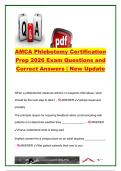
AMCA Phlebotomy Certification
Prep 2026 Exam Questions and
Correct Answers | New Update


When a phlebotomist observes actions or suspects child abuse, what

should be the next step to take? - ANSWER ✔✔advise supervisor

privately

The principle reason for requiring feedback when communicating with

patients is to determine weather they ______________. - ANSWER

✔✔have understood what is being said


Implied consent for a venipuncture on an adult requires _____________.

- ANSWER ✔✔the patient extends their arm to you

, How should the phlebotomist dispose of a needle after drawing blood

from a patient? - ANSWER ✔✔close safety and dispose in a puncture

resistant container (sharps container)

The hospital department that is responsible for sterile supplies -

ANSWER ✔✔Central Supply


The reason a test if ordered timed is to ______________. - ANSWER

✔✔Draw it at the best time for accurate results


The patient's specimen is lipemic, this is usually an indicator that the

patient ___________. - ANSWER ✔✔Has not fasted


Abbreviation for "nothing by mouth" - ANSWER ✔✔NPO


The government agency responsible for regulating the safety and health

of workers - ANSWER ✔✔Occupational Safety and Health

Administration (OSHA)

To prevent cross contamination of microorganisms from one patient to

another, OSHA standards require ____________. - ANSWER

✔✔Barrier protection equipment (PPE personal protective equipment)


The balanced or "steady state" of the body is called: - ANSWER

✔✔Homeostasis

Información del documento

Subido en
17 de julio de 2026
Número de páginas
14
Escrito en
2025/2026
Tipo
Examen
Contiene
Preguntas y respuestas
$18.99

¿Documento equivocado? Cámbialo gratis Dentro de los 14 días posteriores a la compra y antes de descargarlo, puedes elegir otro documento. Puedes gastar el importe de nuevo.
Escrito por estudiantes que aprobaron
Inmediatamente disponible después del pago
Leer en línea o como PDF

Seller avatar
Los indicadores de reputación están sujetos a la cantidad de artículos vendidos por una tarifa y las reseñas que ha recibido por esos documentos. Hay tres niveles: Bronce, Plata y Oro. Cuanto mayor reputación, más podrás confiar en la calidad del trabajo del vendedor.
PROFFKERRYMARTIN
3.3
(55)
Vendido
286
Seguidores
9
Artículos
11175
Última venta
13 horas hace


Por qué los estudiantes eligen Stuvia

Creado por compañeros estudiantes, verificado por reseñas

Calidad en la que puedes confiar: escrito por estudiantes que aprobaron y evaluado por otros que han usado estos resúmenes.

¿No estás satisfecho? Elige otro documento

¡No te preocupes! Puedes elegir directamente otro documento que se ajuste mejor a lo que buscas.

Paga como quieras, empieza a estudiar al instante

Sin suscripción, sin compromisos. Paga como estés acostumbrado con tarjeta de crédito y descarga tu documento PDF inmediatamente.

Student with book image

“Comprado, descargado y aprobado. Así de fácil puede ser.”

Alisha Student

Preguntas frecuentes
