

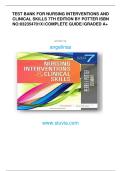
TEST BANK FOR NURSING INTERVENTIONS AND
CLINICAL SKILLS 7TH EDITION BY POTTER ISBN
NO:032354701X//COMPLETE GUIDE//GRADED A+
written by
angelinas
www.stuvia.com
, TEST BANK FOR
Nursing Interventions & Clinical Skills, 7th
Edition
Authors: Anne Griffin Perry & Patricia A. Potter & Wendy
Ostendorf
Chapter 1: Using Evidence in Nursing Practice
Chapter 2: Communication & Collaboration
Chapter 3: Documentation and Informatics
Chapter 4: Patient Safety & Quality Improvement
Chapter 5: Infection Control
Chapter 6: Disaster Preparedness
Chapter 7: Vital Signs
Chapter 8: Health Assessment
Chapter 9: Specimen Collection
Chapter 10: Diagnostic Procedures
Chapter 11: Bathing and Personal Hygiene
Chapter 12: Care of the Eye and Ear
Chapter 13: Promoting Nutrition
Chapter 14: Parenteral Nutrition
Chapter 15: Pain Management
Chapter 16: Promoting Oxygenation
Chapter 17: Safe Patient Handling
Chapter 18: Exercise, Mobility & Immobilization Devices
Chapter 19: Urinary Elimination
Chapter 20: Bowel Elimination
21: Ostomy Care
Chapter 22: Preparation for Safe Medication Administration
Chapter 23: Nonparenteral Medications
Chapter 24: Parenteral Medications
Chapter 25: Wound Care and Irrigation
Chapter 26: Pressure Injury Prevention and Care
Chapter 27: Dressings Bandages and Binders
Chapter 28: Intravenous Therapy
Chapter 29: Pre-Operative and Post-Operative Care
Chapter 30: Emergency Measures for Life Support
Chapter 31: End-of-Life Care
Chapter 32: Home Care Safety
Med C File:
, TEST BANK FOR NURSING INTERVENTIONS AND
CLINICAL SKILLS 7TH EDITION BY POTTER
MULTIPLE CHOICE
1. A nursing educator is explaining how the best clinical practices are
determined. Whichstatement best explains the purpose of evidence-
based practice?
a. It ensures that all patients receive holistic care.
b. It provides a definite reason for providing care in a specific manner.
c. It prevents errors when care is being delivered.
d. It guarantees that care delivered is based on research.
ANS: B
Evidence-based practice is the use of the current best evidence in making
patient care decisions. It applies to all types of health care professionals.
Currently there is no method that can ensure that all patients receive holistic
care, that all errors can be prevented, or that a guarantee exists that care
given is based on research.
DIF: Cognitive Level: Understanding OBJ: NCLEX: Safe and Effective Care
EnvironmentTOP: Nursing Process: Implementation
2. Which question is a problem-focused trigger for initiating the evidence-based
practice methodin nursing care?
a. What is known about reduction of urinary tract infections in the
older adult withdiabetes?
b. How can chronic pain best be described when the patient is nonverbal?
c. How long can an IV catheter remain in place in a patient with obesity?
d. What measures can the nurse take to reduce the rising incidence of
urinary tractinfections on the older adult care unit?
ANS: D
Evidence-based practice (EBP) questions tend to arise from two sources:
recurrent problemsor new knowledge. In the correct option, the increase in
urinary tract infections indicates a trend or recurring problem in a specific
group of patients. The other questions are general information questions, not
based on what is happening in a specific area or to a group of specific patients
in an area or relating to an observed trend.
DIF: Cognitive Level: Applying OBJ: NCLEX: Safe and Effective Care
EnvironmentTOP: Nursing Process: Implementation
3. What does the “I” indicate in a “PICO” question?
a. Intervention of interest
b. Incorporation of concepts
Med C File
, c. Implementation by nursing
d. Interest of personnel
ANS: A
The “I” stands for intervention of interest, meaning what the nurse hopes to
use in practice and believes is worthwhile or valuable. This could be a treatment
for a specific type of woundor an approach on how to teach food preparation for
a patient with impaired sight.
DIF: Cognitive Level: Remembering OBJ: NCLEX: Safe and Effective Care
EnvironmentTOP: Nursing Process: Implementation
4. Who will the clinical research nurse contact to search relevant databases in
preparation for anupcoming study?
a. The physician whose patients may be involved in the study
b. The medical librarian
c. The nurse manager of the unit where the study will be conducted
d. The director of nursing of the facility
ANS: B
The medical librarian is most knowledgeable regarding databases relevant to a
study. Theother individuals do not have the knowledge regarding relevant
databases.
DIF: Cognitive Level: Understanding OBJ: NCLEX: Safe and Effective Care
EnvironmentTOP: Nursing Process: Implementation
5. Which database contains summaries of clinical guidelines and their development?
a. MEDLINE
b. CINAHL
c. Cochrane Database of Systematic Reviews
d. The National Guideline Clearinghouse
ANS: D
The National Guideline Clearinghouse is a database supported by the Agency for
HealthcareResearch and Quality. It contains summaries of clinical guidelines for
practice. MEDLINE isa
database for studies in medic N
ine, nursing, dentistry, psychiatry, veterinary
medicine, and allied health. CINAHL (Cumulative Index of Nursing and Allied
Health Literature) includesstudies in nursing, allied health, and biomedicine.
The Cochrane Database Full text of
regularly updated systematic reviews prepared by the Cochrane Collaboration
includescompleted reviews and protocols.
Med C File
CLINICAL SKILLS 7TH EDITION BY POTTER ISBN
NO:032354701X//COMPLETE GUIDE//GRADED A+
written by
angelinas
www.stuvia.com
, TEST BANK FOR
Nursing Interventions & Clinical Skills, 7th
Edition
Authors: Anne Griffin Perry & Patricia A. Potter & Wendy
Ostendorf
Chapter 1: Using Evidence in Nursing Practice
Chapter 2: Communication & Collaboration
Chapter 3: Documentation and Informatics
Chapter 4: Patient Safety & Quality Improvement
Chapter 5: Infection Control
Chapter 6: Disaster Preparedness
Chapter 7: Vital Signs
Chapter 8: Health Assessment
Chapter 9: Specimen Collection
Chapter 10: Diagnostic Procedures
Chapter 11: Bathing and Personal Hygiene
Chapter 12: Care of the Eye and Ear
Chapter 13: Promoting Nutrition
Chapter 14: Parenteral Nutrition
Chapter 15: Pain Management
Chapter 16: Promoting Oxygenation
Chapter 17: Safe Patient Handling
Chapter 18: Exercise, Mobility & Immobilization Devices
Chapter 19: Urinary Elimination
Chapter 20: Bowel Elimination
21: Ostomy Care
Chapter 22: Preparation for Safe Medication Administration
Chapter 23: Nonparenteral Medications
Chapter 24: Parenteral Medications
Chapter 25: Wound Care and Irrigation
Chapter 26: Pressure Injury Prevention and Care
Chapter 27: Dressings Bandages and Binders
Chapter 28: Intravenous Therapy
Chapter 29: Pre-Operative and Post-Operative Care
Chapter 30: Emergency Measures for Life Support
Chapter 31: End-of-Life Care
Chapter 32: Home Care Safety
Med C File:
, TEST BANK FOR NURSING INTERVENTIONS AND
CLINICAL SKILLS 7TH EDITION BY POTTER
MULTIPLE CHOICE
1. A nursing educator is explaining how the best clinical practices are
determined. Whichstatement best explains the purpose of evidence-
based practice?
a. It ensures that all patients receive holistic care.
b. It provides a definite reason for providing care in a specific manner.
c. It prevents errors when care is being delivered.
d. It guarantees that care delivered is based on research.
ANS: B
Evidence-based practice is the use of the current best evidence in making
patient care decisions. It applies to all types of health care professionals.
Currently there is no method that can ensure that all patients receive holistic
care, that all errors can be prevented, or that a guarantee exists that care
given is based on research.
DIF: Cognitive Level: Understanding OBJ: NCLEX: Safe and Effective Care
EnvironmentTOP: Nursing Process: Implementation
2. Which question is a problem-focused trigger for initiating the evidence-based
practice methodin nursing care?
a. What is known about reduction of urinary tract infections in the
older adult withdiabetes?
b. How can chronic pain best be described when the patient is nonverbal?
c. How long can an IV catheter remain in place in a patient with obesity?
d. What measures can the nurse take to reduce the rising incidence of
urinary tractinfections on the older adult care unit?
ANS: D
Evidence-based practice (EBP) questions tend to arise from two sources:
recurrent problemsor new knowledge. In the correct option, the increase in
urinary tract infections indicates a trend or recurring problem in a specific
group of patients. The other questions are general information questions, not
based on what is happening in a specific area or to a group of specific patients
in an area or relating to an observed trend.
DIF: Cognitive Level: Applying OBJ: NCLEX: Safe and Effective Care
EnvironmentTOP: Nursing Process: Implementation
3. What does the “I” indicate in a “PICO” question?
a. Intervention of interest
b. Incorporation of concepts
Med C File
, c. Implementation by nursing
d. Interest of personnel
ANS: A
The “I” stands for intervention of interest, meaning what the nurse hopes to
use in practice and believes is worthwhile or valuable. This could be a treatment
for a specific type of woundor an approach on how to teach food preparation for
a patient with impaired sight.
DIF: Cognitive Level: Remembering OBJ: NCLEX: Safe and Effective Care
EnvironmentTOP: Nursing Process: Implementation
4. Who will the clinical research nurse contact to search relevant databases in
preparation for anupcoming study?
a. The physician whose patients may be involved in the study
b. The medical librarian
c. The nurse manager of the unit where the study will be conducted
d. The director of nursing of the facility
ANS: B
The medical librarian is most knowledgeable regarding databases relevant to a
study. Theother individuals do not have the knowledge regarding relevant
databases.
DIF: Cognitive Level: Understanding OBJ: NCLEX: Safe and Effective Care
EnvironmentTOP: Nursing Process: Implementation
5. Which database contains summaries of clinical guidelines and their development?
a. MEDLINE
b. CINAHL
c. Cochrane Database of Systematic Reviews
d. The National Guideline Clearinghouse
ANS: D
The National Guideline Clearinghouse is a database supported by the Agency for
HealthcareResearch and Quality. It contains summaries of clinical guidelines for
practice. MEDLINE isa
database for studies in medic N
ine, nursing, dentistry, psychiatry, veterinary
medicine, and allied health. CINAHL (Cumulative Index of Nursing and Allied
Health Literature) includesstudies in nursing, allied health, and biomedicine.
The Cochrane Database Full text of
regularly updated systematic reviews prepared by the Cochrane Collaboration
includescompleted reviews and protocols.
Med C File

