

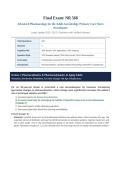
Final Exam: NR 568
Advanced Pharmacology for the Adult-Gerontology Primary Care Nurse
Practitioner
Latest Update | Questions with Verified Answers
Total Questions 100
Sections 9
Cognitive Mix 30% Recall | 50% Application | 20% Analysis
Question Style 70% Scenario-based | 20% Direct recall | 10% Clinical analysis
Curriculum Chamberlain University NR 568 (2026-2027)
Frameworks Pharmacokinetics | Evidence-Based Prescribing | AGPCNP Competencies
Section 1: Pharmacokinetics & Pharmacodynamics in Aging Adults
Absorption, Distribution, Metabolism, Excretion Changes with Age; Polypharmacy
Q1: An 82-year-old female is prescribed a new benzodiazepine for insomnia. Considering
age-related changes in pharmacokinetics, which change most significantly increases this patient's
risk of prolonged sedation and falls?
A. Increased gastric pH slowing drug absorption
B. Increased total body fat prolonging the half-life of lipophilic drugs such as benzodiazepines
[CORRECT]
C. Decreased gastric motility delaying peak effect
D. Decreased splanchnic blood flow reducing bioavailability
Correct Answer: B
Rationale: Lipophilic drugs such as benzodiazepines distribute into adipose tissue, which increases with age. The
expanded volume of distribution prolongs the half-life and produces cumulative sedation, cognitive impairment, and
falls in older adults. This is why benzodiazepines appear on the Beers Criteria as medications to avoid in older
adults. Absorption changes (A, C, D) are clinically minor for most drugs and do not explain the prolonged sedation.
,Q2: A 78-year-old male with chronic kidney disease (eGFR 35 mL/min) is being started on a renally
cleared medication. Which age-related pharmacokinetic change is most important to consider when
determining the dose?
A. Increased hepatic CYP450 enzyme activity
B. Decreased glomerular filtration rate leading to drug accumulation and the need for dose
adjustment [CORRECT]
C. Increased serum albumin increasing free drug levels
D. Increased GI motility decreasing absorption
Correct Answer: B
Rationale: Aging is associated with a decline in GFR and renal blood flow, which reduces the clearance of renally
eliminated drugs and increases the risk of accumulation and toxicity. Dose adjustment based on estimated GFR or
creatinine clearance is essential for drugs such as gabapentin, digoxin, vancomycin, and penicillins. CYP450
activity (A) declines rather than increases, serum albumin decreases (C), and GI motility decreases (D).
Q3: An 85-year-old patient is taking phenytoin for seizure control. The patient has a serum albumin
of 2.4 g/dL (normal 3.5-5.0). How does this finding affect the interpretation of the phenytoin level and
dosing?
A. Total phenytoin levels will appear elevated, requiring a dose reduction
B. Total phenytoin levels will appear falsely low due to decreased protein binding; the free (active)
phenytoin level should be checked to guide therapy [CORRECT]
C. Albumin levels do not affect phenytoin binding or dosing
D. Phenytoin should be discontinued and switched to levetiracetam
Correct Answer: B
Rationale: Phenytoin is highly protein-bound. With hypoalbuminemia (common in older adults and those with
malnutrition or chronic disease), more free (active) drug circulates. The total phenytoin level will appear falsely low
relative to the free (active) drug, so the free phenytoin level should guide therapy. Using total levels without
correction can lead to inappropriate dose escalation and toxicity. The patient does not necessarily need to change
medications (D).
Q4: A 76-year-old female is prescribed amitriptyline for chronic pain. According to the Beers
Criteria, which adverse effect is of greatest concern in this patient?
A. Gastrointestinal upset
B. Anticholinergic effects including confusion, dry mouth, urinary retention, and constipation, which
are particularly hazardous in older adults [CORRECT]
C. Hepatotoxicity
D. Hypertension
Correct Answer: B
Rationale: Amitriptyline is a tertiary tricyclic antidepressant with strong anticholinergic properties. In older adults,
anticholinergic effects increase the risk of confusion, delirium, falls, urinary retention, and constipation, leading the
Beers Criteria to recommend avoiding this medication in older adults. A safer alternative such as gabapentin,
duloxetine, or topical lidocaine should be considered. The other options are not the primary Beers concern.
,Q5: A 79-year-old male is taking warfarin 5 mg daily for atrial fibrillation. He is newly prescribed
sulfamethoxazole-trimethoprim for a urinary tract infection. What is the most important
consideration regarding this combination?
A. Sulfonamides increase warfarin metabolism and reduce INR
B. Sulfamethoxazole displaces warfarin from protein-binding sites and inhibits CYP2C9,
significantly increasing INR and bleeding risk; an alternative antibiotic should be chosen
[CORRECT]
C. Sulfonamides have no significant interaction with warfarin
D. The combination increases the risk of QT prolongation only
Correct Answer: B
Rationale: Sulfamethoxazole displaces warfarin from serum albumin and inhibits its metabolism by CYP2C9, both
of which markedly elevate the INR and increase bleeding risk. This is one of the most clinically significant drug
interactions in primary care. A safer antibiotic alternative (such as nitrofurantoin or fosfomycin for cystitis, or
cephalexin when appropriate) should be selected, and the INR should be monitored closely if the combination
cannot be avoided.
Q6: According to the START/STOPP criteria, which of the following prescribing decisions is most
appropriate for a frail 88-year-old patient with multiple comorbidities?
A. Continue a first-generation antihistamine for chronic insomnia
B. Stop long-term benzodiazepine use and initiate non-pharmacologic sleep interventions or, if
needed, a low-dose melatonin receptor agonist [CORRECT]
C. Continue oxybutynin for overactive bladder due to its proven efficacy
D. Prescribe a long-acting sulfonylurea for type 2 diabetes
Correct Answer: B
Rationale: The STOPP criteria identify potentially inappropriate medications in older adults. Long-term
benzodiazepines increase fall, fracture, and cognitive impairment risk and should be discontinued with slow taper.
First-generation antiholinergic antihistamines (A) and oxybutynin (C) are on the Beers/STOPP lists due to
anticholinergic burden, and long-acting sulfonylureas (D) such as glyburide cause prolonged hypoglycemia.
Q7: A 73-year-old female is started on lisinopril 10 mg daily for hypertension. Three days later, she
presents with swelling of the lips and tongue. Which age-related or patient-specific factor most
likely contributed to this adverse effect?
A. Decreased hepatic metabolism of lisinopril
B. ACE inhibitor-induced angioedema, which is more common in Black patients and may occur at
any time during therapy [CORRECT]
C. Decreased gastric pH enhancing absorption
D. Increased serum albumin reducing free drug
Correct Answer: B
Rationale: Angioedema is a known adverse effect of ACE inhibitors, occurring more frequently in Black patients
and those with a history of drug rash. It can occur at any time during therapy, including shortly after initiation. The
medication should be discontinued immediately, the airway assessed, and the patient switched to an alternative
such as an angiotensin receptor blocker (ARB), with caution. The other options do not explain angioedema.
, Q8: An 80-year-old patient with heart failure with reduced ejection fraction (HFrEF) is taking
furosemide, lisinopril, and metoprolol. Which laboratory value should the AGPCNP monitor most
closely in the first 1-2 weeks after initiation or dose change of the ACE inhibitor?
A. Hemoglobin A1c
B. Serum potassium and creatinine, because ACE inhibitors can cause hyperkalemia and a
reversible decrease in GFR [CORRECT]
C. Liver function tests
D. Thyroid-stimulating hormone
Correct Answer: B
Rationale: ACE inhibitors inhibit angiotensin II, reducing aldosterone secretion and potassium excretion, which
can cause hyperkalemia. They also reduce intraglomerular pressure via efferent arteriole dilation, causing a
reversible rise in serum creatinine. Serum potassium and creatinine should be checked within 1-2 weeks of
initiation or dose change. A small creatinine increase (less than 30% from baseline) is acceptable. The other tests
are not the priority.
Q9: A 75-year-old patient with type 2 diabetes (eGFR 40 mL/min) is currently taking glyburide for
glucose control. The AGPCNP recognizes that this medication is potentially inappropriate. What is
the best action according to the Beers Criteria?
A. Continue glyburide and recheck the A1c in 3 months
B. Switch to a shorter-acting agent such as glipizide, or to a medication with low hypoglycemia risk
such as a DPP-4 inhibitor or GLP-1 receptor agonist, due to the prolonged hypoglycemia risk of
glyburide in older adults and renal impairment [CORRECT]
C. Increase the glyburide dose to achieve better control
D. Discontinue all diabetes medications
Correct Answer: B
Rationale: Glyburide is a long-acting sulfonylurea on the Beers Criteria due to its prolonged half-life in older adults
and risk of severe and prolonged hypoglycemia, particularly with renal impairment. Safer alternatives include
glipizide (shorter-acting), DPP-4 inhibitors, or GLP-1 receptor agonists. Continuing or increasing glyburide (A, C)
increases hypoglycemia risk, and discontinuing all diabetes medications (D) abandons treatment.
Q10: Polypharmacy is a major concern in older adults. Which of the following best describes a
strategy the AGPCNP can use to reduce polypharmacy and adverse drug events in this population?
A. Add a new medication to manage each new symptom as it arises
B. Conduct a comprehensive medication review at each visit, using tools such as the Beers Criteria
and START/STOPP, and discontinue medications that are no longer indicated or are causing
adverse effects [CORRECT]
C. Recommend that the patient take all over-the-counter supplements to maintain health
D. Avoid discussing medications with the patient to prevent confusion
Correct Answer: B
Rationale: A comprehensive medication review at each visit, including prescription, OTC, and herbal products, is
the cornerstone of deprescribing in older adults. Tools such as the Beers Criteria and START/STOPP identify
potentially inappropriate medications. Each medication should have a clear indication, and the AGPCNP should
consider whether benefits outweigh risks. The other options increase risk rather than reducing it.
Advanced Pharmacology for the Adult-Gerontology Primary Care Nurse
Practitioner
Latest Update | Questions with Verified Answers
Total Questions 100
Sections 9
Cognitive Mix 30% Recall | 50% Application | 20% Analysis
Question Style 70% Scenario-based | 20% Direct recall | 10% Clinical analysis
Curriculum Chamberlain University NR 568 (2026-2027)
Frameworks Pharmacokinetics | Evidence-Based Prescribing | AGPCNP Competencies
Section 1: Pharmacokinetics & Pharmacodynamics in Aging Adults
Absorption, Distribution, Metabolism, Excretion Changes with Age; Polypharmacy
Q1: An 82-year-old female is prescribed a new benzodiazepine for insomnia. Considering
age-related changes in pharmacokinetics, which change most significantly increases this patient's
risk of prolonged sedation and falls?
A. Increased gastric pH slowing drug absorption
B. Increased total body fat prolonging the half-life of lipophilic drugs such as benzodiazepines
[CORRECT]
C. Decreased gastric motility delaying peak effect
D. Decreased splanchnic blood flow reducing bioavailability
Correct Answer: B
Rationale: Lipophilic drugs such as benzodiazepines distribute into adipose tissue, which increases with age. The
expanded volume of distribution prolongs the half-life and produces cumulative sedation, cognitive impairment, and
falls in older adults. This is why benzodiazepines appear on the Beers Criteria as medications to avoid in older
adults. Absorption changes (A, C, D) are clinically minor for most drugs and do not explain the prolonged sedation.
,Q2: A 78-year-old male with chronic kidney disease (eGFR 35 mL/min) is being started on a renally
cleared medication. Which age-related pharmacokinetic change is most important to consider when
determining the dose?
A. Increased hepatic CYP450 enzyme activity
B. Decreased glomerular filtration rate leading to drug accumulation and the need for dose
adjustment [CORRECT]
C. Increased serum albumin increasing free drug levels
D. Increased GI motility decreasing absorption
Correct Answer: B
Rationale: Aging is associated with a decline in GFR and renal blood flow, which reduces the clearance of renally
eliminated drugs and increases the risk of accumulation and toxicity. Dose adjustment based on estimated GFR or
creatinine clearance is essential for drugs such as gabapentin, digoxin, vancomycin, and penicillins. CYP450
activity (A) declines rather than increases, serum albumin decreases (C), and GI motility decreases (D).
Q3: An 85-year-old patient is taking phenytoin for seizure control. The patient has a serum albumin
of 2.4 g/dL (normal 3.5-5.0). How does this finding affect the interpretation of the phenytoin level and
dosing?
A. Total phenytoin levels will appear elevated, requiring a dose reduction
B. Total phenytoin levels will appear falsely low due to decreased protein binding; the free (active)
phenytoin level should be checked to guide therapy [CORRECT]
C. Albumin levels do not affect phenytoin binding or dosing
D. Phenytoin should be discontinued and switched to levetiracetam
Correct Answer: B
Rationale: Phenytoin is highly protein-bound. With hypoalbuminemia (common in older adults and those with
malnutrition or chronic disease), more free (active) drug circulates. The total phenytoin level will appear falsely low
relative to the free (active) drug, so the free phenytoin level should guide therapy. Using total levels without
correction can lead to inappropriate dose escalation and toxicity. The patient does not necessarily need to change
medications (D).
Q4: A 76-year-old female is prescribed amitriptyline for chronic pain. According to the Beers
Criteria, which adverse effect is of greatest concern in this patient?
A. Gastrointestinal upset
B. Anticholinergic effects including confusion, dry mouth, urinary retention, and constipation, which
are particularly hazardous in older adults [CORRECT]
C. Hepatotoxicity
D. Hypertension
Correct Answer: B
Rationale: Amitriptyline is a tertiary tricyclic antidepressant with strong anticholinergic properties. In older adults,
anticholinergic effects increase the risk of confusion, delirium, falls, urinary retention, and constipation, leading the
Beers Criteria to recommend avoiding this medication in older adults. A safer alternative such as gabapentin,
duloxetine, or topical lidocaine should be considered. The other options are not the primary Beers concern.
,Q5: A 79-year-old male is taking warfarin 5 mg daily for atrial fibrillation. He is newly prescribed
sulfamethoxazole-trimethoprim for a urinary tract infection. What is the most important
consideration regarding this combination?
A. Sulfonamides increase warfarin metabolism and reduce INR
B. Sulfamethoxazole displaces warfarin from protein-binding sites and inhibits CYP2C9,
significantly increasing INR and bleeding risk; an alternative antibiotic should be chosen
[CORRECT]
C. Sulfonamides have no significant interaction with warfarin
D. The combination increases the risk of QT prolongation only
Correct Answer: B
Rationale: Sulfamethoxazole displaces warfarin from serum albumin and inhibits its metabolism by CYP2C9, both
of which markedly elevate the INR and increase bleeding risk. This is one of the most clinically significant drug
interactions in primary care. A safer antibiotic alternative (such as nitrofurantoin or fosfomycin for cystitis, or
cephalexin when appropriate) should be selected, and the INR should be monitored closely if the combination
cannot be avoided.
Q6: According to the START/STOPP criteria, which of the following prescribing decisions is most
appropriate for a frail 88-year-old patient with multiple comorbidities?
A. Continue a first-generation antihistamine for chronic insomnia
B. Stop long-term benzodiazepine use and initiate non-pharmacologic sleep interventions or, if
needed, a low-dose melatonin receptor agonist [CORRECT]
C. Continue oxybutynin for overactive bladder due to its proven efficacy
D. Prescribe a long-acting sulfonylurea for type 2 diabetes
Correct Answer: B
Rationale: The STOPP criteria identify potentially inappropriate medications in older adults. Long-term
benzodiazepines increase fall, fracture, and cognitive impairment risk and should be discontinued with slow taper.
First-generation antiholinergic antihistamines (A) and oxybutynin (C) are on the Beers/STOPP lists due to
anticholinergic burden, and long-acting sulfonylureas (D) such as glyburide cause prolonged hypoglycemia.
Q7: A 73-year-old female is started on lisinopril 10 mg daily for hypertension. Three days later, she
presents with swelling of the lips and tongue. Which age-related or patient-specific factor most
likely contributed to this adverse effect?
A. Decreased hepatic metabolism of lisinopril
B. ACE inhibitor-induced angioedema, which is more common in Black patients and may occur at
any time during therapy [CORRECT]
C. Decreased gastric pH enhancing absorption
D. Increased serum albumin reducing free drug
Correct Answer: B
Rationale: Angioedema is a known adverse effect of ACE inhibitors, occurring more frequently in Black patients
and those with a history of drug rash. It can occur at any time during therapy, including shortly after initiation. The
medication should be discontinued immediately, the airway assessed, and the patient switched to an alternative
such as an angiotensin receptor blocker (ARB), with caution. The other options do not explain angioedema.
, Q8: An 80-year-old patient with heart failure with reduced ejection fraction (HFrEF) is taking
furosemide, lisinopril, and metoprolol. Which laboratory value should the AGPCNP monitor most
closely in the first 1-2 weeks after initiation or dose change of the ACE inhibitor?
A. Hemoglobin A1c
B. Serum potassium and creatinine, because ACE inhibitors can cause hyperkalemia and a
reversible decrease in GFR [CORRECT]
C. Liver function tests
D. Thyroid-stimulating hormone
Correct Answer: B
Rationale: ACE inhibitors inhibit angiotensin II, reducing aldosterone secretion and potassium excretion, which
can cause hyperkalemia. They also reduce intraglomerular pressure via efferent arteriole dilation, causing a
reversible rise in serum creatinine. Serum potassium and creatinine should be checked within 1-2 weeks of
initiation or dose change. A small creatinine increase (less than 30% from baseline) is acceptable. The other tests
are not the priority.
Q9: A 75-year-old patient with type 2 diabetes (eGFR 40 mL/min) is currently taking glyburide for
glucose control. The AGPCNP recognizes that this medication is potentially inappropriate. What is
the best action according to the Beers Criteria?
A. Continue glyburide and recheck the A1c in 3 months
B. Switch to a shorter-acting agent such as glipizide, or to a medication with low hypoglycemia risk
such as a DPP-4 inhibitor or GLP-1 receptor agonist, due to the prolonged hypoglycemia risk of
glyburide in older adults and renal impairment [CORRECT]
C. Increase the glyburide dose to achieve better control
D. Discontinue all diabetes medications
Correct Answer: B
Rationale: Glyburide is a long-acting sulfonylurea on the Beers Criteria due to its prolonged half-life in older adults
and risk of severe and prolonged hypoglycemia, particularly with renal impairment. Safer alternatives include
glipizide (shorter-acting), DPP-4 inhibitors, or GLP-1 receptor agonists. Continuing or increasing glyburide (A, C)
increases hypoglycemia risk, and discontinuing all diabetes medications (D) abandons treatment.
Q10: Polypharmacy is a major concern in older adults. Which of the following best describes a
strategy the AGPCNP can use to reduce polypharmacy and adverse drug events in this population?
A. Add a new medication to manage each new symptom as it arises
B. Conduct a comprehensive medication review at each visit, using tools such as the Beers Criteria
and START/STOPP, and discontinue medications that are no longer indicated or are causing
adverse effects [CORRECT]
C. Recommend that the patient take all over-the-counter supplements to maintain health
D. Avoid discussing medications with the patient to prevent confusion
Correct Answer: B
Rationale: A comprehensive medication review at each visit, including prescription, OTC, and herbal products, is
the cornerstone of deprescribing in older adults. Tools such as the Beers Criteria and START/STOPP identify
potentially inappropriate medications. Each medication should have a clear indication, and the AGPCNP should
consider whether benefits outweigh risks. The other options increase risk rather than reducing it.

