

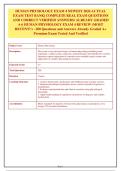
HUMAN PHYSIOLOGY EXAM 4 NEWEST 2026 ACTUAL
EXAM TEST BANK| COMPLETE REAL EXAM QUESTIONS
AND CORRECT VERIFIED ANSWERS/ ALREADY GRADED
A+| HUMAN PHYSIOLOGY EXAM 4 REVIEW (MOST
RECENT!!) - 200 Questions and Answers Already Graded A+
Premium Exam Tested And Verified
Subject Area Human Physiology
Description This exam covers advanced topics in human physiology including renal,
respiratory, cardiovascular, endocrine, gastrointestinal, and reproductive systems.
Questions require integration of concepts across multiple organ systems and
application to complex physiological scenarios.
Expected Grade A+
Total Questions 200
Duration 3 hours
Learning Outcomes 1. Analyze homeostatic mechanisms and feedback loops in organ systems
2. Integrate physiological principles across systems to predict responses to
perturbations
3. Evaluate experimental data and clinical scenarios using physiological
knowledge
4. Apply understanding of regulatory mechanisms to diagnose and explain
dysfunctions
Accreditation Meets standards for rigorous US university physiology examinations at Ivy
League / R1 research institutions.
Page 1
,1. In a person with untreated type 1 diabetes mellitus, which of the following best
explains the observed hyperkalemia?
A. Increased aldosterone secretion due to hyperglycemia
B. Decreased Na+/K+ ATPase activity in skeletal muscle due to insulin deficiency
C. Increased potassium reabsorption in the distal tubule due to high aldosterone
D. Shift of potassium into cells due to metabolic acidosis
Answer: B. Decreased Na+/K+ ATPase activity in skeletal muscle due to insulin
deficiency
Insulin stimulates Na+/K+ ATPase, promoting potassium uptake into cells. In insulin
deficiency, this uptake is reduced, leading to extracellular potassium accumulation
(hyperkalemia). Aldosterone is suppressed by hyperkalemia, not increased. Metabolic
acidosis in diabetes is due to ketoacids, but acidosis typically shifts potassium out of
cells, not in.
2. A 30-year-old individual on a high-protein diet has a glomerular filtration rate
(GFR) of 125 mL/min and a urine flow rate of 1.5 mL/min. The plasma urea
concentration is 5 mmol/L, and urine urea concentration is 350 mmol/L. What is the
renal clearance of urea?
A. 105 mL/min
B. 125 mL/min
C. 175 mL/min
D. 140 mL/min
Answer: A. 105 mL/min
Renal clearance = (urine concentration × urine flow rate) / plasma concentration = (350
mmol/L × 1.5 mL/min) / 5 mmol/L = 105 mL/min. This is less than GFR, indicating net
urea reabsorption.
Page 2
,3. Which of the following best explains why the partial pressure of oxygen in alveolar
air (PAO2) is lower than in inspired air (PIO2) under normal conditions?
A. Oxygen diffuses into pulmonary capillaries and is removed by blood
B. Carbon dioxide diffuses into alveoli, displacing oxygen
C. Water vapor and carbon dioxide dilute alveolar oxygen
D. Oxygen is consumed by alveolar epithelial cells
Answer: C. Water vapor and carbon dioxide dilute alveolar oxygen
Inspired air is humidified and mixed with alveolar gas containing CO2. Water vapor
and CO2 add partial pressures, reducing the fraction of O2. PAO2 = PIO2 -
(PaCO2/RQ) accounting for dilution, not just removal by blood.
4. During the plateau phase of a ventricular action potential, the prolonged influx of
calcium ions primarily serves which function?
A. Triggering rapid repolarization
B. Maintaining the absolute refractory period to prevent tetanus
C. Activating contraction of cardiac muscle
D. Reducing the duration of the action potential
Answer: C. Activating contraction of cardiac muscle
Calcium influx during the plateau phase triggers calcium-induced calcium release from
the sarcoplasmic reticulum, leading to contraction. The plateau also prolongs the
refractory period, but its primary role is excitation-contraction coupling.
5. A patient has a pH of 7.25, PaCO2 of 60 mm Hg, and HCO3- of 26 mEq/L. Which
acid-base disorder is present?
A. Metabolic acidosis with full respiratory compensation
B. Respiratory acidosis with no metabolic compensation
C. Respiratory acidosis with partial metabolic compensation
D. Mixed respiratory and metabolic acidosis
Answer: C. Respiratory acidosis with partial metabolic compensation
Low pH and high PaCO2 indicate respiratory acidosis. HCO3- is slightly elevated
(normal 24), suggesting metabolic compensation (renal retention of HCO3-). Since
HCO3- is not low, metabolic acidosis is absent. Compensation is partial because pH is
still acidic.
Page 3
, 6. A substance has a renal clearance of 140 mL/min and a plasma concentration of 2
mg/dL. If the urine flow rate is 2 mL/min, what is the urine concentration of the
substance?
A. 70 mg/dL
B. 140 mg/dL
C. 280 mg/dL
D. 560 mg/dL
Answer: B. 140 mg/dL
Clearance = (U × V) / P => U = (Clearance × P) / V = (140 mL/min × 2 mg/dL) / 2
mL/min = 140 mg/dL.
7. In the gastrointestinal tract, which of the following is the primary stimulus for the
release of cholecystokinin (CCK)?
A. Distension of the stomach
B. Presence of fatty acids and amino acids in the duodenum
C. Acidic chyme in the duodenum
D. Vagal stimulation
Answer: B. Presence of fatty acids and amino acids in the duodenum
CCK is released from I cells in the duodenum primarily in response to digestion
products of fat and protein (fatty acids, monoglycerides, amino acids). Acid stimulates
secretin, not CCK. Vagal stimulation potentiates but is not primary.
8. Which of the following best describes the effect of atrial natriuretic peptide (ANP)
on the kidneys?
A. Increases sodium reabsorption in the distal tubule
B. Constricts afferent arterioles to reduce GFR
C. Inhibits sodium reabsorption in the collecting duct
D. Stimulates renin release from juxtaglomerular cells
Answer: C. Inhibits sodium reabsorption in the collecting duct
ANP binds to receptors in the collecting duct, inhibiting ENaC and reducing sodium
reabsorption, leading to natriuresis. It also dilates afferent arterioles and constricts
efferent, increasing GFR. ANP inhibits renin and aldosterone.
Page 4
EXAM TEST BANK| COMPLETE REAL EXAM QUESTIONS
AND CORRECT VERIFIED ANSWERS/ ALREADY GRADED
A+| HUMAN PHYSIOLOGY EXAM 4 REVIEW (MOST
RECENT!!) - 200 Questions and Answers Already Graded A+
Premium Exam Tested And Verified
Subject Area Human Physiology
Description This exam covers advanced topics in human physiology including renal,
respiratory, cardiovascular, endocrine, gastrointestinal, and reproductive systems.
Questions require integration of concepts across multiple organ systems and
application to complex physiological scenarios.
Expected Grade A+
Total Questions 200
Duration 3 hours
Learning Outcomes 1. Analyze homeostatic mechanisms and feedback loops in organ systems
2. Integrate physiological principles across systems to predict responses to
perturbations
3. Evaluate experimental data and clinical scenarios using physiological
knowledge
4. Apply understanding of regulatory mechanisms to diagnose and explain
dysfunctions
Accreditation Meets standards for rigorous US university physiology examinations at Ivy
League / R1 research institutions.
Page 1
,1. In a person with untreated type 1 diabetes mellitus, which of the following best
explains the observed hyperkalemia?
A. Increased aldosterone secretion due to hyperglycemia
B. Decreased Na+/K+ ATPase activity in skeletal muscle due to insulin deficiency
C. Increased potassium reabsorption in the distal tubule due to high aldosterone
D. Shift of potassium into cells due to metabolic acidosis
Answer: B. Decreased Na+/K+ ATPase activity in skeletal muscle due to insulin
deficiency
Insulin stimulates Na+/K+ ATPase, promoting potassium uptake into cells. In insulin
deficiency, this uptake is reduced, leading to extracellular potassium accumulation
(hyperkalemia). Aldosterone is suppressed by hyperkalemia, not increased. Metabolic
acidosis in diabetes is due to ketoacids, but acidosis typically shifts potassium out of
cells, not in.
2. A 30-year-old individual on a high-protein diet has a glomerular filtration rate
(GFR) of 125 mL/min and a urine flow rate of 1.5 mL/min. The plasma urea
concentration is 5 mmol/L, and urine urea concentration is 350 mmol/L. What is the
renal clearance of urea?
A. 105 mL/min
B. 125 mL/min
C. 175 mL/min
D. 140 mL/min
Answer: A. 105 mL/min
Renal clearance = (urine concentration × urine flow rate) / plasma concentration = (350
mmol/L × 1.5 mL/min) / 5 mmol/L = 105 mL/min. This is less than GFR, indicating net
urea reabsorption.
Page 2
,3. Which of the following best explains why the partial pressure of oxygen in alveolar
air (PAO2) is lower than in inspired air (PIO2) under normal conditions?
A. Oxygen diffuses into pulmonary capillaries and is removed by blood
B. Carbon dioxide diffuses into alveoli, displacing oxygen
C. Water vapor and carbon dioxide dilute alveolar oxygen
D. Oxygen is consumed by alveolar epithelial cells
Answer: C. Water vapor and carbon dioxide dilute alveolar oxygen
Inspired air is humidified and mixed with alveolar gas containing CO2. Water vapor
and CO2 add partial pressures, reducing the fraction of O2. PAO2 = PIO2 -
(PaCO2/RQ) accounting for dilution, not just removal by blood.
4. During the plateau phase of a ventricular action potential, the prolonged influx of
calcium ions primarily serves which function?
A. Triggering rapid repolarization
B. Maintaining the absolute refractory period to prevent tetanus
C. Activating contraction of cardiac muscle
D. Reducing the duration of the action potential
Answer: C. Activating contraction of cardiac muscle
Calcium influx during the plateau phase triggers calcium-induced calcium release from
the sarcoplasmic reticulum, leading to contraction. The plateau also prolongs the
refractory period, but its primary role is excitation-contraction coupling.
5. A patient has a pH of 7.25, PaCO2 of 60 mm Hg, and HCO3- of 26 mEq/L. Which
acid-base disorder is present?
A. Metabolic acidosis with full respiratory compensation
B. Respiratory acidosis with no metabolic compensation
C. Respiratory acidosis with partial metabolic compensation
D. Mixed respiratory and metabolic acidosis
Answer: C. Respiratory acidosis with partial metabolic compensation
Low pH and high PaCO2 indicate respiratory acidosis. HCO3- is slightly elevated
(normal 24), suggesting metabolic compensation (renal retention of HCO3-). Since
HCO3- is not low, metabolic acidosis is absent. Compensation is partial because pH is
still acidic.
Page 3
, 6. A substance has a renal clearance of 140 mL/min and a plasma concentration of 2
mg/dL. If the urine flow rate is 2 mL/min, what is the urine concentration of the
substance?
A. 70 mg/dL
B. 140 mg/dL
C. 280 mg/dL
D. 560 mg/dL
Answer: B. 140 mg/dL
Clearance = (U × V) / P => U = (Clearance × P) / V = (140 mL/min × 2 mg/dL) / 2
mL/min = 140 mg/dL.
7. In the gastrointestinal tract, which of the following is the primary stimulus for the
release of cholecystokinin (CCK)?
A. Distension of the stomach
B. Presence of fatty acids and amino acids in the duodenum
C. Acidic chyme in the duodenum
D. Vagal stimulation
Answer: B. Presence of fatty acids and amino acids in the duodenum
CCK is released from I cells in the duodenum primarily in response to digestion
products of fat and protein (fatty acids, monoglycerides, amino acids). Acid stimulates
secretin, not CCK. Vagal stimulation potentiates but is not primary.
8. Which of the following best describes the effect of atrial natriuretic peptide (ANP)
on the kidneys?
A. Increases sodium reabsorption in the distal tubule
B. Constricts afferent arterioles to reduce GFR
C. Inhibits sodium reabsorption in the collecting duct
D. Stimulates renin release from juxtaglomerular cells
Answer: C. Inhibits sodium reabsorption in the collecting duct
ANP binds to receptors in the collecting duct, inhibiting ENaC and reducing sodium
reabsorption, leading to natriuresis. It also dilates afferent arterioles and constricts
efferent, increasing GFR. ANP inhibits renin and aldosterone.
Page 4

