

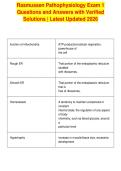
Rasmussen Pathophysiology Exam 1
Questions and Answers with Verified
Solutions | Latest Updated 2026
function of mitochondria ATP production/cellular respiration,
powerhouse of
the cell
Rough ER That portion of the endoplasmic reticulum
studded
with ribosomes.
Smooth ER That portion of the endoplasmic reticulum
that is
free of ribosomes.
Homeostasis A tendency to maintain a balanced or
constant
internal state; the regulation of any aspect
of body
chemistry, such as blood glucose, around
a
particular level
Hypertrophy increase in muscle/tissue size, excessive
development
,atrophy the wasting away of a body organ or
tissue; any
progressive decline or failure; to waste
away
Ischemia an inadequate blood supply to an organ or
part of
the body, especially the heart muscles.
S/S of Objective Data Any observations made by using your
senses (pts.
blood pressure, physical findings, and lab
values)
S/S of Subjective Data Any symptoms pt. complains of, what the
pt. feels
(pain)
Epinephrine Neurotransmitter secreted by the adrenal
medulla
in response to stress. Also known as
adrenaline.
Renin hormone secreted by the kidney; it raises
blood
pressure by influencing vasoconstriction
(narrowing of blood vessels)
What causes edema? -reduced concentration of plasma proteins
-increased permeability of capillary wall
-increased venous pressure
-blockage of lymph vessels
, Signs and symptoms of fluid edema, dysnpea (trouble breathing),
excess hyptertension
(high bp), JVD, pulse increase and
bounding,
weight increase
Signs and symptoms of Dry mucous membranes, decreased skin
dehydration turgor,
Low BP, Low pulse, fatigue, Increased
HCT,
decreased mental function, confusion, and
loss of
consciousness
S/S of hypocalcemia - muscle twitches/tetany
- hyperactive DTRs
- positive Chvostek's sign (tapping on the
facial
nerve triggering facial twitching)
- positive Trousseau's sign (hand/finger
spasms with
sustained blood pressure cuff inflation)
- seizures
Osmosis Diffusion of water through a selectively
permeable
membrane
Diffusion Movement of molecules from an area of
higher
concentration to an area of lower
concentration.
Questions and Answers with Verified
Solutions | Latest Updated 2026
function of mitochondria ATP production/cellular respiration,
powerhouse of
the cell
Rough ER That portion of the endoplasmic reticulum
studded
with ribosomes.
Smooth ER That portion of the endoplasmic reticulum
that is
free of ribosomes.
Homeostasis A tendency to maintain a balanced or
constant
internal state; the regulation of any aspect
of body
chemistry, such as blood glucose, around
a
particular level
Hypertrophy increase in muscle/tissue size, excessive
development
,atrophy the wasting away of a body organ or
tissue; any
progressive decline or failure; to waste
away
Ischemia an inadequate blood supply to an organ or
part of
the body, especially the heart muscles.
S/S of Objective Data Any observations made by using your
senses (pts.
blood pressure, physical findings, and lab
values)
S/S of Subjective Data Any symptoms pt. complains of, what the
pt. feels
(pain)
Epinephrine Neurotransmitter secreted by the adrenal
medulla
in response to stress. Also known as
adrenaline.
Renin hormone secreted by the kidney; it raises
blood
pressure by influencing vasoconstriction
(narrowing of blood vessels)
What causes edema? -reduced concentration of plasma proteins
-increased permeability of capillary wall
-increased venous pressure
-blockage of lymph vessels
, Signs and symptoms of fluid edema, dysnpea (trouble breathing),
excess hyptertension
(high bp), JVD, pulse increase and
bounding,
weight increase
Signs and symptoms of Dry mucous membranes, decreased skin
dehydration turgor,
Low BP, Low pulse, fatigue, Increased
HCT,
decreased mental function, confusion, and
loss of
consciousness
S/S of hypocalcemia - muscle twitches/tetany
- hyperactive DTRs
- positive Chvostek's sign (tapping on the
facial
nerve triggering facial twitching)
- positive Trousseau's sign (hand/finger
spasms with
sustained blood pressure cuff inflation)
- seizures
Osmosis Diffusion of water through a selectively
permeable
membrane
Diffusion Movement of molecules from an area of
higher
concentration to an area of lower
concentration.

