

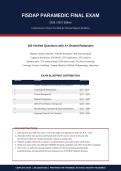
FISDAP PARAMEDIC FINAL EXAM
Edition
Comprehensive Clinical Test Bank for National Registry Readiness
300 Verified Questions with A+ Graded Rationales
Aligned with the 2026/2027 FISDAP Paramedic Final Exam blueprint
Cognitive distribution: 25% Recall | 55% Application | 20% Analysis
Question style: 75% scenario-based | 20% direct recall | 5% clinical reasoning
Coverage: Airway, Cardiology, Trauma, Medical, OB/Peds, Pharmacology, Operations
EXAM BLUEPRINT DISTRIBUTION
Section Domain Questions
1 Airway Management & Respiratory Emergencies Q1 - Q50
2 Cardiology & Resuscitation Q51 - Q110
3 Trauma Emergencies Q111 - Q150
4 Medical Emergencies Q151 - Q200
5 OB/GYN & Pediatric Emergencies Q201 - Q250
6 Pharmacology, Operations & Special Populations Q251 - Q280
7 Integrated Clinical Case Scenarios Q281 - Q300
EXAM INSTRUCTIONS
1. Each question has ONE best answer. Select the single most appropriate option (A, B, C, or D).
2. Rationales follow each question and explain both why the correct answer is best and why
the distractors represent common paramedic clinical reasoning errors.
3. Pediatric weights referenced in scenarios use the Broselow-Lube color system where noted.
4. Medication doses reflect the 2026/2027 NREMT Paramedic guidelines and AHA ACLS/PALS standards.
5. This exam is a study tool; passing requires synthesis of clinical reasoning, pharmacology,
pathophysiology, and operational decision-making across all FISDAP blueprint domains.
COMPLETE EXAM | 300 QUESTIONS | PREPARED FOR PARAMEDIC NATIONAL REGISTRY READINESS
,FISDAP PARAMEDIC FINAL EXAM | 2026/2027 Edition 300-Question Comprehensive Test Bank
SECTION 1: AIRWAY MANAGEMENT AND RESPIRATORY
EMERGENCIES
Questions Q1 - Q50 | Ventilation, oxygenation, airway adjuncts, RSI, ETCO2, pediatric airway, and respiratory
failure recognition.
Q1: A 34-year-old skier is rescued from 14,000 feet after rapid ascent over 2 days. She presents with
severe dyspnea, anxiety, frothy pink sputum, and rales in all lung fields. SpO2 is 72% on room air. Blood
pressure is 118/76, HR 122, RR 38. What is the DEFINITIVE prehospital treatment?
A. Apply CPAP at 10 cmH2O and transport to the nearest facility
B. Administer high-flow oxygen via non-rebreather mask and BEGIN IMMEDIATE DESCENT to lower
altitude [CORRECT]
C. Administer furosemide 40 mg IV and albuterol nebulized
D. Intubate orally and transport via rotor wing to a tertiary center
Correct Answer: B
Rationale: The patient has high-altitude pulmonary edema (HAPE), characterized by severe dyspnea, anxiety, rales in all
lung fields, and profound hypoxia following rapid ascent. The DEFINITIVE treatment is immediate descent combined with
high-flow oxygen; CPAP only temporarily improves oxygenation but does not address the underlying pathophysiology
(pulmonary vasoconstriction and capillary leak). Furosemide is not indicated prehospital, and intubation is reserved for
failure of oxygen/descent.
Q2: A paramedic is performing nasotracheal intubation on a conscious 52-year-old with impending
respiratory failure due to COPD exacerbation. The tube passes easily through the naris but meets
resistance at the glottic opening. At what point in the respiratory cycle should the paramedic advance the
tube through the glottis?
A. During end-exhalation when the vocal cords are fully abducted
B. During patient INSPIRATION when the vocal cords open maximally [CORRECT]
C. Immediately after a cough reflex is elicited
D. During breath-holding at peak inspiration
Correct Answer: B
Rationale: During inspiration, the vocal cords abduct (open) maximally to allow airflow into the trachea. Advancing the
endotracheal tube during the inspiratory phase exploits this natural anatomic opening, reducing trauma and improving the
likelihood of successful passage. Advancing during exhalation or coughing places the cords in adduction, increasing the
risk of arytenoid trauma and esophageal placement.
Q3: A 3-year-old boy presents at 2 AM with a barking cough, inspiratory stridor at rest, low-grade fever
(101°F), and mild respiratory distress. His mother reports the symptoms developed gradually over 24
hours. Lung sounds are clear bilaterally. What is the most likely diagnosis and appropriate treatment?
A. Epiglottitis; prepare for immediate intubation and administer IV ceftriaxone
B. Croup (laryngotracheobronchitis); administer humidified oxygen and nebulized racemic epinephrine
[CORRECT]
C. Bacterial tracheitis; administer nebulized racemic epinephrine and transport emergently
D. Foreign body aspiration; perform abdominal thrusts and transport
Aligned with FISDAP Readiness & NREMT Paramedic Blueprint Page 2
,FISDAP PARAMEDIC FINAL EXAM | 2026/2027 Edition 300-Question Comprehensive Test Bank
Correct Answer: B
Rationale: Croup (laryngotracheobronchitis) is caused by parainfluenza virus producing subglottic swelling, presenting
with barking cough, stridor, low-grade fever, and gradual onset in children 6 months to 6 years. Treatment is humidified
oxygen and nebulized racemic epinephrine (alpha-agonist vasoconstriction reduces edema). Epiglottitis presents with
sudden high fever, drooling, tripoding, and toxic appearance-intubation is indicated, not racemic epi.
Q4: An unresponsive 68-year-old male requires airway management. He has an intact gag reflex but no
cervical spine concern. Which airway adjunct is most appropriate for immediate placement?
A. Oropharyngeal airway (OPA) sized from corner of mouth to angle of jaw
B. Nasopharyngeal airway (NPA) lubricated and inserted into the right naris [CORRECT]
C. A size 3 LMA inserted using the standard technique
D. A Combitube inserted blindly through the mouth
Correct Answer: B
Rationale: An intact gag reflex is a contraindication to OPA placement because it will trigger vomiting and aspiration.
The NPA is the safest airway adjunct in a patient with intact gag reflex, lubricated and inserted bevel-first into the right
naris (which is typically larger and straighter). The LMA and Combitube require unconsciousness without gag reflex and
are not first-line adjuncts for this patient.
Q5: During transport of an intubated patient, you note the capnography waveform shows a steady
reading of 55 mmHg with a normal square waveform. The patient is being ventilated at 24 breaths/min.
What is the most appropriate intervention?
A. Increase the tidal volume to 800 mL per breath
B. REDUCE the ventilation rate to 10-12 breaths/min to maintain ETCO2 35-45 mmHg [CORRECT]
C. Administer sodium bicarbonate 1 mEq/kg IV
D. Suction the endotracheal tube to remove secretions
Correct Answer: B
Rationale: ETCO2 of 55 mmHg indicates hypercapnia from hypoventilation; the elevated rate of 24 bpm is insufficient in
tidal volume or masks underlying CO2 retention. The target ETCO2 is 35-45 mmHg; reducing rate to 10-12 breaths/min in
an adult (or per AHA 1 breath every 6 seconds in cardiac arrest) allows proper CO2 elimination and prevents auto-PEEP.
Increasing tidal volume risks barotrauma; NaHCO3 treats metabolic acidosis, not respiratory.
Q6: A 72-year-old female is in severe respiratory distress with a SpO2 of 84% on room air. She has a
history of congestive heart failure. Bilateral crackles are present to the apices, RR is 42, and she is
diaphoretic and unable to speak in full sentences. BP 210/115. What intervention will most rapidly
improve her oxygenation and reduce work of breathing?
A. Nebulized albuterol 2.5 mg
B. Nitroglycerin 0.4 mg sublingual
C. Continuous Positive Airway Pressure (CPAP) at 10 cmH2O with FiO2 100% [CORRECT]
D. Furosemide 40 mg IV push
Correct Answer: C
Rationale: CPAP provides continuous positive pressure throughout the respiratory cycle, splinting alveoli open, recruiting
collapsed alveoli, reducing preload and afterload, and pushing interstitial fluid out of alveoli. In cardiogenic pulmonary
edema with hypertension, CPAP is the most rapid intervention to improve oxygenation and reduce work of breathing.
Nitroglycerin and furosemide are adjuncts but work slower; albuterol is not indicated without wheezing.
Aligned with FISDAP Readiness & NREMT Paramedic Blueprint Page 3
, FISDAP PARAMEDIC FINAL EXAM | 2026/2027 Edition 300-Question Comprehensive Test Bank
Q7: You are preparing to perform rapid sequence intubation on a 45-year-old with severe head injury
and GCS of 6. Which induction agent is MOST appropriate given the concern for elevated intracranial
pressure?
A. Ketamine 2 mg/kg IV
B. Etomidate 0.3 mg/kg IV [CORRECT]
C. Midazolam 0.1 mg/kg IV
D. Propofol 2 mg/kg IV
Correct Answer: B
Rationale: Etomidate is the preferred induction agent in head-injured patients because it maintains hemodynamic stability
and decreases cerebral metabolic rate and intracranial pressure without causing hypotension. Ketamine has historically
been controversial for TBI due to theoretical ICP elevation, though recent evidence disputes this. Propofol and midazolam
both cause significant hypotension, which is detrimental in TBI where cerebral perfusion pressure must be maintained.
Q8: A 60-year-old male with a history of COPD is in moderate respiratory distress. His baseline SpO2 is
88-92% at home. He is currently breathing 28 times per minute with mild accessory muscle use. SpO2 is
86% on room air. What is the most appropriate oxygen therapy?
A. High-flow oxygen via non-rebreather at 15 L/min to achieve SpO2 of 99-100%
B. Nasal cannula at 2-4 L/min to maintain SpO2 between 88-92% [CORRECT]
C. Bag-valve-mask ventilation at 12 breaths/min
D. CPAP at 5 cmH2O with FiO2 100%
Correct Answer: B
Rationale: In COPD patients who are chronic CO2 retainers, the hypoxic drive is their primary respiratory stimulus.
Administering high-flow oxygen to achieve 99-100% saturation can abolish this hypoxic drive, leading to hypoventilation,
worsening hypercapnia, and CO2 narcosis. The target SpO2 for these patients is 88-92%, achieved with low-flow nasal
cannula. BVM is excessive for this presentation; CPAP is reserved for failure of low-flow O2.
Q9: A 19-year-old male is unconscious after a heroin overdose. RR is 6 and shallow, SpO2 84% on room
air. He has a faint gag reflex. What is the FIRST priority in managing his airway?
A. Immediately administer naloxone 0.4 mg IV
B. Insert a nasopharyngeal airway and ventilate with a bag-valve-mask [CORRECT]
C. Insert an oropharyngeal airway and suction the oropharynx
D. Perform rapid sequence intubation with etomidate and succinylcholine
Correct Answer: B
Rationale: Airway and ventilation ALWAYS come first. With a faint gag reflex, the OPA is contraindicated. The immediate
action is to insert an NPA and provide BVM ventilation to correct hypoxia. Naloxone can be administered once the airway
is secured and ventilation established. RSI is premature before attempting less invasive measures and before naloxone
trial.
Q10: A 56-year-old male is being ventilated via endotracheal tube. The capnography shows a waveform
that suddenly drops to near-zero with loss of chest rise. What is the MOST likely cause?
A. Endotracheal tube displacement into the esophagus [CORRECT]
B. Mucous plug in the endotracheal tube
Aligned with FISDAP Readiness & NREMT Paramedic Blueprint Page 4
Edition
Comprehensive Clinical Test Bank for National Registry Readiness
300 Verified Questions with A+ Graded Rationales
Aligned with the 2026/2027 FISDAP Paramedic Final Exam blueprint
Cognitive distribution: 25% Recall | 55% Application | 20% Analysis
Question style: 75% scenario-based | 20% direct recall | 5% clinical reasoning
Coverage: Airway, Cardiology, Trauma, Medical, OB/Peds, Pharmacology, Operations
EXAM BLUEPRINT DISTRIBUTION
Section Domain Questions
1 Airway Management & Respiratory Emergencies Q1 - Q50
2 Cardiology & Resuscitation Q51 - Q110
3 Trauma Emergencies Q111 - Q150
4 Medical Emergencies Q151 - Q200
5 OB/GYN & Pediatric Emergencies Q201 - Q250
6 Pharmacology, Operations & Special Populations Q251 - Q280
7 Integrated Clinical Case Scenarios Q281 - Q300
EXAM INSTRUCTIONS
1. Each question has ONE best answer. Select the single most appropriate option (A, B, C, or D).
2. Rationales follow each question and explain both why the correct answer is best and why
the distractors represent common paramedic clinical reasoning errors.
3. Pediatric weights referenced in scenarios use the Broselow-Lube color system where noted.
4. Medication doses reflect the 2026/2027 NREMT Paramedic guidelines and AHA ACLS/PALS standards.
5. This exam is a study tool; passing requires synthesis of clinical reasoning, pharmacology,
pathophysiology, and operational decision-making across all FISDAP blueprint domains.
COMPLETE EXAM | 300 QUESTIONS | PREPARED FOR PARAMEDIC NATIONAL REGISTRY READINESS
,FISDAP PARAMEDIC FINAL EXAM | 2026/2027 Edition 300-Question Comprehensive Test Bank
SECTION 1: AIRWAY MANAGEMENT AND RESPIRATORY
EMERGENCIES
Questions Q1 - Q50 | Ventilation, oxygenation, airway adjuncts, RSI, ETCO2, pediatric airway, and respiratory
failure recognition.
Q1: A 34-year-old skier is rescued from 14,000 feet after rapid ascent over 2 days. She presents with
severe dyspnea, anxiety, frothy pink sputum, and rales in all lung fields. SpO2 is 72% on room air. Blood
pressure is 118/76, HR 122, RR 38. What is the DEFINITIVE prehospital treatment?
A. Apply CPAP at 10 cmH2O and transport to the nearest facility
B. Administer high-flow oxygen via non-rebreather mask and BEGIN IMMEDIATE DESCENT to lower
altitude [CORRECT]
C. Administer furosemide 40 mg IV and albuterol nebulized
D. Intubate orally and transport via rotor wing to a tertiary center
Correct Answer: B
Rationale: The patient has high-altitude pulmonary edema (HAPE), characterized by severe dyspnea, anxiety, rales in all
lung fields, and profound hypoxia following rapid ascent. The DEFINITIVE treatment is immediate descent combined with
high-flow oxygen; CPAP only temporarily improves oxygenation but does not address the underlying pathophysiology
(pulmonary vasoconstriction and capillary leak). Furosemide is not indicated prehospital, and intubation is reserved for
failure of oxygen/descent.
Q2: A paramedic is performing nasotracheal intubation on a conscious 52-year-old with impending
respiratory failure due to COPD exacerbation. The tube passes easily through the naris but meets
resistance at the glottic opening. At what point in the respiratory cycle should the paramedic advance the
tube through the glottis?
A. During end-exhalation when the vocal cords are fully abducted
B. During patient INSPIRATION when the vocal cords open maximally [CORRECT]
C. Immediately after a cough reflex is elicited
D. During breath-holding at peak inspiration
Correct Answer: B
Rationale: During inspiration, the vocal cords abduct (open) maximally to allow airflow into the trachea. Advancing the
endotracheal tube during the inspiratory phase exploits this natural anatomic opening, reducing trauma and improving the
likelihood of successful passage. Advancing during exhalation or coughing places the cords in adduction, increasing the
risk of arytenoid trauma and esophageal placement.
Q3: A 3-year-old boy presents at 2 AM with a barking cough, inspiratory stridor at rest, low-grade fever
(101°F), and mild respiratory distress. His mother reports the symptoms developed gradually over 24
hours. Lung sounds are clear bilaterally. What is the most likely diagnosis and appropriate treatment?
A. Epiglottitis; prepare for immediate intubation and administer IV ceftriaxone
B. Croup (laryngotracheobronchitis); administer humidified oxygen and nebulized racemic epinephrine
[CORRECT]
C. Bacterial tracheitis; administer nebulized racemic epinephrine and transport emergently
D. Foreign body aspiration; perform abdominal thrusts and transport
Aligned with FISDAP Readiness & NREMT Paramedic Blueprint Page 2
,FISDAP PARAMEDIC FINAL EXAM | 2026/2027 Edition 300-Question Comprehensive Test Bank
Correct Answer: B
Rationale: Croup (laryngotracheobronchitis) is caused by parainfluenza virus producing subglottic swelling, presenting
with barking cough, stridor, low-grade fever, and gradual onset in children 6 months to 6 years. Treatment is humidified
oxygen and nebulized racemic epinephrine (alpha-agonist vasoconstriction reduces edema). Epiglottitis presents with
sudden high fever, drooling, tripoding, and toxic appearance-intubation is indicated, not racemic epi.
Q4: An unresponsive 68-year-old male requires airway management. He has an intact gag reflex but no
cervical spine concern. Which airway adjunct is most appropriate for immediate placement?
A. Oropharyngeal airway (OPA) sized from corner of mouth to angle of jaw
B. Nasopharyngeal airway (NPA) lubricated and inserted into the right naris [CORRECT]
C. A size 3 LMA inserted using the standard technique
D. A Combitube inserted blindly through the mouth
Correct Answer: B
Rationale: An intact gag reflex is a contraindication to OPA placement because it will trigger vomiting and aspiration.
The NPA is the safest airway adjunct in a patient with intact gag reflex, lubricated and inserted bevel-first into the right
naris (which is typically larger and straighter). The LMA and Combitube require unconsciousness without gag reflex and
are not first-line adjuncts for this patient.
Q5: During transport of an intubated patient, you note the capnography waveform shows a steady
reading of 55 mmHg with a normal square waveform. The patient is being ventilated at 24 breaths/min.
What is the most appropriate intervention?
A. Increase the tidal volume to 800 mL per breath
B. REDUCE the ventilation rate to 10-12 breaths/min to maintain ETCO2 35-45 mmHg [CORRECT]
C. Administer sodium bicarbonate 1 mEq/kg IV
D. Suction the endotracheal tube to remove secretions
Correct Answer: B
Rationale: ETCO2 of 55 mmHg indicates hypercapnia from hypoventilation; the elevated rate of 24 bpm is insufficient in
tidal volume or masks underlying CO2 retention. The target ETCO2 is 35-45 mmHg; reducing rate to 10-12 breaths/min in
an adult (or per AHA 1 breath every 6 seconds in cardiac arrest) allows proper CO2 elimination and prevents auto-PEEP.
Increasing tidal volume risks barotrauma; NaHCO3 treats metabolic acidosis, not respiratory.
Q6: A 72-year-old female is in severe respiratory distress with a SpO2 of 84% on room air. She has a
history of congestive heart failure. Bilateral crackles are present to the apices, RR is 42, and she is
diaphoretic and unable to speak in full sentences. BP 210/115. What intervention will most rapidly
improve her oxygenation and reduce work of breathing?
A. Nebulized albuterol 2.5 mg
B. Nitroglycerin 0.4 mg sublingual
C. Continuous Positive Airway Pressure (CPAP) at 10 cmH2O with FiO2 100% [CORRECT]
D. Furosemide 40 mg IV push
Correct Answer: C
Rationale: CPAP provides continuous positive pressure throughout the respiratory cycle, splinting alveoli open, recruiting
collapsed alveoli, reducing preload and afterload, and pushing interstitial fluid out of alveoli. In cardiogenic pulmonary
edema with hypertension, CPAP is the most rapid intervention to improve oxygenation and reduce work of breathing.
Nitroglycerin and furosemide are adjuncts but work slower; albuterol is not indicated without wheezing.
Aligned with FISDAP Readiness & NREMT Paramedic Blueprint Page 3
, FISDAP PARAMEDIC FINAL EXAM | 2026/2027 Edition 300-Question Comprehensive Test Bank
Q7: You are preparing to perform rapid sequence intubation on a 45-year-old with severe head injury
and GCS of 6. Which induction agent is MOST appropriate given the concern for elevated intracranial
pressure?
A. Ketamine 2 mg/kg IV
B. Etomidate 0.3 mg/kg IV [CORRECT]
C. Midazolam 0.1 mg/kg IV
D. Propofol 2 mg/kg IV
Correct Answer: B
Rationale: Etomidate is the preferred induction agent in head-injured patients because it maintains hemodynamic stability
and decreases cerebral metabolic rate and intracranial pressure without causing hypotension. Ketamine has historically
been controversial for TBI due to theoretical ICP elevation, though recent evidence disputes this. Propofol and midazolam
both cause significant hypotension, which is detrimental in TBI where cerebral perfusion pressure must be maintained.
Q8: A 60-year-old male with a history of COPD is in moderate respiratory distress. His baseline SpO2 is
88-92% at home. He is currently breathing 28 times per minute with mild accessory muscle use. SpO2 is
86% on room air. What is the most appropriate oxygen therapy?
A. High-flow oxygen via non-rebreather at 15 L/min to achieve SpO2 of 99-100%
B. Nasal cannula at 2-4 L/min to maintain SpO2 between 88-92% [CORRECT]
C. Bag-valve-mask ventilation at 12 breaths/min
D. CPAP at 5 cmH2O with FiO2 100%
Correct Answer: B
Rationale: In COPD patients who are chronic CO2 retainers, the hypoxic drive is their primary respiratory stimulus.
Administering high-flow oxygen to achieve 99-100% saturation can abolish this hypoxic drive, leading to hypoventilation,
worsening hypercapnia, and CO2 narcosis. The target SpO2 for these patients is 88-92%, achieved with low-flow nasal
cannula. BVM is excessive for this presentation; CPAP is reserved for failure of low-flow O2.
Q9: A 19-year-old male is unconscious after a heroin overdose. RR is 6 and shallow, SpO2 84% on room
air. He has a faint gag reflex. What is the FIRST priority in managing his airway?
A. Immediately administer naloxone 0.4 mg IV
B. Insert a nasopharyngeal airway and ventilate with a bag-valve-mask [CORRECT]
C. Insert an oropharyngeal airway and suction the oropharynx
D. Perform rapid sequence intubation with etomidate and succinylcholine
Correct Answer: B
Rationale: Airway and ventilation ALWAYS come first. With a faint gag reflex, the OPA is contraindicated. The immediate
action is to insert an NPA and provide BVM ventilation to correct hypoxia. Naloxone can be administered once the airway
is secured and ventilation established. RSI is premature before attempting less invasive measures and before naloxone
trial.
Q10: A 56-year-old male is being ventilated via endotracheal tube. The capnography shows a waveform
that suddenly drops to near-zero with loss of chest rise. What is the MOST likely cause?
A. Endotracheal tube displacement into the esophagus [CORRECT]
B. Mucous plug in the endotracheal tube
Aligned with FISDAP Readiness & NREMT Paramedic Blueprint Page 4

