

P5: Waves in matter
Chapter 5.1: Wave behaviour
Wave properties
● Wave: oscillation that transfers energy
● Electromagnetic waves and mechanical waves
● Mechanical require a medium to travel through, electromagnetic do not
● Longitudinal: direction of vibration of individual air molecules is parallel to wave
● Transverse: direction of vibration is perpendicular to direction of travel of wave
● Amplitude: distance from middle to top/bottom of wave
● Wavelength: distance from one point of wave to same point on next wave
● Frequency: number of waves/oscillations per second
● Time period: time for wave to pass certain point
● Formula: wave velocity (m/s) = frequency (Hz) x wavelength (m)
Sound waves
● Refraction: when wave travels between mediums, wavelength, velocity and direction can
change
● When slowed, refracts towards normal (line parallel to surface) and shorter waves
● If wave hits at line of normal will be slowed and shorter but not change direction
● Slowed by higher density and sped up by lower density
● Can be reflected, transmitted (and possibly refracted) or absorbed at boundary
● Depends on densities of regions either side of boundary
Ultrasound
● 20KHz+ sound
● Cannot be heard by humans but other animals can
● Has small wavelength so can be focused into beam
● How ultrasound is used in an ultrasound:
○ Transmitter beams ultrasound waves into mother
○ Waves reflect from different boundaries
○ Machine calculates distance using time & velocity to provide image
● Can also be used in finding kidney stones and monitor blood flow
Ear
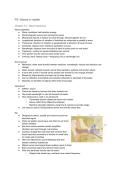
● Designed to detect, amplify and convert sound into
electrical signal
● Outer ear gather sound wave and direct to ear drum
(which vibrates)
● Ear drum makes ossicles vibrate (amplifies
vibration) and sent through oval window
● Cochlea: shaped like snail shell and contains fluid
which transmits movement of window to small hairs
on inside wall of cochlea
● Hairs are attached to sound-detecting cells that
release chemical substances
● Makes nerves send signal down auditory nerve to brain
● Brain processes signal and person hears sound
● Why only particular sounds can be heard:
○ Objects that vibrate (eg. cochlea) have natural frequency
, ○ Natural frequency: certain frequencies at which it vibrates
○ Resonance: when vibration is applied at NF causing big amplitude vibration
○ Cochlea’s hairs have different lengths so resonate at different frequencies
○ Range of frequencies that can be heard depends on range of hair length
○ Ageing causes loss of shorter hairs, making it hard to hear high frequencies
Chapter 5.2: The electromagnetic spectrum
Electromagnetic waves
● Eyes are sensitive to narrow range of frequencies (visible light)
● RMIVUXG (102, 1, 10-2, 10-4, 10-6, 10-8, 10-10, 10-12, 10-14,10-16)
● Shorter wavelength, higher frequency
● Consists of oscillating electric and magnetic fields
● All travel at 3x10⁸m/s in vacuum
● EM waves transfer energy from sources to absorbers
● Producing and detecting radio waves:
○ Oscillating voltage across a wire makes electrons move backwards and forwards
○ Produces changing electric and magnetic field which is emitted as a radio wave
○ When fields meet another piece of metal (aerial), makes electrons move, producing
electrical signal
○ EM waves also produced by movement of electrons in atoms
Uses and dangers of EM radiation
● Some eg. microwaves, transfer information
● Microwaves are absorbed by fat and water (heating up outside) - conduction transfers energy
to middle
● IR cooks food in grill or oven
● UV, X-rays and gamma can damage or kill cells
● Useful for killing bacteria and cancers
● radiation can damage DNA in cells causing them to mutate and turn into cancer
● If eyes are exposed to UV cataracts can be developed (makes corneas cloudy)
● X-rays can damage cells and cause cancer
● Radiographer stands behind lead screen or other room when X-raying
● Gamma can damage or kill cells in body
Imaging with Electromagnetic waves
● IR use in medical imaging:
○ Thermal camera produces thermogram (image) showing regions of temps
○ Pixels inside Charge-Coupled Device (CCD) eg. phone camera absorb IR and
produce image
○ Skin will emit more IR radiation is it is hot due to injury or infection
○ Thermograms can also show problems with blood flow in blood vessels
● X-ray use in medical imaging:
○ Colours show differences in intensity due to different densities of materials x-rays
travel through
○ High density material absorbs more x-rays
○ Can be used for teeth and bones
○ Computer can use x-rays to make image that looks like slice through body
○ Called computerised tomography and produces CT scans
● Gamma use in medical imaging:
○ Used as tracers and to treat problems with organs
■ Tracer: radioactive substance emitting gamma rays
, ■ Doctor injects patient with tracer
■ Patient’s kidneys absorb tracer
■ Doctor diagnoses problems from CCD images
■ Example: if not much tracer in one kidney, means problem in there
○ Can also be used to find leaks in underground pipes
Chapter 5.3: wave interaction
Electromagnetic waves and matter
● Using ray diagrams for reflection and refraction:
○ Used to show what happens when EM waves hit surface or travel through matter
○ When constructing ray diagram:
■ Draw lines to represent rays (with arrows for direction)
■ Draw normal at 900 to surface at point where ray hits it
■ Measure angles from normal to rays
● Why EM waves are refracted:
○ When wave goes into denser medium at angle, wave slows down and bends towards
normal
○ When leaving denser medium, wave speeds up and returns to angle of incidence
● Where EM waves are reflected and refracted:
○ Earth is curved
○ Radio waves can be reflected from
ionosphere to send them long distances
○ High frequency radio waves or microwaves
have smaller wavelength so can be used for
communication
● Where EM waves are transmitted and absorbed:
○ What happens to EM waves depends on wavelength
○ Walls transmit radio and microwaves so TV and phone work
○ Walls absorb visible light so windows needed if want to use light to see
○ Plastic of bin bag absorbs visible light but transmits IR
○ Gamma arrays from sun and space are absorbed by atmosphere
Lenses
● Basic terms:
○ Converging: rays get closer together
○ Diverging: rays get further apart
○ Principal axis: angle that is in centre of lens
○ Focus: where rays of light meet
○ Focal length: length from middle of lens to focus
● Convex lens: converges rays to a focal point
● Convex used when eye focuses rays behind retina
(long-sighted)
● Concave lens: diverge rays to create virtual focal point behind lens
● Concave used when eye focuses rays in front of retina
(short-sighted)
● How to draw ray diagrams:
○ Draw lens with axis
○ Draw line parallel to axis and refract
○ Draw line through centre (undeflected)
○ Draw line parallel to axis and refract (only if possible)
● Ray diagram logics:
Chapter 5.1: Wave behaviour
Wave properties
● Wave: oscillation that transfers energy
● Electromagnetic waves and mechanical waves
● Mechanical require a medium to travel through, electromagnetic do not
● Longitudinal: direction of vibration of individual air molecules is parallel to wave
● Transverse: direction of vibration is perpendicular to direction of travel of wave
● Amplitude: distance from middle to top/bottom of wave
● Wavelength: distance from one point of wave to same point on next wave
● Frequency: number of waves/oscillations per second
● Time period: time for wave to pass certain point
● Formula: wave velocity (m/s) = frequency (Hz) x wavelength (m)
Sound waves
● Refraction: when wave travels between mediums, wavelength, velocity and direction can
change
● When slowed, refracts towards normal (line parallel to surface) and shorter waves
● If wave hits at line of normal will be slowed and shorter but not change direction
● Slowed by higher density and sped up by lower density
● Can be reflected, transmitted (and possibly refracted) or absorbed at boundary
● Depends on densities of regions either side of boundary
Ultrasound
● 20KHz+ sound
● Cannot be heard by humans but other animals can
● Has small wavelength so can be focused into beam
● How ultrasound is used in an ultrasound:
○ Transmitter beams ultrasound waves into mother
○ Waves reflect from different boundaries
○ Machine calculates distance using time & velocity to provide image
● Can also be used in finding kidney stones and monitor blood flow
Ear
● Designed to detect, amplify and convert sound into
electrical signal
● Outer ear gather sound wave and direct to ear drum
(which vibrates)
● Ear drum makes ossicles vibrate (amplifies
vibration) and sent through oval window
● Cochlea: shaped like snail shell and contains fluid
which transmits movement of window to small hairs
on inside wall of cochlea
● Hairs are attached to sound-detecting cells that
release chemical substances
● Makes nerves send signal down auditory nerve to brain
● Brain processes signal and person hears sound
● Why only particular sounds can be heard:
○ Objects that vibrate (eg. cochlea) have natural frequency
, ○ Natural frequency: certain frequencies at which it vibrates
○ Resonance: when vibration is applied at NF causing big amplitude vibration
○ Cochlea’s hairs have different lengths so resonate at different frequencies
○ Range of frequencies that can be heard depends on range of hair length
○ Ageing causes loss of shorter hairs, making it hard to hear high frequencies
Chapter 5.2: The electromagnetic spectrum
Electromagnetic waves
● Eyes are sensitive to narrow range of frequencies (visible light)
● RMIVUXG (102, 1, 10-2, 10-4, 10-6, 10-8, 10-10, 10-12, 10-14,10-16)
● Shorter wavelength, higher frequency
● Consists of oscillating electric and magnetic fields
● All travel at 3x10⁸m/s in vacuum
● EM waves transfer energy from sources to absorbers
● Producing and detecting radio waves:
○ Oscillating voltage across a wire makes electrons move backwards and forwards
○ Produces changing electric and magnetic field which is emitted as a radio wave
○ When fields meet another piece of metal (aerial), makes electrons move, producing
electrical signal
○ EM waves also produced by movement of electrons in atoms
Uses and dangers of EM radiation
● Some eg. microwaves, transfer information
● Microwaves are absorbed by fat and water (heating up outside) - conduction transfers energy
to middle
● IR cooks food in grill or oven
● UV, X-rays and gamma can damage or kill cells
● Useful for killing bacteria and cancers
● radiation can damage DNA in cells causing them to mutate and turn into cancer
● If eyes are exposed to UV cataracts can be developed (makes corneas cloudy)
● X-rays can damage cells and cause cancer
● Radiographer stands behind lead screen or other room when X-raying
● Gamma can damage or kill cells in body
Imaging with Electromagnetic waves
● IR use in medical imaging:
○ Thermal camera produces thermogram (image) showing regions of temps
○ Pixels inside Charge-Coupled Device (CCD) eg. phone camera absorb IR and
produce image
○ Skin will emit more IR radiation is it is hot due to injury or infection
○ Thermograms can also show problems with blood flow in blood vessels
● X-ray use in medical imaging:
○ Colours show differences in intensity due to different densities of materials x-rays
travel through
○ High density material absorbs more x-rays
○ Can be used for teeth and bones
○ Computer can use x-rays to make image that looks like slice through body
○ Called computerised tomography and produces CT scans
● Gamma use in medical imaging:
○ Used as tracers and to treat problems with organs
■ Tracer: radioactive substance emitting gamma rays
, ■ Doctor injects patient with tracer
■ Patient’s kidneys absorb tracer
■ Doctor diagnoses problems from CCD images
■ Example: if not much tracer in one kidney, means problem in there
○ Can also be used to find leaks in underground pipes
Chapter 5.3: wave interaction
Electromagnetic waves and matter
● Using ray diagrams for reflection and refraction:
○ Used to show what happens when EM waves hit surface or travel through matter
○ When constructing ray diagram:
■ Draw lines to represent rays (with arrows for direction)
■ Draw normal at 900 to surface at point where ray hits it
■ Measure angles from normal to rays
● Why EM waves are refracted:
○ When wave goes into denser medium at angle, wave slows down and bends towards
normal
○ When leaving denser medium, wave speeds up and returns to angle of incidence
● Where EM waves are reflected and refracted:
○ Earth is curved
○ Radio waves can be reflected from
ionosphere to send them long distances
○ High frequency radio waves or microwaves
have smaller wavelength so can be used for
communication
● Where EM waves are transmitted and absorbed:
○ What happens to EM waves depends on wavelength
○ Walls transmit radio and microwaves so TV and phone work
○ Walls absorb visible light so windows needed if want to use light to see
○ Plastic of bin bag absorbs visible light but transmits IR
○ Gamma arrays from sun and space are absorbed by atmosphere
Lenses
● Basic terms:
○ Converging: rays get closer together
○ Diverging: rays get further apart
○ Principal axis: angle that is in centre of lens
○ Focus: where rays of light meet
○ Focal length: length from middle of lens to focus
● Convex lens: converges rays to a focal point
● Convex used when eye focuses rays behind retina
(long-sighted)
● Concave lens: diverge rays to create virtual focal point behind lens
● Concave used when eye focuses rays in front of retina
(short-sighted)
● How to draw ray diagrams:
○ Draw lens with axis
○ Draw line parallel to axis and refract
○ Draw line through centre (undeflected)
○ Draw line parallel to axis and refract (only if possible)
● Ray diagram logics:

