

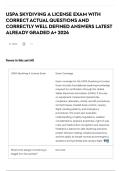
USPA SKYDIVING A LICENSE EXAM WITH
CORRECT ACTUAL QUESTIONS AND
CORRECTLY WELL DEFINED ANSWERS LATEST
ALREADY GRADED A+ 2026
Save
Terms in this set (41)
USPA Skydiving A License Exam Exam Coverage
Exam coverage for the USPA Skydiving A License
Exam includes foundational skydiving knowledge
required for certification through the United
States Parachute Association (USPA). It focuses
on equipment components (parachutes,
containers, altimeters, AADs), aircraft procedures,
exit techniques, freefall body control, canopy
flight, landing patterns, and emergency
procedures. The exam also evaluates
understanding of safety regulations, weather
considerations, airspace awareness, right-of-way
rules, and malfunction recognition and response.
Emphasis is placed on safe skydiving practices,
proper decision-making, situational awareness,
and the ability to handle normal and emergency
situations during freefall and canopy flight. 🪂📘
What is the danger of entering a line twist
toggle turn too quickly?
, How can you avoid the propeller(s) approach only from the rear and behind the wing
while approaching an airplane?
What is the biggest danger of a 1) Line twist
hard toggle turn near the ground? 2) Hard landing while still in a turn
3) Collision with other jumpers
What is the recommended minimum 1,500 feet above the highest planned deployment
breakoff altitude for free fall groups altitude
of five or fewer?
What should be your first response check altitude and communicate with the other
in the event of a canopy collision jumper
and entanglement with another
jumper?
What should you pay attention to 1) Bridle routing
when closing a main container 2) Closing loop tension
equipped with a hand deployed 3) Flap order
pilot chute?
When the brake system uses Velcro, To prevent wear and tear on the lower steering
why is it a good idea to place your lines
toggles back on the Velcro after
you land?
CORRECT ACTUAL QUESTIONS AND
CORRECTLY WELL DEFINED ANSWERS LATEST
ALREADY GRADED A+ 2026
Save
Terms in this set (41)
USPA Skydiving A License Exam Exam Coverage
Exam coverage for the USPA Skydiving A License
Exam includes foundational skydiving knowledge
required for certification through the United
States Parachute Association (USPA). It focuses
on equipment components (parachutes,
containers, altimeters, AADs), aircraft procedures,
exit techniques, freefall body control, canopy
flight, landing patterns, and emergency
procedures. The exam also evaluates
understanding of safety regulations, weather
considerations, airspace awareness, right-of-way
rules, and malfunction recognition and response.
Emphasis is placed on safe skydiving practices,
proper decision-making, situational awareness,
and the ability to handle normal and emergency
situations during freefall and canopy flight. 🪂📘
What is the danger of entering a line twist
toggle turn too quickly?
, How can you avoid the propeller(s) approach only from the rear and behind the wing
while approaching an airplane?
What is the biggest danger of a 1) Line twist
hard toggle turn near the ground? 2) Hard landing while still in a turn
3) Collision with other jumpers
What is the recommended minimum 1,500 feet above the highest planned deployment
breakoff altitude for free fall groups altitude
of five or fewer?
What should be your first response check altitude and communicate with the other
in the event of a canopy collision jumper
and entanglement with another
jumper?
What should you pay attention to 1) Bridle routing
when closing a main container 2) Closing loop tension
equipped with a hand deployed 3) Flap order
pilot chute?
When the brake system uses Velcro, To prevent wear and tear on the lower steering
why is it a good idea to place your lines
toggles back on the Velcro after
you land?

