

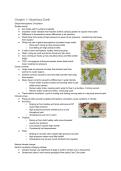
Chapter 1: Hazardous Earth
Global Atmospheric Circulation
Surface winds
● Sun heats earth’s surface unequally
● Insolation (solar radiation that reaches earth’s surface) greater at equator than poles
● Difference in temperature cause differences in air pressure
● Winds blow from areas of high pressure to areas of low pressure - transferring heat away
from equator
● Winds are part of global atmospheric circulation loops (cells)
○ Have warm rising air (low pressure belt)
○ Cool falling air (high pressure belt)
● 3 cells in each hemisphere: hadley, ferrel and polar
● Warm, rising air cools and forms clouds and rain (low)
● Cool, sinking air heats up has cloudless skies and little rainfall
(high)
● ITCZ: convergence at thermal equator where trade winds
meet, creating low pressure
Ocean currents
● Large scale movements of water that transfer heat from
warmer to cooler regions
● Surface currents caused by wind and help transfer heat away
from equator
● Deep ocean currents caused by differences in water density
○ Frozen water at poles causes surrounding water to get
saltier (more dense)
○ Denser water sinks, causing warm water to flow in at surface - forming current
○ Warmer water cooled and sinks, continuing cycle
● Thermohaline circulation: cycle of cooling and sinking moving water in a big loop around earth
Climate zones
● Pressure belts caused by global atmospheric circulation cause variations in climate
● Arid (dry):
○ Sinking air from hadley and ferrel cells around 30o
cause high pressure
○ High pressure prevents rainfall and so is low
throughout year
○ Temperatures are hot or warm
● Tropical:
○ Rising air from both hadley cells around equator
causes low pressure
○ Low pressure causes high rainfall
○ Consistently hot temperatures
● Polar:
○ Sinking air of polar cells creates high pressure at poles
○ High pressure means very little rainfall
○ Temperature low all year round (furthest from equator)
Natural climate change
Earth’s constantly changing climate
● Climate change: any significant change to earth’s climate over a long period
● Quaternary period: most recent geological time period, last 2.6m years
, ● In period before quaternary, climate was quite stable and warmer
● During quaternary, global temperature has shifted between cold glacial periods (100k years)
and warmer interglacial years (10k years) by orbital changes
● Last glacial period ended 15k years ago - since then, climate has been warming
Causes (4)
● Orbital changes:
○ Orbital changes: variations in way earth moves around sun
○ Affects how much solar radiation earth receives
○ May have caused glacial and interglacial cycles of quaternary period
○ Methods of orbital change:
■ Stretch (aka eccentricity): path of earth’s orbit changes from circle to ellipse
and back every 96k years
■ Tilt: earth’s axis’ tilt changes over cycle of 41k years
■ Wobble (aka precession): axis of earth wobbles in a circle every 22k years
● Volcanic activity:
○ Major volcanic eruptions eject large quantities of material into atmosphere
○ Some particles reflect sun’s rays back out to space, causing earth’s surface to cool
○ May cause short-term changes in climate
● Solar output:
○ Sun’s output of energy changes in short cycles of 11 years and possibly even in
longer cycles of several hundred years
○ Periods of reduced solar output may cause earth’s climate to become cooler
● Asteroid collisions:
○ Asteroids hitting earth’s surface can send huge amounts of dust into atmosphere
○ Particles prevent sun’s energy from earth’s surface to temperatures fall for up to
several years
Evidence (3)
● Tree rings:
○ Most trees produce a ring within their trunks every year
○ Thicker ring = warmer climate
○ Scientists take cores through tree trunks and date them by counting them and use
thickness of rings to determine climate of each year
● Ice cores:
○ Ice sheets made up of layers of ice - layer formed each year
○ Scientists drill into sheets to get long cores of ice
○ By analysing gases trapped in layers of ice, can tell what the temperature was each
year
● Historical records:
○ Since 1850s global temperatures have been measured accurately using
thermometers, giving reliable but short-term record
○ Historical records can extend records of climate change a bit further back
○ For example, historical diaries can show what climate was like in past by giving dates
of harvests (earlier harvest = warmer weather)
Using sources to reconstruct UK’s past climate (2)
● Medieval warm period (900-1300):
○ Harvest records show England was warm enough to grow lots of grapes
○ Tree ring data suggests this was the case during Roman times, when temperatures
were <1oC warmer than today
● Little ice age (following mediaeval warm period):
○ Paintings from 17th century show London Frost Fairs on frozen River Thames
○ Historical records talk of arctic ice reaching scotland and sightings of inuits
, Human climate change
Natural greenhouse effect
● Temperature of Earth balanced between heat gained from sun and heat lost to space
● Short-wave radiation: incoming energy from sun, long-wave radiation: outgoing energy from
Earth
● Greenhouse effect: gases in atmosphere (greenhouse gases) act as insulating layer -
allowing short-wave while trapping long-wave
● Some gases absorb more than others and stay in atmosphere for longer, contributing to
global warming
Humans affecting greenhouse effect (4)
● Farming:
○ Livestock produces lots of methane
○ Rice paddies contribute - flooded fields emit methane
○ When trees are cleared for agriculture, stops absorption of CO2
● Energy:
○ CO2 released into atmosphere when fossil fuels burnt in power stations
● Industry:
○ Most industry uses lots of energy
○ Some industrial processes release greenhouse gases eg. producing cement
○ Industrial waste may end up in landfill sites, releasing methane as it decays
● Transport:
○ Most vehicles run on fossil fuels
○ Car ownership rapidly increasing in developing countries - results in more cars on
roads and so congestion (engines running longer)
Evidence (4)
● Declining Arctic ice:
○ Sea ice forms around poles when ocean <1.8oC and melts in summer
○ Extent of Arctic sea ice decreased by 3%+ each decade over past 35 years
● Global temperature rise:
○ Temperatures increased <1oC since 1880 and expected to rise <5OC by 2100
○ Top 10 warmest years on record since 2000
● Sea level rise and warming oceans:
○ Since 1901: sea levels risen <0.2m
○ Eustatic sea level rise:
■ Warmer temperatures causing glaciers to shrink and ice sheets to melt
■ Melting of land ice means water stored on land returns to oceans
○ Thermal expansion:
■ Thermal expansion: water in oceans expand as it gets warmer
■ May account for half of measured sea level rise
● Extreme weather events:
○ Since 1950: more heat waves in may areas and less cold weather extremes
○ In UK: more rainfall records broken in 2010-2014 than any decade on record
Impacts on people
● Heatstroke deaths increased but cold deaths decreased
● Some areas could be so hot they are impossible to inhabit
● Low-lying coastal areas lost to sea or flood to often to inhabit
● Can lead to migration and overcrowding
● Some crops suffered due to climate change
● Some farmers in high-latitude countries having crops benefit from warmer conditions
● Lower crop yields could increase malnutrition, ill health and starvation death - especially near
to equator
Global Atmospheric Circulation
Surface winds
● Sun heats earth’s surface unequally
● Insolation (solar radiation that reaches earth’s surface) greater at equator than poles
● Difference in temperature cause differences in air pressure
● Winds blow from areas of high pressure to areas of low pressure - transferring heat away
from equator
● Winds are part of global atmospheric circulation loops (cells)
○ Have warm rising air (low pressure belt)
○ Cool falling air (high pressure belt)
● 3 cells in each hemisphere: hadley, ferrel and polar
● Warm, rising air cools and forms clouds and rain (low)
● Cool, sinking air heats up has cloudless skies and little rainfall
(high)
● ITCZ: convergence at thermal equator where trade winds
meet, creating low pressure
Ocean currents
● Large scale movements of water that transfer heat from
warmer to cooler regions
● Surface currents caused by wind and help transfer heat away
from equator
● Deep ocean currents caused by differences in water density
○ Frozen water at poles causes surrounding water to get
saltier (more dense)
○ Denser water sinks, causing warm water to flow in at surface - forming current
○ Warmer water cooled and sinks, continuing cycle
● Thermohaline circulation: cycle of cooling and sinking moving water in a big loop around earth
Climate zones
● Pressure belts caused by global atmospheric circulation cause variations in climate
● Arid (dry):
○ Sinking air from hadley and ferrel cells around 30o
cause high pressure
○ High pressure prevents rainfall and so is low
throughout year
○ Temperatures are hot or warm
● Tropical:
○ Rising air from both hadley cells around equator
causes low pressure
○ Low pressure causes high rainfall
○ Consistently hot temperatures
● Polar:
○ Sinking air of polar cells creates high pressure at poles
○ High pressure means very little rainfall
○ Temperature low all year round (furthest from equator)
Natural climate change
Earth’s constantly changing climate
● Climate change: any significant change to earth’s climate over a long period
● Quaternary period: most recent geological time period, last 2.6m years
, ● In period before quaternary, climate was quite stable and warmer
● During quaternary, global temperature has shifted between cold glacial periods (100k years)
and warmer interglacial years (10k years) by orbital changes
● Last glacial period ended 15k years ago - since then, climate has been warming
Causes (4)
● Orbital changes:
○ Orbital changes: variations in way earth moves around sun
○ Affects how much solar radiation earth receives
○ May have caused glacial and interglacial cycles of quaternary period
○ Methods of orbital change:
■ Stretch (aka eccentricity): path of earth’s orbit changes from circle to ellipse
and back every 96k years
■ Tilt: earth’s axis’ tilt changes over cycle of 41k years
■ Wobble (aka precession): axis of earth wobbles in a circle every 22k years
● Volcanic activity:
○ Major volcanic eruptions eject large quantities of material into atmosphere
○ Some particles reflect sun’s rays back out to space, causing earth’s surface to cool
○ May cause short-term changes in climate
● Solar output:
○ Sun’s output of energy changes in short cycles of 11 years and possibly even in
longer cycles of several hundred years
○ Periods of reduced solar output may cause earth’s climate to become cooler
● Asteroid collisions:
○ Asteroids hitting earth’s surface can send huge amounts of dust into atmosphere
○ Particles prevent sun’s energy from earth’s surface to temperatures fall for up to
several years
Evidence (3)
● Tree rings:
○ Most trees produce a ring within their trunks every year
○ Thicker ring = warmer climate
○ Scientists take cores through tree trunks and date them by counting them and use
thickness of rings to determine climate of each year
● Ice cores:
○ Ice sheets made up of layers of ice - layer formed each year
○ Scientists drill into sheets to get long cores of ice
○ By analysing gases trapped in layers of ice, can tell what the temperature was each
year
● Historical records:
○ Since 1850s global temperatures have been measured accurately using
thermometers, giving reliable but short-term record
○ Historical records can extend records of climate change a bit further back
○ For example, historical diaries can show what climate was like in past by giving dates
of harvests (earlier harvest = warmer weather)
Using sources to reconstruct UK’s past climate (2)
● Medieval warm period (900-1300):
○ Harvest records show England was warm enough to grow lots of grapes
○ Tree ring data suggests this was the case during Roman times, when temperatures
were <1oC warmer than today
● Little ice age (following mediaeval warm period):
○ Paintings from 17th century show London Frost Fairs on frozen River Thames
○ Historical records talk of arctic ice reaching scotland and sightings of inuits
, Human climate change
Natural greenhouse effect
● Temperature of Earth balanced between heat gained from sun and heat lost to space
● Short-wave radiation: incoming energy from sun, long-wave radiation: outgoing energy from
Earth
● Greenhouse effect: gases in atmosphere (greenhouse gases) act as insulating layer -
allowing short-wave while trapping long-wave
● Some gases absorb more than others and stay in atmosphere for longer, contributing to
global warming
Humans affecting greenhouse effect (4)
● Farming:
○ Livestock produces lots of methane
○ Rice paddies contribute - flooded fields emit methane
○ When trees are cleared for agriculture, stops absorption of CO2
● Energy:
○ CO2 released into atmosphere when fossil fuels burnt in power stations
● Industry:
○ Most industry uses lots of energy
○ Some industrial processes release greenhouse gases eg. producing cement
○ Industrial waste may end up in landfill sites, releasing methane as it decays
● Transport:
○ Most vehicles run on fossil fuels
○ Car ownership rapidly increasing in developing countries - results in more cars on
roads and so congestion (engines running longer)
Evidence (4)
● Declining Arctic ice:
○ Sea ice forms around poles when ocean <1.8oC and melts in summer
○ Extent of Arctic sea ice decreased by 3%+ each decade over past 35 years
● Global temperature rise:
○ Temperatures increased <1oC since 1880 and expected to rise <5OC by 2100
○ Top 10 warmest years on record since 2000
● Sea level rise and warming oceans:
○ Since 1901: sea levels risen <0.2m
○ Eustatic sea level rise:
■ Warmer temperatures causing glaciers to shrink and ice sheets to melt
■ Melting of land ice means water stored on land returns to oceans
○ Thermal expansion:
■ Thermal expansion: water in oceans expand as it gets warmer
■ May account for half of measured sea level rise
● Extreme weather events:
○ Since 1950: more heat waves in may areas and less cold weather extremes
○ In UK: more rainfall records broken in 2010-2014 than any decade on record
Impacts on people
● Heatstroke deaths increased but cold deaths decreased
● Some areas could be so hot they are impossible to inhabit
● Low-lying coastal areas lost to sea or flood to often to inhabit
● Can lead to migration and overcrowding
● Some crops suffered due to climate change
● Some farmers in high-latitude countries having crops benefit from warmer conditions
● Lower crop yields could increase malnutrition, ill health and starvation death - especially near
to equator

