C1: Particles
Chapter 1.1: The particle model
Particle model
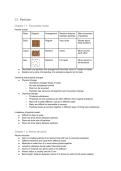
State Diagram Arrangement Relative distance Main movement
between particles of particles
Solid Regular Very close Vibrate about
fixed positions
Liquid Random Close Move around
each other
Gas Random Far apart Move quickly in
all directions
● Describes how particles are arranged and how they move in 3 states of matter
● Explains why some of properties of a substance depend on its state
Chemical and physical changes
● Physical change
○ Substance changed shape or state
○ No new substances formed
○ Most can be reversed
○ Particles stay same but arrangement and movement change
● Chemical change
○ Produces substances
○ Properties of new substance are often different from original substance
○ May look or taste different, may be in different state
○ Many are difficult or impossible to reverse
○ Particles break up and join together in different ways, forming new substances
Limitations of particle model
● Difficult to draw to scale
● Does not show forces between particles
● Does not show size of particles
● Does not show space between particles
Chapter 1.2: Atomic structure
Atomic structure
● Atom is smallest particle of an element that still has its chemical properties
● Different elements are made from different atoms
● Molecule is made from 2 or more atoms joined together
● Joined by attractive forces called chemical bonds
● Atoms in molecule can all be same or be different
● Atomic radius is usually around 0.1nm
● Bond length: distance between centre of 2 atoms (so radii of both atoms added)
, ● 3 subatomic particles:
○ Protons and neutrons joined together in nucleus in centre
○ Electrons surrounding nucleus in shells
● Radius of nucleus is about 100,000x less than radius of atom
Subatomic Relative Actual mass Relative Actual
particle mass charge charge
proton 1 1.673 x 10⁻²⁷kg +1 +1.6 x 10⁻¹⁹
neutron 1 1.675 x 10⁻²⁷kg 0 0
electron 0.0005 9.109 x 10⁻³¹kg -1 -1.6 x 10⁻¹⁹
Isotopes and ions
● Each element has name and chemical symbol
● Bottom number is atomic number: number of protons
● Top number is mass number: number of protons and neutrons
● All atoms have same number of electrons and protons
● Isotopes: atoms with different amount of neutrons
○ Same atomic number, different mass number
○ Can be identified from their full chemical symbol or name eg. hydrogen-2
○ Have same chemical properties (number of protons), but different physical properties
● Ions: charged particles
○ Same atomic and mass number, different amount of electrons
○ Can happen during chemical reactions
○ Atoms want full outer shell so lose or gain electrons based on which is easier
History of atom
● 1803
○ John Dalton suggested all matter is made from atoms
○ All atoms of an element are identical
○ Different elements have different types of atom
○ Believed atoms were solid balls
● 1897
○
Thomson discovered electrons
○
Found beams of “cathode rays” changed direction in electric and magnetic fields
○
Concluded cathode rays were tiny particles that were negatively charged and smaller
than atoms
○ Atoms are overall neutral
○ Plum-pudding model
● 1909
○ Rutherford worked with Geiger and Marsden to test plum-pudding model
○ Pointed beams of positively charged particles (called alpha particles) at thin gold foil
○ Expected: particles go straight through foil
○ Reality: most did, some changed direction, some came straight back - as if alpha
particles had been pushed back by something
○ Rutherford explained results by suggesting atom has positively charged nucleus
containing most of mass
○ Electrons orbit nucleus
● 1913
○ Bohr noticed electrons would be attracted to oppositely-charged nucleus and spiral
inwards
○ Used mathematical models to improve Rutherford’s model
Chapter 1.1: The particle model
Particle model
State Diagram Arrangement Relative distance Main movement
between particles of particles
Solid Regular Very close Vibrate about
fixed positions
Liquid Random Close Move around
each other
Gas Random Far apart Move quickly in
all directions
● Describes how particles are arranged and how they move in 3 states of matter
● Explains why some of properties of a substance depend on its state
Chemical and physical changes
● Physical change
○ Substance changed shape or state
○ No new substances formed
○ Most can be reversed
○ Particles stay same but arrangement and movement change
● Chemical change
○ Produces substances
○ Properties of new substance are often different from original substance
○ May look or taste different, may be in different state
○ Many are difficult or impossible to reverse
○ Particles break up and join together in different ways, forming new substances
Limitations of particle model
● Difficult to draw to scale
● Does not show forces between particles
● Does not show size of particles
● Does not show space between particles
Chapter 1.2: Atomic structure
Atomic structure
● Atom is smallest particle of an element that still has its chemical properties
● Different elements are made from different atoms
● Molecule is made from 2 or more atoms joined together
● Joined by attractive forces called chemical bonds
● Atoms in molecule can all be same or be different
● Atomic radius is usually around 0.1nm
● Bond length: distance between centre of 2 atoms (so radii of both atoms added)
, ● 3 subatomic particles:
○ Protons and neutrons joined together in nucleus in centre
○ Electrons surrounding nucleus in shells
● Radius of nucleus is about 100,000x less than radius of atom
Subatomic Relative Actual mass Relative Actual
particle mass charge charge
proton 1 1.673 x 10⁻²⁷kg +1 +1.6 x 10⁻¹⁹
neutron 1 1.675 x 10⁻²⁷kg 0 0
electron 0.0005 9.109 x 10⁻³¹kg -1 -1.6 x 10⁻¹⁹
Isotopes and ions
● Each element has name and chemical symbol
● Bottom number is atomic number: number of protons
● Top number is mass number: number of protons and neutrons
● All atoms have same number of electrons and protons
● Isotopes: atoms with different amount of neutrons
○ Same atomic number, different mass number
○ Can be identified from their full chemical symbol or name eg. hydrogen-2
○ Have same chemical properties (number of protons), but different physical properties
● Ions: charged particles
○ Same atomic and mass number, different amount of electrons
○ Can happen during chemical reactions
○ Atoms want full outer shell so lose or gain electrons based on which is easier
History of atom
● 1803
○ John Dalton suggested all matter is made from atoms
○ All atoms of an element are identical
○ Different elements have different types of atom
○ Believed atoms were solid balls
● 1897
○
Thomson discovered electrons
○
Found beams of “cathode rays” changed direction in electric and magnetic fields
○
Concluded cathode rays were tiny particles that were negatively charged and smaller
than atoms
○ Atoms are overall neutral
○ Plum-pudding model
● 1909
○ Rutherford worked with Geiger and Marsden to test plum-pudding model
○ Pointed beams of positively charged particles (called alpha particles) at thin gold foil
○ Expected: particles go straight through foil
○ Reality: most did, some changed direction, some came straight back - as if alpha
particles had been pushed back by something
○ Rutherford explained results by suggesting atom has positively charged nucleus
containing most of mass
○ Electrons orbit nucleus
● 1913
○ Bohr noticed electrons would be attracted to oppositely-charged nucleus and spiral
inwards
○ Used mathematical models to improve Rutherford’s model