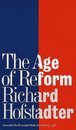
The Age of Reform: From Bryan to FDR by Richard Hofstadter - Chapter 2
References
Footnote - Richard Hofstadter, The Age of Reform: From Bryan to FDR, (London: Jonathan Cape, 1962),
Chap. 2.
Bibliography - Hofstadter, Richard. The Age of Reform: From Bryan to FDR. London: Jonathan Cape,
1962. Chap 2
Notes and Quotes
- ‘In the short run the Populists did not get what they wanted, but they released the flow of protest and
criticism that swept through American political affairs from the 1890’s to the beginning of the first World
War.’ - 60
- Similar to the Postel argument that populists did not manage to enter the mainstream political sphere
as their own individual entity, but penetrated it in other ways with some of their ideas being take on
and adapted by the main parties
- ‘Populism was the first modern political movement of practical importance in the United States to insist
that the federal government has some responsibility for the common weal’ - 61
- Argument that populism was a moral movement as well as a political one
- ‘In the books that have been written about the Populist movement, only passing mention has been
made of its significant provincialism; little has been said of its relations with nativism and nationalism;
nothing has been said of its tincture of anti-Semitism.’ - 61
- ‘If the people failed to enjoy prosperity, it must be because of a harsh and arbitrary intrusion of human
greed and error’ - 63
- ‘the Populists adhered, less formally to be sure, but quite persistently, to a kind of social dualism: …
“On the one side are the allied hosts of monopolies, the money power, great trusts and railroad
corporations, who seek the enactment of laws to benefit them and impoverish the people. On the other
are the farmers, laborers, merchants, and all other people who produce wealth and bear the burdens of
taxation. . . . Between these two there is no middle ground.”’ - 64
- This demonstrates that populists were mostly critical of people holding power over sectors of society
which they had no involvement in, as seen in Postel’s argument that rural communities were
discontented with urban powers controlling their communities
- ‘the victory over injustice, the solution for all social ills, was concentrated in the crusade against a single,
relatively small but immensely strong interest, the money power.’ - 65
- The populist ideal was centred around reclaiming control over one’s community, again demonstrating
discontent with the structures of power, especially financial power
- Contrary to Postel’s overall argument, Hofstatder says that ‘it would be misleading to imply that the
tone of Populistic thinking was uniformly optimistic. Often, indeed, a deep-lying vein of anxiety showed
through.’ Demonstrating populism to be a fight for something deemed as deeply necessary, similar to
the later civil rights movements, rather than just a political movement which was wanted in order to
make surface level social changes. Although Postel agrees that the changes populists wanted are deep
rooted, his argument suggests that populists were more optimistic - 66
- ‘common feeling that farmers and workers were not simply oppressed but oppressed deliberately,
consciously, continuously, and with wanton malice by “the interests.”’ - 70
- ‘Populist thought showed an unusually strong tendency to account for relatively impersonal events in
highly personal terms.’ - 73
- This is a crucial part of the Hofstatder argument which asserts that the populist movement spread
across America because it made people feel a personal affiliation with matters which they would have
References
Footnote - Richard Hofstadter, The Age of Reform: From Bryan to FDR, (London: Jonathan Cape, 1962),
Chap. 2.
Bibliography - Hofstadter, Richard. The Age of Reform: From Bryan to FDR. London: Jonathan Cape,
1962. Chap 2
Notes and Quotes
- ‘In the short run the Populists did not get what they wanted, but they released the flow of protest and
criticism that swept through American political affairs from the 1890’s to the beginning of the first World
War.’ - 60
- Similar to the Postel argument that populists did not manage to enter the mainstream political sphere
as their own individual entity, but penetrated it in other ways with some of their ideas being take on
and adapted by the main parties
- ‘Populism was the first modern political movement of practical importance in the United States to insist
that the federal government has some responsibility for the common weal’ - 61
- Argument that populism was a moral movement as well as a political one
- ‘In the books that have been written about the Populist movement, only passing mention has been
made of its significant provincialism; little has been said of its relations with nativism and nationalism;
nothing has been said of its tincture of anti-Semitism.’ - 61
- ‘If the people failed to enjoy prosperity, it must be because of a harsh and arbitrary intrusion of human
greed and error’ - 63
- ‘the Populists adhered, less formally to be sure, but quite persistently, to a kind of social dualism: …
“On the one side are the allied hosts of monopolies, the money power, great trusts and railroad
corporations, who seek the enactment of laws to benefit them and impoverish the people. On the other
are the farmers, laborers, merchants, and all other people who produce wealth and bear the burdens of
taxation. . . . Between these two there is no middle ground.”’ - 64
- This demonstrates that populists were mostly critical of people holding power over sectors of society
which they had no involvement in, as seen in Postel’s argument that rural communities were
discontented with urban powers controlling their communities
- ‘the victory over injustice, the solution for all social ills, was concentrated in the crusade against a single,
relatively small but immensely strong interest, the money power.’ - 65
- The populist ideal was centred around reclaiming control over one’s community, again demonstrating
discontent with the structures of power, especially financial power
- Contrary to Postel’s overall argument, Hofstatder says that ‘it would be misleading to imply that the
tone of Populistic thinking was uniformly optimistic. Often, indeed, a deep-lying vein of anxiety showed
through.’ Demonstrating populism to be a fight for something deemed as deeply necessary, similar to
the later civil rights movements, rather than just a political movement which was wanted in order to
make surface level social changes. Although Postel agrees that the changes populists wanted are deep
rooted, his argument suggests that populists were more optimistic - 66
- ‘common feeling that farmers and workers were not simply oppressed but oppressed deliberately,
consciously, continuously, and with wanton malice by “the interests.”’ - 70
- ‘Populist thought showed an unusually strong tendency to account for relatively impersonal events in
highly personal terms.’ - 73
- This is a crucial part of the Hofstatder argument which asserts that the populist movement spread
across America because it made people feel a personal affiliation with matters which they would have