
CWV-101 Topic 1 Quiz 2026-2027 | Actual Questions
Grand Canyon University | Actual Q&A | Undergraduate Theology Students
Introduction
This original CWV-101 Topic 1 Quiz question set is designed to reinforce Grand Canyon University Christian
Worldview objectives for exam readiness. The questions cover Foundations of the Christian Worldview, Creation and
the Nature of God, The Fall and Human Nature, and Revelation and Scripture. Items emphasize worldview
components, biblical authority, creation, the Fall of humanity, the attributes of God, and the intersection of faith and
reason. Use this document as original practice content alongside GCU CWV-101 materials, The Beginning of Wisdom,
and the Holy Bible to build Christian Worldview Foundational Mastery.
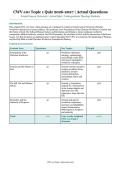
Content Area Overview
Content Area Questions Key Topics Weight
Foundations of the 50 Worldview definition; 25%
Christian Worldview ontology, epistemology,
and axiology; truth; faith
and reason; apologetics;
worldview evaluation
Creation and the Nature of 50 Genesis creation narrative; 25%
God creation ex nihilo; divine
attributes; Creator-
creature distinction;
stewardship; Christ and
creation
The Fall, Sin, and Human 50 Genesis 3; temptation; 25%
Nature original sin; consequences
of sin; human dignity and
depravity; free will;
repentance; hope after the
Fall
Revelation and the 50 General and special 25%
Authority of Scripture revelation; inspiration;
inerrancy and infallibility;
canon; hermeneutics;
biblical genres; Scripture
and authority
Total 200 Four evenly weighted 100%
CWV-101 Topic 1
domains
CWV-101 Topic 1 Quiz 2026-2027
,Domain: Foundations of the Christian Worldview
Q1. Which statement best defines a worldview in Christian worldview studies?
A. A set of basic beliefs through which a person interprets reality, meaning, values, and action.
B. A list of personal hobbies with no effect on decisions.
C. A scientific formula used only in laboratory experiments.
D. A political slogan that changes every day.
Answer: A
Rationale: CWV-101 presents worldview as the interpretive framework by which people understand God,
humanity, truth, morality, and purpose. Turner and Wallace emphasize that worldview beliefs shape thought and
life.
Q2. Why is a worldview often compared to a lens?
A. It prevents people from having any beliefs.
B. It shapes how people perceive, interpret, and respond to experience.
C. It is used only for reading ancient manuscripts.
D. It guarantees that every person sees reality identically.
Answer: B
Rationale: A lens metaphor shows that worldview assumptions influence interpretation. Christian worldview study
asks students to examine the assumptions through which they view life.
Q3. In worldview analysis, what question does ontology primarily address?
A. How should a budget be balanced?
B. Which learning style is preferred?
C. What is ultimately real?
D. What is the fastest way to memorize vocabulary?
Answer: C
Rationale: Ontology concerns the nature of reality or being. In Christian worldview study, ontological questions
include whether God exists and what kind of reality creation is.
Q4. What is epistemology concerned with?
A. The arrangement of church architecture.
B. The sequence of biblical books only.
C. The study of agricultural soils.
D. The nature, sources, and limits of knowledge.
Answer: D
Rationale: Epistemology asks how people know what they claim to know. CWV-101 connects this to Scripture,
reason, experience, and revelation.
Q5. Which worldview component focuses on values, goodness, beauty, and moral worth?
A. Axiology.
B. Meteorology.
C. Genealogy.
D. Cartography.
Answer: A
Rationale: Axiology addresses value, including ethics and aesthetics. A Christian worldview grounds moral value
in God's character and purposes.
Q6. Which question is most directly ethical?
A. How many chapters are in Genesis?
B. What ought a person do in light of what is good and right?
C. What is the chemical symbol for oxygen?
D. What year was a textbook published?
Answer: B
Rationale: Ethics is the branch of axiology focused on right conduct. Christian ethics connects moral obligation to
God, human dignity, and love of neighbor.
Q7. In worldview study, philosophical anthropology asks which question?
A. How many planets orbit the sun?
B. Which font should a paper use?
C. What is a human being?
CWV-101 Topic 1 Quiz 2026-2027
, D. What is the exchange rate today?
Answer: C
Rationale: Philosophical anthropology examines human nature, identity, and purpose. CWV-101 compares
Christian claims about humans with alternative worldview claims.
Q8. Which question best represents teleology in a worldview?
A. What is the mass of a molecule?
B. Which note begins a musical scale?
C. How many pages are in a syllabus?
D. What is the purpose or end for which life exists?
Answer: D
Rationale: Teleology concerns purpose, goal, or final end. The Christian worldview understands human purpose in
relation to God, creation, worship, service, and redemption.
Q9. What is a metanarrative in worldview analysis?
A. An overarching story that explains reality, human identity, problem, and hope.
B. A footnote format used in academic writing.
C. A private opinion with no relation to action.
D. A random list of unrelated events.
Answer: A
Rationale: A worldview often functions as a grand story. The Christian metanarrative commonly frames reality
through creation, fall, redemption, and restoration.
Q10. Which test asks whether a worldview's beliefs fit together without contradiction?
A. Popularity.
B. Coherence.
C. Entertainment value.
D. Advertising reach.
Answer: B
Rationale: Coherence evaluates internal consistency. CWV-101 encourages students to assess whether worldview
claims logically fit together and explain reality well.
Q11. Which statement best reflects the correspondence view of truth?
A. A claim is true only when most people vote for it.
B. A claim is true when it is emotionally comforting.
C. A claim is true when it matches reality.
D. A claim is true when it is repeated often enough.
Answer: C
Rationale: Christian worldview materials commonly affirm that truth is grounded in reality and ultimately in God.
Correspondence helps distinguish truth from preference or popularity.
Q12. Which statement is a truth claim rather than merely a preference?
A. I prefer quiet study rooms.
B. Chocolate tastes better than vanilla to me.
C. Blue is my favorite color.
D. God created the heavens and the earth.
Answer: D
Rationale: Truth claims assert something about reality and can be evaluated as true or false. Preferences describe
personal likes and do not carry the same objective claim.
Q13. What does objective truth mean?
A. Truth that is real independent of individual opinion or preference.
B. Truth that changes whenever a person changes feelings.
C. Truth that exists only for one culture and never beyond it.
D. Truth that cannot be discussed rationally.
Answer: A
Rationale: Christian worldview study affirms that some truths are objective because they are grounded in God's
reality and character, not merely individual perception.
Q14. Why does moral relativism challenge the Christian worldview?
A. It affirms that God is the source of all moral truth.
CWV-101 Topic 1 Quiz 2026-2027
, B. It denies universal moral norms grounded in God's character.
C. It teaches that Scripture is authoritative for all people.
D. It insists that moral claims can be objectively evaluated.
Answer: B
Rationale: Moral relativism treats moral truth as dependent on individual or cultural preference. Christianity
claims moral reality is rooted in God and applies beyond personal opinion.
Q15. In Christian worldview study, faith is best understood as what?
A. Belief without any object or reason.
B. A refusal to think critically about truth.
C. Trustful commitment grounded in knowledge of God rather than blind irrationality.
D. An emotion that excludes evidence.
Answer: C
Rationale: Biblical faith includes trust, loyalty, and confidence in God. CWV-101 materials present faith and reason
as connected rather than enemies.
Q16. What role does reason play in the Christian worldview?
A. It must be rejected because Christians never think.
B. It replaces all revelation and worship.
C. It proves every mystery can be exhausted by logic.
D. It helps people understand, evaluate, and articulate truth while remaining accountable to God.
Answer: D
Rationale: Christian thought values reason as a gift from God, while recognizing human limits. Reason can serve
faith through careful reflection and discernment.
Q17. Which statement best describes the relationship between faith and reason in the Christian
worldview?
A. Faith and reason can be complementary when both are oriented toward truth.
B. Faith and reason are always mutually exclusive.
C. Reason is sinful in every situation.
D. Faith means accepting contradictions as virtues.
Answer: A
Rationale: CWV-101 emphasizes that Christian belief is not anti-intellectual. Faith seeks understanding, and reason
helps examine and express worldview commitments.
Q18. What are presuppositions in worldview thinking?
A. Random facts that no one believes.
B. Basic assumptions a person brings to interpretation before evaluating specific claims.
C. Final exam answers only.
D. Printed page numbers in a textbook.
Answer: B
Rationale: Presuppositions shape how evidence is interpreted. Worldview study encourages students to identify
underlying assumptions rather than assume neutrality.
Q19. Which claim is most characteristic of philosophical naturalism?
A. God is personal and created all things from nothing.
B. Scripture is the final authority for faith and life.
C. Reality is ultimately limited to nature and material processes.
D. Humans are created in God's image for relationship with him.
Answer: C
Rationale: Naturalism typically excludes supernatural reality from ultimate explanation. This differs from
Christian theism, which affirms God as Creator and sustainer.
Q20. Which statement best reflects secular humanism?
A. God's revelation is the highest authority.
B. Sin is humanity's deepest problem before God.
C. Creation exists primarily to glorify its Creator.
D. Human reason and human flourishing are treated as central without dependence on God.
Answer: D
CWV-101 Topic 1 Quiz 2026-2027
Grand Canyon University | Actual Q&A | Undergraduate Theology Students
Introduction
This original CWV-101 Topic 1 Quiz question set is designed to reinforce Grand Canyon University Christian
Worldview objectives for exam readiness. The questions cover Foundations of the Christian Worldview, Creation and
the Nature of God, The Fall and Human Nature, and Revelation and Scripture. Items emphasize worldview
components, biblical authority, creation, the Fall of humanity, the attributes of God, and the intersection of faith and
reason. Use this document as original practice content alongside GCU CWV-101 materials, The Beginning of Wisdom,
and the Holy Bible to build Christian Worldview Foundational Mastery.
Content Area Overview
Content Area Questions Key Topics Weight
Foundations of the 50 Worldview definition; 25%
Christian Worldview ontology, epistemology,
and axiology; truth; faith
and reason; apologetics;
worldview evaluation
Creation and the Nature of 50 Genesis creation narrative; 25%
God creation ex nihilo; divine
attributes; Creator-
creature distinction;
stewardship; Christ and
creation
The Fall, Sin, and Human 50 Genesis 3; temptation; 25%
Nature original sin; consequences
of sin; human dignity and
depravity; free will;
repentance; hope after the
Fall
Revelation and the 50 General and special 25%
Authority of Scripture revelation; inspiration;
inerrancy and infallibility;
canon; hermeneutics;
biblical genres; Scripture
and authority
Total 200 Four evenly weighted 100%
CWV-101 Topic 1
domains
CWV-101 Topic 1 Quiz 2026-2027
,Domain: Foundations of the Christian Worldview
Q1. Which statement best defines a worldview in Christian worldview studies?
A. A set of basic beliefs through which a person interprets reality, meaning, values, and action.
B. A list of personal hobbies with no effect on decisions.
C. A scientific formula used only in laboratory experiments.
D. A political slogan that changes every day.
Answer: A
Rationale: CWV-101 presents worldview as the interpretive framework by which people understand God,
humanity, truth, morality, and purpose. Turner and Wallace emphasize that worldview beliefs shape thought and
life.
Q2. Why is a worldview often compared to a lens?
A. It prevents people from having any beliefs.
B. It shapes how people perceive, interpret, and respond to experience.
C. It is used only for reading ancient manuscripts.
D. It guarantees that every person sees reality identically.
Answer: B
Rationale: A lens metaphor shows that worldview assumptions influence interpretation. Christian worldview study
asks students to examine the assumptions through which they view life.
Q3. In worldview analysis, what question does ontology primarily address?
A. How should a budget be balanced?
B. Which learning style is preferred?
C. What is ultimately real?
D. What is the fastest way to memorize vocabulary?
Answer: C
Rationale: Ontology concerns the nature of reality or being. In Christian worldview study, ontological questions
include whether God exists and what kind of reality creation is.
Q4. What is epistemology concerned with?
A. The arrangement of church architecture.
B. The sequence of biblical books only.
C. The study of agricultural soils.
D. The nature, sources, and limits of knowledge.
Answer: D
Rationale: Epistemology asks how people know what they claim to know. CWV-101 connects this to Scripture,
reason, experience, and revelation.
Q5. Which worldview component focuses on values, goodness, beauty, and moral worth?
A. Axiology.
B. Meteorology.
C. Genealogy.
D. Cartography.
Answer: A
Rationale: Axiology addresses value, including ethics and aesthetics. A Christian worldview grounds moral value
in God's character and purposes.
Q6. Which question is most directly ethical?
A. How many chapters are in Genesis?
B. What ought a person do in light of what is good and right?
C. What is the chemical symbol for oxygen?
D. What year was a textbook published?
Answer: B
Rationale: Ethics is the branch of axiology focused on right conduct. Christian ethics connects moral obligation to
God, human dignity, and love of neighbor.
Q7. In worldview study, philosophical anthropology asks which question?
A. How many planets orbit the sun?
B. Which font should a paper use?
C. What is a human being?
CWV-101 Topic 1 Quiz 2026-2027
, D. What is the exchange rate today?
Answer: C
Rationale: Philosophical anthropology examines human nature, identity, and purpose. CWV-101 compares
Christian claims about humans with alternative worldview claims.
Q8. Which question best represents teleology in a worldview?
A. What is the mass of a molecule?
B. Which note begins a musical scale?
C. How many pages are in a syllabus?
D. What is the purpose or end for which life exists?
Answer: D
Rationale: Teleology concerns purpose, goal, or final end. The Christian worldview understands human purpose in
relation to God, creation, worship, service, and redemption.
Q9. What is a metanarrative in worldview analysis?
A. An overarching story that explains reality, human identity, problem, and hope.
B. A footnote format used in academic writing.
C. A private opinion with no relation to action.
D. A random list of unrelated events.
Answer: A
Rationale: A worldview often functions as a grand story. The Christian metanarrative commonly frames reality
through creation, fall, redemption, and restoration.
Q10. Which test asks whether a worldview's beliefs fit together without contradiction?
A. Popularity.
B. Coherence.
C. Entertainment value.
D. Advertising reach.
Answer: B
Rationale: Coherence evaluates internal consistency. CWV-101 encourages students to assess whether worldview
claims logically fit together and explain reality well.
Q11. Which statement best reflects the correspondence view of truth?
A. A claim is true only when most people vote for it.
B. A claim is true when it is emotionally comforting.
C. A claim is true when it matches reality.
D. A claim is true when it is repeated often enough.
Answer: C
Rationale: Christian worldview materials commonly affirm that truth is grounded in reality and ultimately in God.
Correspondence helps distinguish truth from preference or popularity.
Q12. Which statement is a truth claim rather than merely a preference?
A. I prefer quiet study rooms.
B. Chocolate tastes better than vanilla to me.
C. Blue is my favorite color.
D. God created the heavens and the earth.
Answer: D
Rationale: Truth claims assert something about reality and can be evaluated as true or false. Preferences describe
personal likes and do not carry the same objective claim.
Q13. What does objective truth mean?
A. Truth that is real independent of individual opinion or preference.
B. Truth that changes whenever a person changes feelings.
C. Truth that exists only for one culture and never beyond it.
D. Truth that cannot be discussed rationally.
Answer: A
Rationale: Christian worldview study affirms that some truths are objective because they are grounded in God's
reality and character, not merely individual perception.
Q14. Why does moral relativism challenge the Christian worldview?
A. It affirms that God is the source of all moral truth.
CWV-101 Topic 1 Quiz 2026-2027
, B. It denies universal moral norms grounded in God's character.
C. It teaches that Scripture is authoritative for all people.
D. It insists that moral claims can be objectively evaluated.
Answer: B
Rationale: Moral relativism treats moral truth as dependent on individual or cultural preference. Christianity
claims moral reality is rooted in God and applies beyond personal opinion.
Q15. In Christian worldview study, faith is best understood as what?
A. Belief without any object or reason.
B. A refusal to think critically about truth.
C. Trustful commitment grounded in knowledge of God rather than blind irrationality.
D. An emotion that excludes evidence.
Answer: C
Rationale: Biblical faith includes trust, loyalty, and confidence in God. CWV-101 materials present faith and reason
as connected rather than enemies.
Q16. What role does reason play in the Christian worldview?
A. It must be rejected because Christians never think.
B. It replaces all revelation and worship.
C. It proves every mystery can be exhausted by logic.
D. It helps people understand, evaluate, and articulate truth while remaining accountable to God.
Answer: D
Rationale: Christian thought values reason as a gift from God, while recognizing human limits. Reason can serve
faith through careful reflection and discernment.
Q17. Which statement best describes the relationship between faith and reason in the Christian
worldview?
A. Faith and reason can be complementary when both are oriented toward truth.
B. Faith and reason are always mutually exclusive.
C. Reason is sinful in every situation.
D. Faith means accepting contradictions as virtues.
Answer: A
Rationale: CWV-101 emphasizes that Christian belief is not anti-intellectual. Faith seeks understanding, and reason
helps examine and express worldview commitments.
Q18. What are presuppositions in worldview thinking?
A. Random facts that no one believes.
B. Basic assumptions a person brings to interpretation before evaluating specific claims.
C. Final exam answers only.
D. Printed page numbers in a textbook.
Answer: B
Rationale: Presuppositions shape how evidence is interpreted. Worldview study encourages students to identify
underlying assumptions rather than assume neutrality.
Q19. Which claim is most characteristic of philosophical naturalism?
A. God is personal and created all things from nothing.
B. Scripture is the final authority for faith and life.
C. Reality is ultimately limited to nature and material processes.
D. Humans are created in God's image for relationship with him.
Answer: C
Rationale: Naturalism typically excludes supernatural reality from ultimate explanation. This differs from
Christian theism, which affirms God as Creator and sustainer.
Q20. Which statement best reflects secular humanism?
A. God's revelation is the highest authority.
B. Sin is humanity's deepest problem before God.
C. Creation exists primarily to glorify its Creator.
D. Human reason and human flourishing are treated as central without dependence on God.
Answer: D
CWV-101 Topic 1 Quiz 2026-2027

