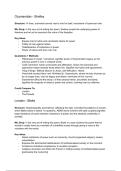
Ozymandias - Shelley
Structure:14 lines, subverted sonnet: man’s lovefor itself, narcissism of tyrannical ruler
ic Drop:In the very act of writing this poem, Shelleyreveals the underlying power of
M
literature and art as he resurrects the voice of the forgotten.
Key Ideas:
- Expose man’s hubris and narcissistic desire for power
- Futility of man against nature
- Totalitarianism of institutions of power
- Power of nature and time over man
Quotations + Methods:
- Palimpsest of voices / narratives: signifies power of Ozymandias’ legacy, as his
previous power is now a ‘colossal wreck’.
- ‘Cold command’: harsh consonants and alliteration, shows his tyrannical and
oppressive nature towards those below him. Signifies his hubris and egocentrism.
- ‘King of kings’: Biblical allusion to Jesus, self deification. Hubris.
- ‘Hand that mocked them’ and ‘Wrinkled lip’: Synecdoche, shows his loss of power as
he no longer lives, only his legacy and others’ memories of him ‘survive’.
- Enjambment [Round the decay / of that colossal wreck, boundless and bare]:
signifies the longevity of nature’s power and control, outliving man by millennia.
Could Compare To:
- London
- The Prelude
London - Blake
tructure:Graphologically symmetrical, reflecting the rigid, controlled foundations of society
S
which Blake seeks to attack. 4x quatrains, ABAB rhyme scheme with split couplets [signifies
large imbalance of power between institutions of power and the destitute underbelly of
society].
ic Drop:In the very act of writing this poem, Blakein a way reclaims the power that he
M
wouldn’t usually have as a member of a stratified society through giving a voice to the
voiceless with his words.
Key Ideas:
- Attack institutions of power such as monarchy, church [organised religion], empire,
industrialism.
- Exposes the detrimental totalitarianism of institutionalised society on the innocent.
- Condemns individual complacency in societal corruption.
- Catalyse revolution and follow the French in ridding society of institutionalised power
[particularly the monarchy]
, - Power of man over man
Quotations + Methods:
- Anaphora: ‘in every’ - signifies ubiquity of the misery caused by institutions of power,
reinforced by coupling with repetition of ‘cry’.
- ‘Runs in blood down palace walls’ - directly references the French Revolution, whilst
also directly blaming the monarchy for overseeing the ‘woe’ in society. Also ‘runs in
blood’ could signify the longevity of the royal family line, perhaps Blake is saying it is
outdated and should therefore be overturned.
- Repetition of ‘marks’ - Cain, the first murderer; forever tainted / marked by his sins.
Ironic because Blake utilises this allusion to signify the permanence of the damage
caused by institutionalised power whilst also ironically using it to show the people are
suffering as a result of others’ hubris/sins.
- Lexical field of crying: ‘sigh, cry, appals’ - signifies the misery of the destitute
underbelly of society.
- ^ Coupled with the acrostic of the third stanza ‘HEAR’ as well as the aural imagery
shows the ignorance of those in power who choose to remain stagnant in their views.
- ‘Mind forged manacles’: metaphor - Blake is angry at individual complacency whilst
also urging them to rise up as the institutions have not yet physically chained them
and there is still time to make a difference.
- Direct attacks on institutions of power: ‘chimney sweeper’ - industrial, ‘black’ning
church’ - religious, ‘hapless soldier’ - military, ‘palace walls’ - the monarchy.
- Lexical field of lost innocence / youth: ‘infant’, ‘youthful harlot’, ‘new-born infant’ -
Blake wrote Songs of Innocence and Songs of Experience, Blake therefore
condemns the loss of innocence after experiencing the horrors of ‘London’.
Could Compare To:
- Ozymandias
The Prelude - Wordsworth
Structure:First person, blank verse, regular rhythm.
ic Drop:In the very act of writing his rumination,Wordsworth traces the development of
M
the human psyche, particularly in the face of nature after foolish hubris. Wordsworth utilises
the extended metaphor of the river to mirror his own spiritual journey of reflection.
Key Ideas:
- Expose man’s insignificance in comparison to nature.
- Reveal the futility of hubris in the face of nature as it is short lived.
- Reveal nature’s omnipresence as well as omnipotence especially compared to man -
transcendent.
- Power of nature over man.
Quotations + Methods:
, - olta as speaker realises his insignificance in comparison to nature; he sees the
V
‘huge peak, black and huge’. Signifies the nemesis after Wordsworth’s hamartia,
hubris.
- ‘An act of stealth’ - acknowledgement of sin, also ‘stealth’ connotes ideas of
quietness and being unseen, however this is debunked as Wordsworth realises
nature sees everything and is omnipresent. Also signifies arrogance of mankind.
- ‘Troubled pleasure’: oxymoron, excitement interrupted by guilt - foreshadows his
newfound insignificance in the face of nature.
- Conflicting lexical fields of light and darkness: ‘glittering, sparkling, summer, stars,
light, day’ vs. ‘moon, evening, stars, grey, grim, black, darkness, dim’ - signifies the
beauty of nature superficially that man sees versus its true power and potency over
man, as well as the superficial arrogance and ‘pleasure’ of man’s hubris before it
turns dark as fearful as man is punished.
- ‘She was an elfin pinnace’: metaphor - signifies speaker’s hubris, feels he transcends
reality and has entered a different realm. Also connotes ignorance and arrogance as
he has no idea what is going to happen to him. Personification of the boat [man
made] also signifies a form of veneration for man and its creations, however the boat
was nature’s first, as referenced by the ‘little boat’ being ‘tied to a willow tree’.
- ‘Do not live / like living men’: Simile + enjambment - creates distance between nature
and man whilst also signifying the longevity of nature’s power, as well as its
transcendence over the natural world. Deification of nature.
Could Compare To:
- Ozymandias
- Exposure
- Storm on the Island
My Last Duchess - Browning
tructure:Dramatic monologue, free verse: signifiessporadic thoughts and mentality. Also
S
signifies the Duke’s narcissism and hubris.
ic Drop:In the very act of writing this poem, Browning not only exposes the sinister
M
undertones and power struggles in relationships, especially within institutions of power, but
also satirises the rich and educated and their inability to love and exert honesty.
Key Ideas:
- Exposes the hubris of those in power.
- Satirises the narcissism of institutions of power [ie. the monarchy].
- Exposes the transactional nature of marriage.
- Condemns the patriarchy and its detrimental conventions for women, particularly the
Duchess in this case.
- Condemns man’s obsession with material goods.
- Power of man over man.
Quotations + Methods:
Structure:14 lines, subverted sonnet: man’s lovefor itself, narcissism of tyrannical ruler
ic Drop:In the very act of writing this poem, Shelleyreveals the underlying power of
M
literature and art as he resurrects the voice of the forgotten.
Key Ideas:
- Expose man’s hubris and narcissistic desire for power
- Futility of man against nature
- Totalitarianism of institutions of power
- Power of nature and time over man
Quotations + Methods:
- Palimpsest of voices / narratives: signifies power of Ozymandias’ legacy, as his
previous power is now a ‘colossal wreck’.
- ‘Cold command’: harsh consonants and alliteration, shows his tyrannical and
oppressive nature towards those below him. Signifies his hubris and egocentrism.
- ‘King of kings’: Biblical allusion to Jesus, self deification. Hubris.
- ‘Hand that mocked them’ and ‘Wrinkled lip’: Synecdoche, shows his loss of power as
he no longer lives, only his legacy and others’ memories of him ‘survive’.
- Enjambment [Round the decay / of that colossal wreck, boundless and bare]:
signifies the longevity of nature’s power and control, outliving man by millennia.
Could Compare To:
- London
- The Prelude
London - Blake
tructure:Graphologically symmetrical, reflecting the rigid, controlled foundations of society
S
which Blake seeks to attack. 4x quatrains, ABAB rhyme scheme with split couplets [signifies
large imbalance of power between institutions of power and the destitute underbelly of
society].
ic Drop:In the very act of writing this poem, Blakein a way reclaims the power that he
M
wouldn’t usually have as a member of a stratified society through giving a voice to the
voiceless with his words.
Key Ideas:
- Attack institutions of power such as monarchy, church [organised religion], empire,
industrialism.
- Exposes the detrimental totalitarianism of institutionalised society on the innocent.
- Condemns individual complacency in societal corruption.
- Catalyse revolution and follow the French in ridding society of institutionalised power
[particularly the monarchy]
, - Power of man over man
Quotations + Methods:
- Anaphora: ‘in every’ - signifies ubiquity of the misery caused by institutions of power,
reinforced by coupling with repetition of ‘cry’.
- ‘Runs in blood down palace walls’ - directly references the French Revolution, whilst
also directly blaming the monarchy for overseeing the ‘woe’ in society. Also ‘runs in
blood’ could signify the longevity of the royal family line, perhaps Blake is saying it is
outdated and should therefore be overturned.
- Repetition of ‘marks’ - Cain, the first murderer; forever tainted / marked by his sins.
Ironic because Blake utilises this allusion to signify the permanence of the damage
caused by institutionalised power whilst also ironically using it to show the people are
suffering as a result of others’ hubris/sins.
- Lexical field of crying: ‘sigh, cry, appals’ - signifies the misery of the destitute
underbelly of society.
- ^ Coupled with the acrostic of the third stanza ‘HEAR’ as well as the aural imagery
shows the ignorance of those in power who choose to remain stagnant in their views.
- ‘Mind forged manacles’: metaphor - Blake is angry at individual complacency whilst
also urging them to rise up as the institutions have not yet physically chained them
and there is still time to make a difference.
- Direct attacks on institutions of power: ‘chimney sweeper’ - industrial, ‘black’ning
church’ - religious, ‘hapless soldier’ - military, ‘palace walls’ - the monarchy.
- Lexical field of lost innocence / youth: ‘infant’, ‘youthful harlot’, ‘new-born infant’ -
Blake wrote Songs of Innocence and Songs of Experience, Blake therefore
condemns the loss of innocence after experiencing the horrors of ‘London’.
Could Compare To:
- Ozymandias
The Prelude - Wordsworth
Structure:First person, blank verse, regular rhythm.
ic Drop:In the very act of writing his rumination,Wordsworth traces the development of
M
the human psyche, particularly in the face of nature after foolish hubris. Wordsworth utilises
the extended metaphor of the river to mirror his own spiritual journey of reflection.
Key Ideas:
- Expose man’s insignificance in comparison to nature.
- Reveal the futility of hubris in the face of nature as it is short lived.
- Reveal nature’s omnipresence as well as omnipotence especially compared to man -
transcendent.
- Power of nature over man.
Quotations + Methods:
, - olta as speaker realises his insignificance in comparison to nature; he sees the
V
‘huge peak, black and huge’. Signifies the nemesis after Wordsworth’s hamartia,
hubris.
- ‘An act of stealth’ - acknowledgement of sin, also ‘stealth’ connotes ideas of
quietness and being unseen, however this is debunked as Wordsworth realises
nature sees everything and is omnipresent. Also signifies arrogance of mankind.
- ‘Troubled pleasure’: oxymoron, excitement interrupted by guilt - foreshadows his
newfound insignificance in the face of nature.
- Conflicting lexical fields of light and darkness: ‘glittering, sparkling, summer, stars,
light, day’ vs. ‘moon, evening, stars, grey, grim, black, darkness, dim’ - signifies the
beauty of nature superficially that man sees versus its true power and potency over
man, as well as the superficial arrogance and ‘pleasure’ of man’s hubris before it
turns dark as fearful as man is punished.
- ‘She was an elfin pinnace’: metaphor - signifies speaker’s hubris, feels he transcends
reality and has entered a different realm. Also connotes ignorance and arrogance as
he has no idea what is going to happen to him. Personification of the boat [man
made] also signifies a form of veneration for man and its creations, however the boat
was nature’s first, as referenced by the ‘little boat’ being ‘tied to a willow tree’.
- ‘Do not live / like living men’: Simile + enjambment - creates distance between nature
and man whilst also signifying the longevity of nature’s power, as well as its
transcendence over the natural world. Deification of nature.
Could Compare To:
- Ozymandias
- Exposure
- Storm on the Island
My Last Duchess - Browning
tructure:Dramatic monologue, free verse: signifiessporadic thoughts and mentality. Also
S
signifies the Duke’s narcissism and hubris.
ic Drop:In the very act of writing this poem, Browning not only exposes the sinister
M
undertones and power struggles in relationships, especially within institutions of power, but
also satirises the rich and educated and their inability to love and exert honesty.
Key Ideas:
- Exposes the hubris of those in power.
- Satirises the narcissism of institutions of power [ie. the monarchy].
- Exposes the transactional nature of marriage.
- Condemns the patriarchy and its detrimental conventions for women, particularly the
Duchess in this case.
- Condemns man’s obsession with material goods.
- Power of man over man.
Quotations + Methods: