
MEIOSIS
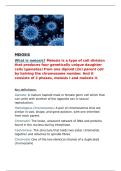
What is meiosis? Meiosis is a type of cell division
that produces four genetically unique daughter
cells (gametes) from one diploid (2n) parent cell
by halving the chromosome number. And it
consists of 2 phases, meiosis I and meiosis II.
Key definitions:
Gamete: A mature haploid male or female germ cell which that
can unite with another of the opposite sex in sexual
reproduction.
Homologous Chromosomes: A pair of chromosomes that are
similar in size, shape, and gene position, with one inherited
from each parent.
Chromatin: The loose, unwound network of DNA and proteins
found in the nucleus during interphase.
Centromere: The structure that holds two sister chromatids
together and attaches to spindle fibres.
Chromatid: One of the two identical strands of a duplicated
chromosome

