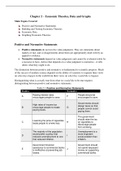
Chapter 2 – Economic Theories, Data and Graphs
Main Topics Covered
Positive and Normative Statements
Building and Testing Economic Theories
Economic Data
Graphing Economic Theories
Positive and Normative Statements
• Positive statements do not involve value judgments. They are statements about
matters of fact, and so disagreements about them are appropriately dealt with by an
appeal to evidence.
• Normative statements depend on value judgments and cannot be evaluated solely by
a recourse to facts. Advice that depends on a value judgment is normative—it tells
others what they ought to do.
The distinction between positive and normative is fundamental to scientific progress. Much
of the success of modern science depends on the ability of scientists to separate their views
on what does happen in the world from their views on what they would like to happen.
Distinguishing what is actually true from what we would like to be true requires
distinguishing between positive and normative statements.
Table2-1 Positive and Normative Statements
Positive Normative
Raising interest rates People should be
A F
encourages people to save. encouraged to save.
Governments should
High rates of income tax
design taxes so that
B encourage people to evade G
people cannot avoid
paying taxes.
paying them.
The government
should raise the tax
Lowering the price of cigarettes
C H on cigarettes to
leads people to smoke less.
discourage people
from smoking.
The majority of the population Unemployment is a
would prefer a policy that more important
D I
reduced unemployment to one social problem than
that reduced inflation. inflation.
Government financial Government should
assistance to commercial banks not spend taxpayers’
E J
is ineffective at preventing job money on supporting
losses. commercial banks.
,Two things to notice about the positive/normative distinction:
1. Positive statements need not be true. Statement C is almost certainly false, and yet it
is positive, not normative
2. The inclusion of a value judgment in a statement does not necessarily make the
statement itself normative. Statement D is a positive statement about the value
judgments that people hold.
There is no need for the economist to rely on a value judgment to check the validity of
the statement itself.
Disagreements Among Economists
Reasons for it:
• Poor communication. They often fail to define their terms or their points of reference
clearly, and so they end up “arguing past” each other, with the only certain result
being that the audience is left confused.
• Failure to acknowledge the full state of their ignorance. There are many points on
which the evidence is far from conclusive. In such cases, a responsible economist
makes clear the extent to which his or her view is based on judgments about the
relevant (and uncertain) facts.
Building and Testing Economic Theories
• Theories are used to both explain events that have already happened and to help
predict events that might happen in the future.
• Like demand and supply theory and all other theories are distinguished by
their variables, assumptions, and predictions.
Building Theories
Variables
• A variable is a well-defined item, such as a price or a quantity, that can take on
different possible values.
• There are two broad categories of variables that are important in any theory.
1. An endogenous variable: a variable that is explained within a theory.
Sometimes called an induced variable or a dependent variable. E.g. Price and
quantity of eggs
2. An exogenous variable: A variable that is determined outside the theory.
Sometimes called an autonomous variable or an independent variable. E.g. the
state of weather (as it may affect the number of eggs consumed and produced)
, Assumptions
• A theory’s assumptions concern motives, directions of causation, and the conditions
under which the theory is meant to apply.
Motives
• Individuals are assumed to strive to maximize their utility, while firms are
assumed to try to maximize their profits.
• Not only are they assumed to know what they want, but we also assume that
they know how to go about getting it within the constraints they face
Directions of Causation
• When economists assume that one variable is related to another, they are
usually assuming some causal link between the two
• E.g. Producers supply more wheat because the growing conditions improve;
they are not assumed to experience better weather as a result of their increased
supply of wheat.
Conditions of Application
• Assumptions are used to specify the conditions under which a theory is meant
to hold
• A good theory abstracts in a useful way; a poor theory does not. If a theory has
ignored some genuinely important factors, its predictions will usually be
contradicted by the evidence.
Predictions
• A theory’s predictions are the propositions that can be deduced from it. They are often
called hypotheses
Main Topics Covered
Positive and Normative Statements
Building and Testing Economic Theories
Economic Data
Graphing Economic Theories
Positive and Normative Statements
• Positive statements do not involve value judgments. They are statements about
matters of fact, and so disagreements about them are appropriately dealt with by an
appeal to evidence.
• Normative statements depend on value judgments and cannot be evaluated solely by
a recourse to facts. Advice that depends on a value judgment is normative—it tells
others what they ought to do.
The distinction between positive and normative is fundamental to scientific progress. Much
of the success of modern science depends on the ability of scientists to separate their views
on what does happen in the world from their views on what they would like to happen.
Distinguishing what is actually true from what we would like to be true requires
distinguishing between positive and normative statements.
Table2-1 Positive and Normative Statements
Positive Normative
Raising interest rates People should be
A F
encourages people to save. encouraged to save.
Governments should
High rates of income tax
design taxes so that
B encourage people to evade G
people cannot avoid
paying taxes.
paying them.
The government
should raise the tax
Lowering the price of cigarettes
C H on cigarettes to
leads people to smoke less.
discourage people
from smoking.
The majority of the population Unemployment is a
would prefer a policy that more important
D I
reduced unemployment to one social problem than
that reduced inflation. inflation.
Government financial Government should
assistance to commercial banks not spend taxpayers’
E J
is ineffective at preventing job money on supporting
losses. commercial banks.
,Two things to notice about the positive/normative distinction:
1. Positive statements need not be true. Statement C is almost certainly false, and yet it
is positive, not normative
2. The inclusion of a value judgment in a statement does not necessarily make the
statement itself normative. Statement D is a positive statement about the value
judgments that people hold.
There is no need for the economist to rely on a value judgment to check the validity of
the statement itself.
Disagreements Among Economists
Reasons for it:
• Poor communication. They often fail to define their terms or their points of reference
clearly, and so they end up “arguing past” each other, with the only certain result
being that the audience is left confused.
• Failure to acknowledge the full state of their ignorance. There are many points on
which the evidence is far from conclusive. In such cases, a responsible economist
makes clear the extent to which his or her view is based on judgments about the
relevant (and uncertain) facts.
Building and Testing Economic Theories
• Theories are used to both explain events that have already happened and to help
predict events that might happen in the future.
• Like demand and supply theory and all other theories are distinguished by
their variables, assumptions, and predictions.
Building Theories
Variables
• A variable is a well-defined item, such as a price or a quantity, that can take on
different possible values.
• There are two broad categories of variables that are important in any theory.
1. An endogenous variable: a variable that is explained within a theory.
Sometimes called an induced variable or a dependent variable. E.g. Price and
quantity of eggs
2. An exogenous variable: A variable that is determined outside the theory.
Sometimes called an autonomous variable or an independent variable. E.g. the
state of weather (as it may affect the number of eggs consumed and produced)
, Assumptions
• A theory’s assumptions concern motives, directions of causation, and the conditions
under which the theory is meant to apply.
Motives
• Individuals are assumed to strive to maximize their utility, while firms are
assumed to try to maximize their profits.
• Not only are they assumed to know what they want, but we also assume that
they know how to go about getting it within the constraints they face
Directions of Causation
• When economists assume that one variable is related to another, they are
usually assuming some causal link between the two
• E.g. Producers supply more wheat because the growing conditions improve;
they are not assumed to experience better weather as a result of their increased
supply of wheat.
Conditions of Application
• Assumptions are used to specify the conditions under which a theory is meant
to hold
• A good theory abstracts in a useful way; a poor theory does not. If a theory has
ignored some genuinely important factors, its predictions will usually be
contradicted by the evidence.
Predictions
• A theory’s predictions are the propositions that can be deduced from it. They are often
called hypotheses