
Workplace Motivation
Thursday, 18 September 2025 12:22
Motivation Process
Content theories
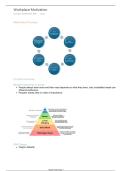
Maslow's hierarchy of needs:
• People always want more and their need depends on what they have, only unsatisfied needs can
influence behaviour
• People's needs arise in order of importance
ERG Theory
• Clayton Alderfer
Quick Notes Page 1
, •
• More than one level of needs can motivate at the same time
Herzberg's 2 factor theory:
• Motivator: (job content) the work itself, achievement, recognition, responsibility and growth, areas of
satisfication and motivation
• Hygiene factors: (Job context) salary, interpersonal relations, org. policy, job security, areas of
dissatisfaction, does not lead to motivation itself but can be dissatisfactory if not fulfilled.
Acquired needs model:
• David McClelland
• Need for Achievement: need to excel, strive for success
• Need for Affiliation: desire for friendly and close interpersonal relationships
• Need for power: to make others behave in a way they would not otherwise have.
Management Application:
Achievement- motivated by non routine, challenging tasks with clear goals
Affiliation- motivated if they work in teams and receive praise/recognition
Power- direct the actions of others and work in competitive/ status orientated situations
Process Theories
Equity Theory:
• Compare their inputs/outputs to those they perceive as an equal to establish if the reward they
receive is fair
• If the perceive that they are under-rewarded: -reduce inputs by lower performance, - increase reward
by asking for a raise, - leave situation
Expectancy Theory:
• Need to perceive a relationship between their effort and performance, their performance and reward
they receive and the value they place on the reward
• Victor Vroom
• Expectancy theory(effort-reward): belief that a particular level of performance will follow a level of
effort
• Instrumentality (Performance-reward): degree of belief that a certain level of performance will lead to
attainment of desired outcome
• Valence (rewards- personal goals): value attached to various work outcomes
Manager Application:
Link performance of employees to rewards received
Clearly communicate desired behaviours/outcomes
Quick Notes Page 2

