

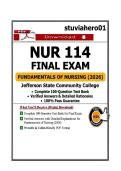
,NUR 114 FINAL EXAM – FUNDAMENTALS OF NURSING (2026)
Jefferson State Community College | Complete 100-Question
Test Bank | Verified Answers & Detailed Rationales | 100%
Pass Guarantee
EXAM BLUEPRINT
Topic Area Questions
Nursing Process & Clinical Judgment 1–15
Safety & Fall Prevention 16–25
Infection Control & PPE 26–35
Medication Administration & Pharmacology 36–50
Fluid, Electrolyte & Acid-Base Balance 51–60
Legal & Ethical Issues 61–75
Therapeutic Communication 76–85
Mobility, Skin Integrity & Wound Care 86–95
Comprehensive NGN Case Scenarios 96–100
,SECTION 1: NURSING PROCESS & CLINICAL JUDGMENT
(Questions 1–15)
1. Which of the following is the correct order of the nursing
process?
A) Evaluation, Assessment, Planning, Implementation, Diagnosis
B) Assessment, Diagnosis, Planning, Implementation, Evaluation
C) Planning, Assessment, Diagnosis, Evaluation, Implementation
D) Diagnosis, Assessment, Planning, Implementation,
Evaluation
Answer: B) Assessment, Diagnosis, Planning, Implementation,
Evaluation
Rationale: The nursing process is a systematic, problem-solving
approach used by nurses to identify patient needs and deliver
individualized care. The correct sequence begins with
Assessment (gathering data), followed by Diagnosis (analyzing
data to identify problems), Planning (setting goals),
Implementation (carrying out interventions), and Evaluation
(determining effectiveness).
2. A nurse is collecting data about a patient's sleep patterns.
The patient states, "I wake up three or four times every night."
This information is classified as:
A) Objective data
, B) Subjective data
C) Secondary data
D) Historical data
Answer: B) Subjective data
Rationale: Subjective data are what the patient says or feels—
symptoms, perceptions, and sensations that cannot be directly
observed or measured by the nurse. The patient's report of
waking up during the night is subjective. Objective data are
measurable and observable findings such as vital signs or
physical examination results.
3. During the evaluation phase of the nursing process, a nurse
determines that a patient's pain level remains at an 8 out of 10
after administering prescribed medication. What is the most
appropriate next action?
A) Document the findings and discontinue the intervention
B) Reassess the patient and revise the plan of care
C) Wait 24 hours to see if the pain improves
D) Administer a second dose immediately without an order
Answer: B) Reassess the patient and revise the plan of care
Rationale: Evaluation involves comparing patient responses to
expected outcomes. If the outcome is not met, the nurse
should reassess the patient and revise the plan of care.
Jefferson State Community College | Complete 100-Question
Test Bank | Verified Answers & Detailed Rationales | 100%
Pass Guarantee
EXAM BLUEPRINT
Topic Area Questions
Nursing Process & Clinical Judgment 1–15
Safety & Fall Prevention 16–25
Infection Control & PPE 26–35
Medication Administration & Pharmacology 36–50
Fluid, Electrolyte & Acid-Base Balance 51–60
Legal & Ethical Issues 61–75
Therapeutic Communication 76–85
Mobility, Skin Integrity & Wound Care 86–95
Comprehensive NGN Case Scenarios 96–100
,SECTION 1: NURSING PROCESS & CLINICAL JUDGMENT
(Questions 1–15)
1. Which of the following is the correct order of the nursing
process?
A) Evaluation, Assessment, Planning, Implementation, Diagnosis
B) Assessment, Diagnosis, Planning, Implementation, Evaluation
C) Planning, Assessment, Diagnosis, Evaluation, Implementation
D) Diagnosis, Assessment, Planning, Implementation,
Evaluation
Answer: B) Assessment, Diagnosis, Planning, Implementation,
Evaluation
Rationale: The nursing process is a systematic, problem-solving
approach used by nurses to identify patient needs and deliver
individualized care. The correct sequence begins with
Assessment (gathering data), followed by Diagnosis (analyzing
data to identify problems), Planning (setting goals),
Implementation (carrying out interventions), and Evaluation
(determining effectiveness).
2. A nurse is collecting data about a patient's sleep patterns.
The patient states, "I wake up three or four times every night."
This information is classified as:
A) Objective data
, B) Subjective data
C) Secondary data
D) Historical data
Answer: B) Subjective data
Rationale: Subjective data are what the patient says or feels—
symptoms, perceptions, and sensations that cannot be directly
observed or measured by the nurse. The patient's report of
waking up during the night is subjective. Objective data are
measurable and observable findings such as vital signs or
physical examination results.
3. During the evaluation phase of the nursing process, a nurse
determines that a patient's pain level remains at an 8 out of 10
after administering prescribed medication. What is the most
appropriate next action?
A) Document the findings and discontinue the intervention
B) Reassess the patient and revise the plan of care
C) Wait 24 hours to see if the pain improves
D) Administer a second dose immediately without an order
Answer: B) Reassess the patient and revise the plan of care
Rationale: Evaluation involves comparing patient responses to
expected outcomes. If the outcome is not met, the nurse
should reassess the patient and revise the plan of care.

