
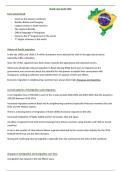
Brazil case study- EDC
Facts about Brazil
- Home to the Amazon rainforest
- Borders Bolivia and Paraguay
- Largest country in South America
- The capital is Brasilia
- Official language is Portuguese
- Home to the 2nd longest river in the world
- 7th largest economy in the world
History of Brazils migration
In the late 1800s and 1900s 1.9 million Europeans were attracted to work in the agricultural sector;
especially coffee cultivation.
Since the 1930s, Japanese have been drawn towards the agricultural and industrial sectors.
World wars drastically reduced migration to Brazil (during WW2 there were 12 migrants) as the
government was concerned about the potential for Axis powers to exploit their connections with
immigrants; seeking to influence and mobilise them in support of their war efforts.
Economic migration to neighbouring countries have always been high; Paraguay and Argentina
Current patterns of immigration and emigration
A net migration loss of 500,000 in each of the 4-year periods 2000-2004 and 2005-2009. But this slowed to
190,000 between 2010-2014.
Increased migration between Brazil and its neighbouring countries (especially Mercosur members but also
Chile and the Andean states).
There is a slowing down of emigration of lower skilled economic migrants to the USA.
Increased emigration of highly skilled workers to Europe, USA and Japan.
An influx of migrants from Haiti and increasingly from African countries using Ecuador and Chile as transit
countries.
A rise in the number of international labour migrants attracted by the construction industry for the 2014
football World Cup and the 2016 olympics.
Strong and continuing internal migration, especially from the northeast to the cities of the southeast.
Changes in immigration and emigration over time
Immigration has slowed in the last fifteen years.

