
Escrito por estudiantes que aprobaron Inmediatamente disponible después del pago Leer en línea o como PDF ¿Documento equivocado? Cámbialo gratis 4,6 TrustPilot
logo-home
Document preview thumbnail
Vista previa 2 fuera de 14 páginas
Examen

ABCTE PTK Practice Exam 2026 | 30+ Exam Questions & Verified Answers | Assessment, Bloom’s Taxonomy, Classroom Management & Instructional Strategies | American Board for Certification of Teacher Excellence (ABCTE)

Document preview thumbnail
Vista previa 2 fuera de 14 páginas

This ABCTE Professional Teaching Knowledge (PTK) Practice Exam 2026 contains more than 30 carefully selected exam-style questions and detailed answer explanations designed to help teacher candidates prepare for the American Board for Certification of Teacher Excellence (ABCTE) PTK certification examination. The resource focuses on the practical application of educational theory, instructional decision-making, classroom management, assessment design, curriculum planning, and effective teaching practices that are commonly assessed on teacher licensure and certification examinations. The practice questions evaluate a candidate’s ability to apply pedagogical knowledge to authentic classroom scenarios, interpret assessment data, select appropriate instructional strategies, promote higher-order thinking, support student learning, and implement research-based educational practices. Topics include Bloom’s Taxonomy, formative and summative assessment, criterion-referenced and norm-referenced testing, cooperative learning, differentiated instruction, transfer of learning, inductive and deductive reasoning, graphic organizers, classroom procedures, student engagement, curriculum alignment, educational measurement, and instructional planning. The content reflects evidence-based instructional principles found in major educational research and teacher preparation literature. Bloom’s cognitive framework is based on the seminal work of Bloom et al. (Taxonomy of Educational Objectives: The Classification of Educational Goals, 1956). Instructional strategies and effective teaching practices align with Rosenshine’s research on explicit instruction and cognitive support (Rosenshine, B. Principles of Instruction: Research-Based Strategies That All Teachers Should Know, American Educator, 2012). Concepts related to transfer of learning, formative assessment, and curriculum alignment are supported by contemporary educational assessment literature, including Wiggins & McTighe’s Understanding by Design and Brookhart’s How to Create and Use Rubrics for Formative Assessment and Grading. Throughout the document, candidates encounter realistic classroom situations requiring professional judgment and pedagogical reasoning, making this an effective preparation tool for both first-time test takers and educators seeking certification through alternative licensure pathways. The question-and-answer format promotes self-assessment, content review, and exam readiness while reinforcing essential teaching competencies expected of beginning educators. Relevant Students: ABCTE PTK certification candidates Alternative teacher certification candidates Elementary education students Secondary education students Teacher licensure examination candidates Student teachers Bachelor of Education students Graduate education students Educational psychology students Curriculum and instruction students Professional development participants New and aspiring teachers Substitute teachers pursuing certification Teacher preparation program participants Keywords ABCTE PTK Practice Exam, ABCTE Professional Teaching Knowledge, PTK Exam Questions, PTK Practice Test, Teacher Certification Exam, Teacher Licensure Preparation, Bloom's Taxonomy, Higher Order Thinking Skills, Classroom Management, Instructional Strategies, Educational Assessment, Formative Assessment, Summative Assessment, Criterion Referenced Assessment, Norm Referenced Assessment, Curriculum Planning, Curriculum Alignment, Cooperative Learning, Student Engagement, Educational Psychology, Transfer of Learning, Differentiated Instruction, Graphic Organizers, Educational Measurement, Learning Objectives, Explicit Instruction, Inductive Reasoning, Deductive Reasoning, Teacher Preparation, Pedagogy, Assessment Design, Classroom Procedures, Educational Research, Practice Questions and Answers, Teacher Exam Study Guide

Vista previa del contenido

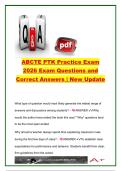
ABCTE PTK Practice Exam
2026 Exam Questions and
Correct Answers | New Update


What type of question would most likely generate the widest range of

answers and discussions among students? - ANSWER ✔✔Why

would the author have ended the book this way? "Why" questions tend

to be the most open-ended.

Why should a teacher always spend time explaining classroom rules

during the first few days of class? - ANSWER ✔✔To establish clear

expectations for performance and behavior. Students benefit from clear,

firm guidelines from the outset.

, What method will BEST hold students accountable for their full

participation in cooperative learning groups? - ANSWER ✔✔Assign

each student in the group a specific role in accomplishing the objectives

of the activity. If each student has a role in meeting the objectives and

the activity is well structured, then all students will be drawn into

participating because they all have something to do.

When teachers share standardized test results with parents, there is a

large amount of information in the score report to be discussed. Which

information will be of MOST use to the typical parent? - ANSWER

✔✔Specific areas of academic strength and weakness. When parents

know their child's weaknesses, they can emphasize working to improve

them.

Suppose your objective for a lesson is "The student will demonstrate an

ability to differentiate among igneous, sedimentary, and metamorphic

rocks." Which of the following is the BEST activity for introducing

students to the attributes of each type of rock? - ANSWER

✔✔Students examine rocks belonging to each group and identify the

similarities and differences. The activity is followed by a group

discussion in which the teacher brings out the important characteristics

of each type. Students learn best when they are actively involved.

Información del documento

Subido en
18 de junio de 2026
Número de páginas
14
Escrito en
2025/2026
Tipo
Examen
Contiene
Preguntas y respuestas
$18.99

¿Documento equivocado? Cámbialo gratis Dentro de los 14 días posteriores a la compra y antes de descargarlo, puedes elegir otro documento. Puedes gastar el importe de nuevo.
Escrito por estudiantes que aprobaron
Inmediatamente disponible después del pago
Leer en línea o como PDF

Seller avatar
Los indicadores de reputación están sujetos a la cantidad de artículos vendidos por una tarifa y las reseñas que ha recibido por esos documentos. Hay tres niveles: Bronce, Plata y Oro. Cuanto mayor reputación, más podrás confiar en la calidad del trabajo del vendedor.
PROFFKERRYMARTIN
3.3
(55)
Vendido
286
Seguidores
9
Artículos
11174
Última venta
3 días hace


Por qué los estudiantes eligen Stuvia

Creado por compañeros estudiantes, verificado por reseñas

Calidad en la que puedes confiar: escrito por estudiantes que aprobaron y evaluado por otros que han usado estos resúmenes.

¿No estás satisfecho? Elige otro documento

¡No te preocupes! Puedes elegir directamente otro documento que se ajuste mejor a lo que buscas.

Paga como quieras, empieza a estudiar al instante

Sin suscripción, sin compromisos. Paga como estés acostumbrado con tarjeta de crédito y descarga tu documento PDF inmediatamente.

Student with book image

“Comprado, descargado y aprobado. Así de fácil puede ser.”

Alisha Student

Preguntas frecuentes
