

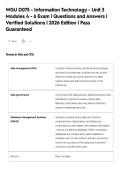
WGU D075 - Information Technology - Unit 3
Modules 4 - 6 Exam | Questions and Answers |
Verified Solutions | 2026 Edition | Pass
Guaranteed
Save
Terms in this set (73)
data management (DM) consists of the practices, architectural techniques,
and tools for achieving consistent access to and
delivery of data across the spectrum of data
subject areas and data structure types in the
enterprise.
data governance concerned with data policies, data procedures, and
standards to govern business-critical data.
Basically, that means securing data so that they
remain confidential and safe
Database Management Systems Software systems where data are stored in
(DBMS) computer files called tables, and tables are
connected to other tables with related information
—hence, a relational database. Within a business,
databases are created and made available to
multiple users on the network and are secured to
ensure the accuracy of the data and to prevent
access by unauthorized users.
Record Row in a table
,Field A column in a table.
Relational Database A group of database tables that is connected or
linked by a defined relationship that ties the
information together.
SQL (Structured Query Language) an international standard language for processing
a database
Schema The organization or layout of a database that
defines the tables, fields and constraints, keys, and
integrity of the database. It is the reference or
blueprint of the database.
Big Data vast amounts of data that organizations want are
not in readily available, neat, and tidy database
tables. Data come from everywhere—including
smartphone metadata, internet usage records,
social media activity, computer usage records, and
countless other data sources—to be sifted for
patterns and trends. These large and expansive
collected data sets
Volume The main characteristic of big data is that it is big,
and the remarkable volume it takes just to hold and
manage digital data requires significant resources.
The total volume of big data is growing
exponentially because the sources that are
producing big data are ever increasing.
, Variety Data come both from structured and unstructured
areas and in various forms. Structured data are data
that you can easily recognize and this information
easily fits into a relational database. But there are
also the unstructured data that come from more
fragmented sources; it contains valuable
information but does not fit a form.
Veracity The data must also be of high quality and
trustworthy. Do the data represent what you
believe they should? Are there discrepancies within
the data that must be scrubbed to make the data
worthwhile and valuable?
Velocity This is the accelerating speed of the data being
produced over a given time period. Streaming
applications such as Amazon Web Services and
Netflix are examples of a good velocity of data, as
is the data your cell phone generates each minute
it is turned on.
Data Mining (Data Discovery) is the examination of huge sets of data to find
patterns, connections, outliers, and hidden
relationships. Data mining is a business intelligence
tool used for decision making.
Extract Once you have determined where your data is
coming from and where you want it to reside, you
can start extracting. The data are often extracted
from customer relationship management (CRM or
enterprise resource planning (ERP) systems.
Modules 4 - 6 Exam | Questions and Answers |
Verified Solutions | 2026 Edition | Pass
Guaranteed
Save
Terms in this set (73)
data management (DM) consists of the practices, architectural techniques,
and tools for achieving consistent access to and
delivery of data across the spectrum of data
subject areas and data structure types in the
enterprise.
data governance concerned with data policies, data procedures, and
standards to govern business-critical data.
Basically, that means securing data so that they
remain confidential and safe
Database Management Systems Software systems where data are stored in
(DBMS) computer files called tables, and tables are
connected to other tables with related information
—hence, a relational database. Within a business,
databases are created and made available to
multiple users on the network and are secured to
ensure the accuracy of the data and to prevent
access by unauthorized users.
Record Row in a table
,Field A column in a table.
Relational Database A group of database tables that is connected or
linked by a defined relationship that ties the
information together.
SQL (Structured Query Language) an international standard language for processing
a database
Schema The organization or layout of a database that
defines the tables, fields and constraints, keys, and
integrity of the database. It is the reference or
blueprint of the database.
Big Data vast amounts of data that organizations want are
not in readily available, neat, and tidy database
tables. Data come from everywhere—including
smartphone metadata, internet usage records,
social media activity, computer usage records, and
countless other data sources—to be sifted for
patterns and trends. These large and expansive
collected data sets
Volume The main characteristic of big data is that it is big,
and the remarkable volume it takes just to hold and
manage digital data requires significant resources.
The total volume of big data is growing
exponentially because the sources that are
producing big data are ever increasing.
, Variety Data come both from structured and unstructured
areas and in various forms. Structured data are data
that you can easily recognize and this information
easily fits into a relational database. But there are
also the unstructured data that come from more
fragmented sources; it contains valuable
information but does not fit a form.
Veracity The data must also be of high quality and
trustworthy. Do the data represent what you
believe they should? Are there discrepancies within
the data that must be scrubbed to make the data
worthwhile and valuable?
Velocity This is the accelerating speed of the data being
produced over a given time period. Streaming
applications such as Amazon Web Services and
Netflix are examples of a good velocity of data, as
is the data your cell phone generates each minute
it is turned on.
Data Mining (Data Discovery) is the examination of huge sets of data to find
patterns, connections, outliers, and hidden
relationships. Data mining is a business intelligence
tool used for decision making.
Extract Once you have determined where your data is
coming from and where you want it to reside, you
can start extracting. The data are often extracted
from customer relationship management (CRM or
enterprise resource planning (ERP) systems.

