

Escrito por estudiantes que aprobaron Inmediatamente disponible después del pago Leer en línea o como PDF ¿Documento equivocado? Cámbialo gratis 4,6 TrustPilot
logo-home
Document preview thumbnail
Vista previa 4 fuera de 713 páginas
Examen

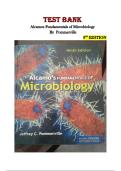
Test Bank for Alcamo's Fundamentals of Microbiology 9th Edition – Complete Exam Q&A with Rationales (All 27 Chapters)

Document preview thumbnail
Vista previa 4 fuera de 713 páginas

This comprehensive Test Bank for Alcamo's Fundamentals of Microbiology, 9th Edition is the definitive study companion for students, educators, and healthcare professionals seeking to master microbiology concepts and excel on exams. With over 2,500 multiple-choice questions, true/false statements, matching exercises, and essay prompts covering all 27 chapters, this resource provides complete exam preparation with verified correct answers and detailed rationales. What's Inside Complete Chapter Coverage (Chapters 1-27) Chapters Topics Covered 1-3 History of Microbiology, Chemistry of Life, Cell Structure 4-5 Prokaryotes vs. Eukaryotes, Bacterial Growth & Reproduction 6-7 Microbial Metabolism, Physical & Chemical Control Methods 8-9 Microbial Genetics, Genetic Engineering & Recombination 10-11 Respiratory & Digestive System Infections 12-13 Skin, Wound & Sexually Transmitted Infections 14-16 Virology: Structure, Replication & Viral Diseases 17-18 Mycology & Protozoology 19-21 Host-Microbe Interactions & Immunology 22-23 Hypersensitivity & Immune Disorders 24-27 Antimicrobial Therapy, Food & Water Microbiology, Industrial Microbiology Question Types Included Multiple Choice – Over 1,500 questions testing recall, comprehension, and application True/False with Corrections – Learn why false statements are incorrect with detailed corrections Matching Exercises – Reinforce terminology and concept associations Essay Questions – Bloom's taxonomy levels (Knowledge through Evaluation) for deep learning Key Features Verified Answers with Rationales Every question includes the correct answer followed by a clear, concise explanation of why it is correct. For false statements, the corrected version is provided. Bloom's Taxonomy Integration Questions are tagged with cognitive levels (Knowledge, Comprehension, Application, Analysis, Synthesis, Evaluation) to help instructors assess different learning objectives. Clinical Correlations Real-world scenarios link microbiology concepts to infectious diseases, diagnostics, and treatment strategies – ideal for nursing, medical, and allied health students. Comprehensive Rationales for Key Concepts Include: History of Microbiology: Contributions of Hooke, Leeuwenhoek, Pasteur, Koch, Lister, Jenner, Redi, Spallanzani, Needham; spontaneous generation experiments; germ theory of disease Chemistry of Life: Atoms, elements, isotopes, chemical bonds (ionic, covalent, hydrogen), pH, buffers, acids and bases, organic molecules (carbohydrates, lipids, proteins, nucleic acids) Cell Structure: Prokaryotic vs. eukaryotic cells, cell theory, organelles, Gram staining, bacterial cell wall (peptidoglycan), capsules, pili, fimbriae, flagella, endospores, plasma membrane Microbial Growth: Binary fission, generation time, growth curve phases (lag, log, stationary, death), environmental factors (temperature, pH, oxygen, osmotic pressure), culture media (selective, differential, enrichment) Metabolism: Catabolism vs. anabolism, enzymes (structure, function, inhibition), glycolysis, Krebs cycle, electron transport chain, fermentation, photosynthesis, chemiosmosis, ATP production Microbial Control: Physical methods (heat, autoclave, filtration, radiation, UV light), chemical methods (antiseptics, disinfectants, halogens, phenols, alcohols, heavy metals), sterilization, pasteurization Microbial Genetics: DNA structure and replication, transcription, translation, mutations, mutagens, Ames test, plasmids, transposons, gene transfer (transformation, conjugation, transduction) Virology: Virus structure (capsid, envelope, genome), bacteriophages, lytic vs. lysogenic cycles, animal virus replication, retroviruses, reverse transcriptase, HIV, prions, viroids Infectious Diseases: Respiratory infections (pneumonia, tuberculosis, strep throat, influenza, COVID-19), digestive system infections (salmonellosis, cholera, botulism, E. coli), STIs (syphilis, gonorrhea, chlamydia, herpes), skin and wound infections, vector-borne diseases Immunology: Innate vs. adaptive immunity, phagocytes, lymphocytes (B cells, T cells), antibodies (IgG, IgM, IgA, IgE, IgD), antigens and epitopes, MHC molecules, complement system, hypersensitivity reactions (Types I-IV), autoimmune diseases, vaccination, serological tests (ELISA, RIA) Mycology: Fungal structure (hyphae, mycelium, yeasts), reproduction (sexual and asexual), fungal diseases (candidiasis, histoplasmosis, cryptococcosis, tinea, aspergillosis), antifungal drugs Protozoology: Protozoan classification and locomotion, diseases (malaria, giardiasis, toxoplasmosis, trichomoniasis, trypanosomiasis, leishmaniasis, amoebiasis) Helminthology: Parasitic worms (nematodes, cestodes, trematodes), diseases (ascariasis, hookworm, pinworm, tapeworm, schistosomiasis) Antimicrobial Agents: Antibiotics (penicillins, cephalosporins, tetracyclines, macrolides, aminoglycosides), mechanisms of action, antibiotic resistance (beta-lactamases, MRSA, VRE), antiviral, antifungal, and antiprotozoal drugs Food & Water Microbiology: Food spoilage, food preservation methods, foodborne pathogens, water purification, coliform testing, MPN, membrane filtration, sewage treatment Industrial Microbiology: Fermentation, antibiotic production, enzyme production, bioremediation, biotechnology, genetically engineered products Sample Questions from the Test Bank Question: Who was one of the early natural philosophers who coined the name "cella" for the empty cork spaces that became the word we use today, "cells"? A) Robert Hooke B) Zacharias Janssen C) Francesco Stalluti D) Giovanni Faber Rationale: Robert Hooke observed thin slices of cork under a microscope and saw empty box-like compartments, which he named "cellae" (Latin for small rooms), coining the term "cells." Question: Leeuwenhoek was the first person to: A) see viruses B) use a microscope C) describe bacteria D) suggest animalcules caused disease Rationale: Antoni van Leeuwenhoek used his handcrafted microscopes to observe bacteria (which he called "animalcules") from dental scrapings and pond water, making him the first person to describe bacteria. Question: The Gram stain technique is valuable in distinguishing: A) types of fungi B) the size and structure of viruses C) the nucleus of bacteria from other cellular organelles D) different types of bacteria Rationale: The Gram stain differentiates bacteria into Gram-positive (purple) and Gram-negative (pink) based on cell wall structure differences in peptidoglycan thickness and outer membrane presence. Who Should Use This Test Bank Microbiology Students – Prepare for chapter quizzes, midterms, and final exams Nursing & Medical Students – Master clinically relevant microbiology for board exams (NCLEX, USMLE) Allied Health Students – Review for certification exams (MLT, MLS, PharmD, DDS) Pre-Health Students – Build a strong foundation for MCAT, DAT, and PCAT preparation Educators & Instructors – Save hours creating exams with ready-to-use, validated questions Format & Accessibility This test bank is provided in an accessible text-based format compatible with: Learning management systems (Canvas, Blackboard, Moodle) Study apps and flashcard tools Print or digital distribution for course use

Vista previa del contenido

,Chapter 1

Multiple Choice


1. Who was one of the early natural philosophers who coined the name “cella” for the
empty cork spaces that became the word we use today, “cells”?
A. Robert Hooke
B. Zacharias Janssen
C. Francesco Stalluti
D. Giovanni Faber


Ans: A


2. Leeuwenhoek made lenses that allowed him to magnify objects more than 200X.
However, he failed to promote scientific inquiry because:
A. he didn't share his drawings with other scientists.
B. he didn't reveal how he ground the lenses and no one else was doing it that well.
C. he limited his research to pond water
D. it was only a hobby and he didn't live very long


Ans: B

,3. Leeuwenhoek was the first person to:
A. see viruses.
B. use a microscope.
C. describe bacteria.
D. suggest animalcules caused disease.


Ans: C


4. Francesco Redi is famous for performing one of the first experiments over the debate
regarding spontaneous generation. What was his experiment?
A. He boiled some mutton gravy and sealed the tops with corks.

B. He covered some jars of meat with gauze and left others open. The covered jars did not
develop maggots, the uncovered ones did.
C. He showed that mice will appear with damp rags and rice.
D. He boiled broth for longer periods of time and sealed the tops with melted glass.


Ans: B


5. did not attempt to prove or refute the idea of spontaneous generation.

A. Francesco Redi
B. Robert Koch
C. Lazzaro Spallanzani

D. Louis Pasteur


Ans: B

, 6. Which one of the following would be consistent with the idea of spontaneous
generation?
A. Microorganisms may be cultivated on solid laboratory media.
B. Insects are important in the transmission of disease.
C. Sick people give rise to microorganisms in their body.

D. Disinfection is essential to prevent the spread of microorganisms.


Ans: C


7. Spallanzani’s experiments showed that:
A. viruses were transmitted by water.
B. spontaneous generation occurs.
C. miasma was the cause of disease.
D. experiments can be modified to test a hypothesis.


Ans: D
Page: 8


8. Which pair of scientists were antagonists during the same period of history?
A. Pasteur and Ehrlich
B. Koch and Leeuwenhoek
C. Spallanzani and Needham


Libro relacionado
 image
Editorial: 2010 ISBN: 9780763762582 Edición: Desconocido

Información del documento

Subido en
13 de junio de 2026
Número de páginas
713
Escrito en
2025/2026
Tipo
Examen
Contiene
Preguntas y respuestas
$18.99

¿Documento equivocado? Cámbialo gratis Dentro de los 14 días posteriores a la compra y antes de descargarlo, puedes elegir otro documento. Puedes gastar el importe de nuevo.
Escrito por estudiantes que aprobaron
Inmediatamente disponible después del pago
Leer en línea o como PDF

Seller avatar
Los indicadores de reputación están sujetos a la cantidad de artículos vendidos por una tarifa y las reseñas que ha recibido por esos documentos. Hay tres niveles: Bronce, Plata y Oro. Cuanto mayor reputación, más podrás confiar en la calidad del trabajo del vendedor.
PrepPulse
3.8
(4)
Vendido
32
Seguidores
2
Artículos
1437
Última venta
22 horas hace


Por qué los estudiantes eligen Stuvia

Creado por compañeros estudiantes, verificado por reseñas

Calidad en la que puedes confiar: escrito por estudiantes que aprobaron y evaluado por otros que han usado estos resúmenes.

¿No estás satisfecho? Elige otro documento

¡No te preocupes! Puedes elegir directamente otro documento que se ajuste mejor a lo que buscas.

Paga como quieras, empieza a estudiar al instante

Sin suscripción, sin compromisos. Paga como estés acostumbrado con tarjeta de crédito y descarga tu documento PDF inmediatamente.

Student with book image

“Comprado, descargado y aprobado. Así de fácil puede ser.”

Alisha Student

Preguntas frecuentes