
4 nBACTERIA SLIDE DECK - Questions and Study Guide
1) What are three key differences between prokaryotes and eukaryotes?
Prokaryotes are 10 -100 times smaller; prokaryotes do not have organized membrane-bound
organelles; prokaryotes have no nucleus but rather a “nucleoid” region where the main, large
single circle of DNA exists.
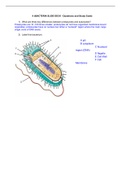
2) Label this bacterium.
A pili
B cytoplasm
C Nucleoid
region (DNA)
D flagella
E Cell Wall
F Cell
Membrane
, 3) Using the terms from class, label these shapes. Treat c) and d) as the same
shape. e) is vibrio shaped; not necessary to know.
A bacillus
B coccus
C spirillum
D spirillum
E vibrio
F streptococcus
G staphylococcus
H diplococcus
I streptobacillus
4) Gram staining works because the
peptidoglycan layer in gram
positive and gram negative
bacteria differ. Describe how
these layers differ.
Gram positive cells have a thick peptidoglycan layer that is the outer layer. Gram
negative cells have a thinner peptidoglycan layer that is under a layer of
lipopolysaccharide.
5) List the 4 chemicals used to perform a gram stain, and what each of them does.
Crystal Violet stains the peptidoglycan layer purple in both + and - cells
Iodine forms an insoluble complex in the layer of both + and - cells.
Ethanol dehydrates the outer peptidoglycan layer in + cells sealing in much of the
purple complex; however, in - cells it dissolves the outer lipopolysaccharide layer,
allowing for the purple complex to escape the thin peptidoglycan layer, resulting in clear
cells. Safranin is a “counterstain” that both cells pick up, but the darker purple + cells
are already darker than the pink safranin. The - cells pick up the pink safranin, staining
them pink.
6) LIST three ways in which bacteria can cause disease.
● Crowd out healthy cells through rapid growth of cells via binary fission
● “Steal” iron from our bodies as bacteria require it for reproduction; however it is a
tug of war as humans require it for healthy immune responses
● Produce toxins, many of which cause serious illness and/or death
1) What are three key differences between prokaryotes and eukaryotes?
Prokaryotes are 10 -100 times smaller; prokaryotes do not have organized membrane-bound
organelles; prokaryotes have no nucleus but rather a “nucleoid” region where the main, large
single circle of DNA exists.
2) Label this bacterium.
A pili
B cytoplasm
C Nucleoid
region (DNA)
D flagella
E Cell Wall
F Cell
Membrane
, 3) Using the terms from class, label these shapes. Treat c) and d) as the same
shape. e) is vibrio shaped; not necessary to know.
A bacillus
B coccus
C spirillum
D spirillum
E vibrio
F streptococcus
G staphylococcus
H diplococcus
I streptobacillus
4) Gram staining works because the
peptidoglycan layer in gram
positive and gram negative
bacteria differ. Describe how
these layers differ.
Gram positive cells have a thick peptidoglycan layer that is the outer layer. Gram
negative cells have a thinner peptidoglycan layer that is under a layer of
lipopolysaccharide.
5) List the 4 chemicals used to perform a gram stain, and what each of them does.
Crystal Violet stains the peptidoglycan layer purple in both + and - cells
Iodine forms an insoluble complex in the layer of both + and - cells.
Ethanol dehydrates the outer peptidoglycan layer in + cells sealing in much of the
purple complex; however, in - cells it dissolves the outer lipopolysaccharide layer,
allowing for the purple complex to escape the thin peptidoglycan layer, resulting in clear
cells. Safranin is a “counterstain” that both cells pick up, but the darker purple + cells
are already darker than the pink safranin. The - cells pick up the pink safranin, staining
them pink.
6) LIST three ways in which bacteria can cause disease.
● Crowd out healthy cells through rapid growth of cells via binary fission
● “Steal” iron from our bodies as bacteria require it for reproduction; however it is a
tug of war as humans require it for healthy immune responses
● Produce toxins, many of which cause serious illness and/or death

