

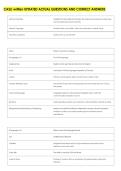
CASLI written UPDATED ACTUAL QUESTIONS AND CORRECT ANSWERS
Abstract Classifiers Classifiers that are smaller than life sized, the shape and movement of which does
not necessarily have iconic features.
Abstract Language describes ideas and qualities, rather than observable or specific things
adventitious deafness deafness that occurs after birth
Affect Refers to emotions or feelings
A-Language or L1 One's first language
Anglicized ASL English and ASL sign blends (More ASL than English)
AVLIC Association of Visual Language Interpreters of Canada
Audism Attitude causing negative stigma toward anyone unable to hear
Auditory feedback loop The channel through which hearing people hear (and monitor) their own voice as
they speak
Aural-oral languages Languages based on a structured set of linguistic rules in which the
communication is based on sound
Bicultural used to describe a person who crosses two cultures, lifestyles, and sets of values
bilingual-bicultural philosophy of interpreting Based on the belief that effective interpretation requires cultural and linguistic
mediation in order to accomplish speaker goals and maintain dynamic
equivalence
B-Language or L2 Refers to ones 2nd language learned
CDI certified Deaf Interpreter
Classifiers Designated handshapes and/or rule-grounded body pantomime used to
represent nouns and verbs.
Cloze skills The ability to mentally "fill in the blanks"
code of ethics Principles of conduct within an organization that guide decision making and
behavior.
, code switching the practice of changing language or dialect to accommodate to the
communication situation (unconscious)
code mixing using various combinations of words or phrases from more than one language
(conscious)
Communication dynamics The way people in a communication interaction react to or engage with one
another and to the overall interaction
Communication facilitation philosophy Set of beliefs including that Deaf people are handicapped, ASL as a means of
communicating only with less educated individuals
CASE Conceptually accurate signed English (ASL signs, English order)
Conduit or machine philosophy Interpreter has no responsibility for interaction or communication dynamics taking
place.
CIT Conference of Interpreter Trainers
congenital deafness deafness from birth
Consecutive interpretation More accurate than simultaneous.
Cultural and linguistic mediation Interpreting so that information has equivalent meaning and impact for individuals
with different language and cultural schemas
Cultural Expansion Provide contextual information needed to help understanding
Cultural reduction Reducing the volume and sometimes the detail of info without affecting the
meaning intended
Culture Beliefs, customs, and traditions of a specific group of people.
DI Deaf Interpreter
Dynamic Equivalence -concerned with expressing the MESSAGE of the original language in the words
of the target language(speaker's goals should be accomplished)
Empowerment of the client Behaving in a way that supports another's right to make decisions
environmental factors Environmental demands
equivocal language ambiguous language that has two or more equally plausible meanings
Abstract Classifiers Classifiers that are smaller than life sized, the shape and movement of which does
not necessarily have iconic features.
Abstract Language describes ideas and qualities, rather than observable or specific things
adventitious deafness deafness that occurs after birth
Affect Refers to emotions or feelings
A-Language or L1 One's first language
Anglicized ASL English and ASL sign blends (More ASL than English)
AVLIC Association of Visual Language Interpreters of Canada
Audism Attitude causing negative stigma toward anyone unable to hear
Auditory feedback loop The channel through which hearing people hear (and monitor) their own voice as
they speak
Aural-oral languages Languages based on a structured set of linguistic rules in which the
communication is based on sound
Bicultural used to describe a person who crosses two cultures, lifestyles, and sets of values
bilingual-bicultural philosophy of interpreting Based on the belief that effective interpretation requires cultural and linguistic
mediation in order to accomplish speaker goals and maintain dynamic
equivalence
B-Language or L2 Refers to ones 2nd language learned
CDI certified Deaf Interpreter
Classifiers Designated handshapes and/or rule-grounded body pantomime used to
represent nouns and verbs.
Cloze skills The ability to mentally "fill in the blanks"
code of ethics Principles of conduct within an organization that guide decision making and
behavior.
, code switching the practice of changing language or dialect to accommodate to the
communication situation (unconscious)
code mixing using various combinations of words or phrases from more than one language
(conscious)
Communication dynamics The way people in a communication interaction react to or engage with one
another and to the overall interaction
Communication facilitation philosophy Set of beliefs including that Deaf people are handicapped, ASL as a means of
communicating only with less educated individuals
CASE Conceptually accurate signed English (ASL signs, English order)
Conduit or machine philosophy Interpreter has no responsibility for interaction or communication dynamics taking
place.
CIT Conference of Interpreter Trainers
congenital deafness deafness from birth
Consecutive interpretation More accurate than simultaneous.
Cultural and linguistic mediation Interpreting so that information has equivalent meaning and impact for individuals
with different language and cultural schemas
Cultural Expansion Provide contextual information needed to help understanding
Cultural reduction Reducing the volume and sometimes the detail of info without affecting the
meaning intended
Culture Beliefs, customs, and traditions of a specific group of people.
DI Deaf Interpreter
Dynamic Equivalence -concerned with expressing the MESSAGE of the original language in the words
of the target language(speaker's goals should be accomplished)
Empowerment of the client Behaving in a way that supports another's right to make decisions
environmental factors Environmental demands
equivocal language ambiguous language that has two or more equally plausible meanings

