

Escrito por estudiantes que aprobaron Inmediatamente disponible después del pago Leer en línea o como PDF ¿Documento equivocado? Cámbialo gratis 4,6 TrustPilot
logo-home
Document preview thumbnail
Vista previa 2 fuera de 15 páginas
Examen

Illinois Fire Mod B 2026 Study Guide Questions and Answers (120+ Q&A) | Fire Hose, Hydrants, Ladders, Forcible Entry, Rescue & Wildland Firefighting Review

Document preview thumbnail
Vista previa 2 fuera de 15 páginas

This Illinois Fire Mod B 2026 Study Guide features more than 120 expertly compiled exam questions and verified answers covering the core firefighting concepts most frequently tested in firefighter certification programs and academy examinations. Designed to help candidates master both theoretical knowledge and practical applications, this comprehensive review resource focuses on fire hose operations, water supply systems, ladder operations, forcible entry techniques, search and rescue procedures, fire attack strategies, and wildland firefighting principles. The question-and-answer format encourages active recall and reinforces critical terminology, operational procedures, and decision-making skills necessary for examination success and real-world emergency response. This study guide provides an in-depth review of fire stream applications and hose operations, including attack engines, booster hoses, cellar nozzles, piercing nozzles, water curtain nozzles, fog streams, breakaway nozzles, Siamese and wye appliances, hose inspections, hose testing requirements, hose damage recognition, nozzle classifications, master-stream devices, and NFPA hose standards. Candidates will strengthen their understanding of flow rates, coupling components, hose maintenance practices, and the proper selection of firefighting equipment under varying incident conditions. The water supply section explores municipal distribution systems and hydrant operations, covering primary feeders, water mains, gravity-feed systems, static and residual pressure, friction loss, pilot gauges, static hydrants, tanker shuttle operations, portable water tanks, dump valves, dry-barrel hydrants, water hammer, and hydrant inspection procedures. Students will develop the knowledge necessary to evaluate available water supplies, interpret hydrant performance, and support efficient fireground water management. Additional content focuses extensively on ground ladder construction and deployment, including ladder anatomy, halyards, pawls, staypoles, guides, rails, beams, bed sections, folding ladders, Fresno ladders, carrying techniques, raising procedures, climbing safety, utility hazard awareness, and placement considerations. The guide also reviews forcible entry principles such as Halligan tools, A-tools, purchase points, lock components, inward-swinging doors, load-bearing walls, and door construction methods frequently encountered during emergency operations. Search and rescue operations are thoroughly addressed through concepts involving primary and secondary searches, victim removal techniques, ladder rescues, webbing slings, RIC activation, mayday procedures, exit assists, safe refuge locations, and the prioritization of life safety at emergency incidents. Fire attack strategies are equally emphasized, including offensive and defensive operations, direct and indirect attacks, transitional attacks, solid streams, extinguishing agents, electrical fire considerations, and master-stream applications. The study guide concludes with a detailed review of wildland firefighting terminology and tactics, including head and heel fires, spot fires, slash, black, islands, pockets, backfiring operations, fuel continuity, fuel classifications, topography, aerial fuels, ground duff, surface fuels, flanking attacks, pinch attacks, and wildland apparatus capabilities. By integrating structural firefighting concepts with wildland operations, this resource delivers a well-rounded review aligned with the knowledge expectations of modern firefighter training programs. The material reflects concepts and terminology consistent with nationally recognized firefighting standards and educational references, including: • NFPA 1001: Standard for Fire Fighter Professional Qualifications. • NFPA 1962: Standard for the Care, Use, Inspection, Service Testing, and Replacement of Fire Hose. • NFPA 1901: Standard for Automotive Fire Apparatus. • IFSTA Essentials of Fire Fighting and Fire Department Operations. • NFPA Wildland Fire Operations guidance and fireground best practices. Relevant Students: This document is ideal for Illinois firefighter recruits, Fire Mod B students, firefighter academy candidates, volunteer firefighters, career firefighter trainees, fire science students, EMTs transitioning into fire service roles, firefighter certification candidates, emergency response professionals seeking refresher training, and individuals preparing for state written examinations and practical firefighter assessments. Keywords: Illinois Fire Mod B, Illinois Fire Mod B study guide, Illinois Fire Mod B exam questions, Fire Mod B answers, firefighter exam preparation, firefighter study guide, fire academy review, IFSTA Essentials, NFPA 1001, attack engine, booster hose, cellar nozzle, piercing nozzle, water curtain nozzle, fog nozzle, breakaway nozzle, master stream, handlines, Siamese connection, wye appliance, hose clamp, hose jacket, hose testing, hose inspection, hydrants, static pressure, residual pressure, friction loss, gravity feed system, water mains, tanker shuttle, portable tanks, dry barrel hydrants, water hammer, ground ladders, halyard, pawls, staypoles, Fresno ladder, folding ladder, ladder rescue, Halligan tool, forcible entry, A-tool, purchase point, primary search, secondary search, rescue techniques, RIC, mayday, offensive attack, defensive attack, transitional attack, direct attack, indirect attack, Class C extinguisher, wildland firefighting, head fire, heel fire, spot fire, backfiring, fuel continuity, ground duff, aerial fuels, surface fuels, topography, flanking attack, pinch attack, firefighter certification exam, fire science review

Vista previa del contenido

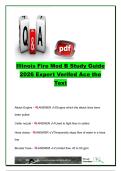
Illinois Fire Mod B Study Guide
2026 Expert Verifed Ace the
Text


Attack Engine - ANSWER ✔✔Engine which the attack lines have

been pulled


Cellar nozzle - ANSWER ✔✔Used to fight fires in cellars


Hose clamp - ANSWER ✔✔Temporarily stops flow of water in a hose

line


Booster hose - ANSWER ✔✔Limited flow, 40 to 50 gpm

, Water curtain nozzle - ANSWER ✔✔A nozzle that uses a flat screen

of water on an exposed building


Breakaway nozzle - ANSWER ✔✔Can be separated between the

shut off and the tip


Wye - ANSWER ✔✔Splits one hose into two


Fog stream nozzle - ANSWER ✔✔Produces fine droplets


Piercing nozzle - ANSWER ✔✔Used to make a hole in metal


Hose liner - ANSWER ✔✔Inner part of the hose that prevents leaks


A 1 3/4 line flows ______ gpm - ANSWER ✔✔120 to 180


Higabee - ANSWER ✔✔Notch on coupling threads


Attack lines can be multiple jacket or ______________ - ANSWER

✔✔Rubber covered


NFPA requires ______ ft of 2 1/2 inch line on a fire pumper -

ANSWER ✔✔800


Attack hose is tested annually at _____ psi - ANSWER ✔✔300


The three groups of nozzles are low-volume, master-stream, and

___________ - ANSWER ✔✔Handlines

Información del documento

Subido en
11 de junio de 2026
Número de páginas
15
Escrito en
2025/2026
Tipo
Examen
Contiene
Preguntas y respuestas
$18.99

¿Documento equivocado? Cámbialo gratis Dentro de los 14 días posteriores a la compra y antes de descargarlo, puedes elegir otro documento. Puedes gastar el importe de nuevo.
Escrito por estudiantes que aprobaron
Inmediatamente disponible después del pago
Leer en línea o como PDF

Seller avatar
Los indicadores de reputación están sujetos a la cantidad de artículos vendidos por una tarifa y las reseñas que ha recibido por esos documentos. Hay tres niveles: Bronce, Plata y Oro. Cuanto mayor reputación, más podrás confiar en la calidad del trabajo del vendedor.
JOSHCLAY
3.6
(87)
Vendido
405
Seguidores
16
Artículos
20795
Última venta
10 horas hace


Por qué los estudiantes eligen Stuvia

Creado por compañeros estudiantes, verificado por reseñas

Calidad en la que puedes confiar: escrito por estudiantes que aprobaron y evaluado por otros que han usado estos resúmenes.

¿No estás satisfecho? Elige otro documento

¡No te preocupes! Puedes elegir directamente otro documento que se ajuste mejor a lo que buscas.

Paga como quieras, empieza a estudiar al instante

Sin suscripción, sin compromisos. Paga como estés acostumbrado con tarjeta de crédito y descarga tu documento PDF inmediatamente.

Student with book image

“Comprado, descargado y aprobado. Así de fácil puede ser.”

Alisha Student

Preguntas frecuentes
