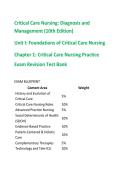
Critical Care Nursing: Diagnosis and
Management (10th Edition)
Unit I: Foundations of Critical Care Nursing
Chapter 1: Critical Care Nursing Practice
Exam Revision Test Bank
EXAM BLUEPRINT
Content Area Weight
History and Evolution of
5%
Critical Care
Critical Care Nursing Roles 10%
Advanced Practice Nursing 5%
Social Determinants of Health
10%
(SDOH)
Evidence-Based Practice 10%
Patient-Centered & Holistic
10%
Care
Complementary Therapies 5%
Technology and Tele-ICU 10%
, Interprofessional
10%
Collaboration
Rapid Response Teams 10%
Quality & Safety 10%
Healthy Work Environment 5%
Question 1 (MCQ)
A critical care nurse is discussing the evolution of intensive care nursing with a
newly hired graduate nurse. Which historical event most directly contributed to the
development of modern intensive care units (ICUs)?
A. Development of home health nursing programs
B. Centralization of critically ill patients requiring mechanical ventilation during polio
epidemics
C. Expansion of outpatient surgical centers
D. Introduction of electronic health records
Correct Answer: B
Rationale:
The modern ICU emerged largely from the need to centralize and closely monitor patients
requiring ventilatory support during the poliomyelitis epidemics. Concentrating critically
ill patients in one area improved outcomes and established the foundation for modern
critical care.
Distractor Analysis:
A. Home health nursing expanded community care but did not create ICUs.
C. Outpatient surgery focuses on less acute patients.
D. Electronic health records improved documentation but developed much later.
Bloom's Level: Recall
Difficulty: Easy
Learning Objective: Describe the historical development of critical care nursing.
Chapter Reference: Chapter 1 – History of Critical Care
Clinical Significance: Understanding ICU origins helps nurses appreciate the rationale for
specialized critical care environments.
,Question 2 (MCQ)
Which statement best reflects the primary goal of addressing Social Determinants of
Health (SDOH) in critical care practice?
A. Eliminate all genetic risk factors for disease
B. Ensure equitable opportunities for optimal health outcomes
C. Reduce ICU staffing requirements
D. Replace evidence-based practice with community-based interventions
Correct Answer: B
Rationale:
The goal of SDOH initiatives is to improve health equity by ensuring individuals have fair
opportunities to achieve their highest level of health regardless of socioeconomic or
environmental circumstances.
Distractor Analysis:
A. Genetics cannot be eliminated.
C. Staffing is unrelated to SDOH goals.
D. SDOH complements rather than replaces evidence-based practice.
Bloom's Level: Comprehension
Difficulty: Easy
Learning Objective: Explain the purpose of SDOH initiatives.
Chapter Reference: Chapter 1 – Social Determinants of Health
Clinical Significance: SDOH significantly influence outcomes among critically ill
populations.
Question 3 (SATA)
Which activities are within the scope of an Advanced Practice Nurse (APN) working
in critical care? Select all that apply.
A. Diagnosing health conditions
B. Prescribing medications where authorized
, C. Independently performing patient assessments
D. Providing advanced clinical consultation
E. Managing unit staffing schedules exclusively
Correct Answers: A, B, C, D
Rationale:
APNs perform comprehensive assessments, diagnose conditions, prescribe therapies
where permitted, and provide expert consultation.
Distractor Analysis:
E. Staffing schedules may be a management responsibility but are not a defining APN role.
Bloom's Level: Recall
Difficulty: Easy
Learning Objective: Identify functions of advanced practice nurses.
Chapter Reference: Chapter 1 – Advanced Practice Nurses
Clinical Significance: APNs improve quality, safety, and continuity of care in critically ill
populations.
Question 4 (MCQ)
A nurse uses the latest clinical practice guideline to prevent catheter-associated
bloodstream infections. This action exemplifies:
A. Case management
B. Evidence-based practice
C. Delegation
D. Quality assurance only
Correct Answer: B
Rationale:
Evidence-based practice integrates best available evidence, clinical expertise, and patient
preferences into care decisions.
Distractor Analysis:
A. Case management focuses on coordination of care.
C. Delegation involves assigning tasks.
D. Quality assurance may result but is not the primary concept.
Management (10th Edition)
Unit I: Foundations of Critical Care Nursing
Chapter 1: Critical Care Nursing Practice
Exam Revision Test Bank
EXAM BLUEPRINT
Content Area Weight
History and Evolution of
5%
Critical Care
Critical Care Nursing Roles 10%
Advanced Practice Nursing 5%
Social Determinants of Health
10%
(SDOH)
Evidence-Based Practice 10%
Patient-Centered & Holistic
10%
Care
Complementary Therapies 5%
Technology and Tele-ICU 10%
, Interprofessional
10%
Collaboration
Rapid Response Teams 10%
Quality & Safety 10%
Healthy Work Environment 5%
Question 1 (MCQ)
A critical care nurse is discussing the evolution of intensive care nursing with a
newly hired graduate nurse. Which historical event most directly contributed to the
development of modern intensive care units (ICUs)?
A. Development of home health nursing programs
B. Centralization of critically ill patients requiring mechanical ventilation during polio
epidemics
C. Expansion of outpatient surgical centers
D. Introduction of electronic health records
Correct Answer: B
Rationale:
The modern ICU emerged largely from the need to centralize and closely monitor patients
requiring ventilatory support during the poliomyelitis epidemics. Concentrating critically
ill patients in one area improved outcomes and established the foundation for modern
critical care.
Distractor Analysis:
A. Home health nursing expanded community care but did not create ICUs.
C. Outpatient surgery focuses on less acute patients.
D. Electronic health records improved documentation but developed much later.
Bloom's Level: Recall
Difficulty: Easy
Learning Objective: Describe the historical development of critical care nursing.
Chapter Reference: Chapter 1 – History of Critical Care
Clinical Significance: Understanding ICU origins helps nurses appreciate the rationale for
specialized critical care environments.
,Question 2 (MCQ)
Which statement best reflects the primary goal of addressing Social Determinants of
Health (SDOH) in critical care practice?
A. Eliminate all genetic risk factors for disease
B. Ensure equitable opportunities for optimal health outcomes
C. Reduce ICU staffing requirements
D. Replace evidence-based practice with community-based interventions
Correct Answer: B
Rationale:
The goal of SDOH initiatives is to improve health equity by ensuring individuals have fair
opportunities to achieve their highest level of health regardless of socioeconomic or
environmental circumstances.
Distractor Analysis:
A. Genetics cannot be eliminated.
C. Staffing is unrelated to SDOH goals.
D. SDOH complements rather than replaces evidence-based practice.
Bloom's Level: Comprehension
Difficulty: Easy
Learning Objective: Explain the purpose of SDOH initiatives.
Chapter Reference: Chapter 1 – Social Determinants of Health
Clinical Significance: SDOH significantly influence outcomes among critically ill
populations.
Question 3 (SATA)
Which activities are within the scope of an Advanced Practice Nurse (APN) working
in critical care? Select all that apply.
A. Diagnosing health conditions
B. Prescribing medications where authorized
, C. Independently performing patient assessments
D. Providing advanced clinical consultation
E. Managing unit staffing schedules exclusively
Correct Answers: A, B, C, D
Rationale:
APNs perform comprehensive assessments, diagnose conditions, prescribe therapies
where permitted, and provide expert consultation.
Distractor Analysis:
E. Staffing schedules may be a management responsibility but are not a defining APN role.
Bloom's Level: Recall
Difficulty: Easy
Learning Objective: Identify functions of advanced practice nurses.
Chapter Reference: Chapter 1 – Advanced Practice Nurses
Clinical Significance: APNs improve quality, safety, and continuity of care in critically ill
populations.
Question 4 (MCQ)
A nurse uses the latest clinical practice guideline to prevent catheter-associated
bloodstream infections. This action exemplifies:
A. Case management
B. Evidence-based practice
C. Delegation
D. Quality assurance only
Correct Answer: B
Rationale:
Evidence-based practice integrates best available evidence, clinical expertise, and patient
preferences into care decisions.
Distractor Analysis:
A. Case management focuses on coordination of care.
C. Delegation involves assigning tasks.
D. Quality assurance may result but is not the primary concept.