

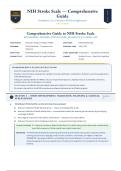
NIH Stroke Scale — Comprehensive
SSHIN • EDIUG
NIH
SS
Guide
Development, Use, Limitations & Clinical Applications
GUIDE
TIME IS BRAIN
Comprehensive Guide to NIH Stroke Scale
D E V E LO P M E N T, T R A I N I N G , C E RT I F I C AT I O N , R E L I A B I L I TY & C L I N I C A L U S E
INSTITUTION National Institutes of Health / NINDS EXAM CODE NIHSS-GUIDE-2026
PROGRAM NIH Stroke Scale — Comprehensive ACADEMIC YEAR
Reference
EXAM TITLE NIHSS Development, Use & Limitations TOTAL QUESTIONS 30 Questions — Comprehensive Review
COURSE TITLE NIH Stroke Scale Training & Certification FORMAT Multiple Choice — Select the Single Best
Answer
COMPREHENSIVE GUIDE INSTRUCTIONS
▸ Select the single best answer for each question.
▸ Questions cover the history, development, validation, training, certification, modifications, limitations, and clinical applications
of the NIH Stroke Scale.
▸ Distinguish carefully between the NIHSS's role as an impairment measure vs. disability measure, its reliability in trained vs.
untrained hands, and its hemispheric scoring bias.
▸ Correct answers and detailed rationales appear below each question for comprehensive review.
▸ All content is derived from the NIHSS comprehensive reference literature and certification program.
SECTION I — NIHSS DEVELOPMENT, VALIDATION, TRAINING & CLINICAL Questions 1 –
APPLICATIONS 30
1. What does NIHSS stand for, and what is its primary purpose?
A. National Institute of Health Severity Score — measures disability after stroke
B. National Institutes of Health Stroke Scale — a standardized method for assessing stroke severity by quantifying
neurological deficits
C. Neurological Impairment Hemispheric Stroke Scale — measures only motor deficits
D. National Intracranial Hemorrhage Severity Score — assesses hemorrhagic stroke only
CORRECT ANSWER B — National Institutes of Health Stroke Scale. It is a deficit rating scale that provides a standardized,
quantitative measure of stroke-related neurological impairment.
RATIONALE The NIHSS was developed by combining several existing stroke-deficit rating scales. It assesses 15 items
covering consciousness, language, motor function, sensation, visual fields, and neglect. It measures
IMPAIRMENT (neurological deficits), not disability (functional limitations). It is used in clinical trials, acute
stroke management, and as a prognostic tool. The total score ranges from 0 (no symptoms) to 42 (maximum
severity).
, 2. What clinical trial established the NIHSS as the gold standard for stroke severity rating?
A. The ECASS III Trial
B. The NINDS r-tPA for Acute Stroke Trial (1995)
C. The DAWN Trial
D. The MR CLEAN Trial
CORRECT ANSWER B — The NINDS r-tPA for Acute Stroke Trial, published in 1995. This landmark trial demonstrated the
efficacy of IV thrombolysis and established the NIHSS as the standard severity assessment tool.
RATIONALE The NINDS r-tPA trial used the NIHSS to quantify stroke severity at baseline and measure outcomes. The trial's
positive results — showing improved outcomes with tPA given within 3 hours of symptom onset —
revolutionized acute stroke care. Following this trial, the NIHSS became the de facto standard for measuring
stroke severity in clinical trials and clinical practice. The final version was validated against infarct volumes.
3. Approximately how many healthcare professionals have been certified to administer the NIHSS?
A. 50,000
B. 100,000
C. Over 500,000
D. Over 1 million
CORRECT ANSWER C — Over 500,000 healthcare professionals have been certified to administer the NIHSS as of February
2016.
RATIONALE The NIHSS is one of the most widely taught neurological assessment tools worldwide. Certification has been
achieved by over half a million users through web-based training platforms. This widespread adoption
reflects the scale's importance in stroke care — The Joint Commission requires an NIHSS score within 12
hours of admission for all stroke patients at Primary Stroke Centers.
4. What is a known hemispheric bias in the NIHSS scoring?
A. Right hemisphere strokes score 4 points higher than left hemisphere strokes
B. Left hemisphere strokes score approximately 4 more points than right hemisphere strokes of similar size
C. There is no hemispheric bias in NIHSS scoring
D. The NIHSS cannot score brainstem strokes
CORRECT ANSWER B — Left hemisphere strokes score approximately 4 more points than right hemisphere strokes of
similar infarct volume. The NIHSS favors left hemisphere strokes.
RATIONALE This bias occurs because the NIHSS contains more language items (7 points for language function — Items 1b,
1c, 9, and portions of other items) than right-hemisphere functions (only 2 points for neglect — Item 11). Since
language is predominantly a left hemisphere function, left hemisphere strokes appear more severe on the
NIHSS. A patient with a large right hemisphere stroke causing profound neglect may score lower than a
patient with a moderate left hemisphere stroke causing aphasia, despite similar functional impact.
SSHIN • EDIUG
NIH
SS
Guide
Development, Use, Limitations & Clinical Applications
GUIDE
TIME IS BRAIN
Comprehensive Guide to NIH Stroke Scale
D E V E LO P M E N T, T R A I N I N G , C E RT I F I C AT I O N , R E L I A B I L I TY & C L I N I C A L U S E
INSTITUTION National Institutes of Health / NINDS EXAM CODE NIHSS-GUIDE-2026
PROGRAM NIH Stroke Scale — Comprehensive ACADEMIC YEAR
Reference
EXAM TITLE NIHSS Development, Use & Limitations TOTAL QUESTIONS 30 Questions — Comprehensive Review
COURSE TITLE NIH Stroke Scale Training & Certification FORMAT Multiple Choice — Select the Single Best
Answer
COMPREHENSIVE GUIDE INSTRUCTIONS
▸ Select the single best answer for each question.
▸ Questions cover the history, development, validation, training, certification, modifications, limitations, and clinical applications
of the NIH Stroke Scale.
▸ Distinguish carefully between the NIHSS's role as an impairment measure vs. disability measure, its reliability in trained vs.
untrained hands, and its hemispheric scoring bias.
▸ Correct answers and detailed rationales appear below each question for comprehensive review.
▸ All content is derived from the NIHSS comprehensive reference literature and certification program.
SECTION I — NIHSS DEVELOPMENT, VALIDATION, TRAINING & CLINICAL Questions 1 –
APPLICATIONS 30
1. What does NIHSS stand for, and what is its primary purpose?
A. National Institute of Health Severity Score — measures disability after stroke
B. National Institutes of Health Stroke Scale — a standardized method for assessing stroke severity by quantifying
neurological deficits
C. Neurological Impairment Hemispheric Stroke Scale — measures only motor deficits
D. National Intracranial Hemorrhage Severity Score — assesses hemorrhagic stroke only
CORRECT ANSWER B — National Institutes of Health Stroke Scale. It is a deficit rating scale that provides a standardized,
quantitative measure of stroke-related neurological impairment.
RATIONALE The NIHSS was developed by combining several existing stroke-deficit rating scales. It assesses 15 items
covering consciousness, language, motor function, sensation, visual fields, and neglect. It measures
IMPAIRMENT (neurological deficits), not disability (functional limitations). It is used in clinical trials, acute
stroke management, and as a prognostic tool. The total score ranges from 0 (no symptoms) to 42 (maximum
severity).
, 2. What clinical trial established the NIHSS as the gold standard for stroke severity rating?
A. The ECASS III Trial
B. The NINDS r-tPA for Acute Stroke Trial (1995)
C. The DAWN Trial
D. The MR CLEAN Trial
CORRECT ANSWER B — The NINDS r-tPA for Acute Stroke Trial, published in 1995. This landmark trial demonstrated the
efficacy of IV thrombolysis and established the NIHSS as the standard severity assessment tool.
RATIONALE The NINDS r-tPA trial used the NIHSS to quantify stroke severity at baseline and measure outcomes. The trial's
positive results — showing improved outcomes with tPA given within 3 hours of symptom onset —
revolutionized acute stroke care. Following this trial, the NIHSS became the de facto standard for measuring
stroke severity in clinical trials and clinical practice. The final version was validated against infarct volumes.
3. Approximately how many healthcare professionals have been certified to administer the NIHSS?
A. 50,000
B. 100,000
C. Over 500,000
D. Over 1 million
CORRECT ANSWER C — Over 500,000 healthcare professionals have been certified to administer the NIHSS as of February
2016.
RATIONALE The NIHSS is one of the most widely taught neurological assessment tools worldwide. Certification has been
achieved by over half a million users through web-based training platforms. This widespread adoption
reflects the scale's importance in stroke care — The Joint Commission requires an NIHSS score within 12
hours of admission for all stroke patients at Primary Stroke Centers.
4. What is a known hemispheric bias in the NIHSS scoring?
A. Right hemisphere strokes score 4 points higher than left hemisphere strokes
B. Left hemisphere strokes score approximately 4 more points than right hemisphere strokes of similar size
C. There is no hemispheric bias in NIHSS scoring
D. The NIHSS cannot score brainstem strokes
CORRECT ANSWER B — Left hemisphere strokes score approximately 4 more points than right hemisphere strokes of
similar infarct volume. The NIHSS favors left hemisphere strokes.
RATIONALE This bias occurs because the NIHSS contains more language items (7 points for language function — Items 1b,
1c, 9, and portions of other items) than right-hemisphere functions (only 2 points for neglect — Item 11). Since
language is predominantly a left hemisphere function, left hemisphere strokes appear more severe on the
NIHSS. A patient with a large right hemisphere stroke causing profound neglect may score lower than a
patient with a moderate left hemisphere stroke causing aphasia, despite similar functional impact.

