

Escrito por estudiantes que aprobaron Inmediatamente disponible después del pago Leer en línea o como PDF ¿Documento equivocado? Cámbialo gratis 4,6 TrustPilot
logo-home
Document preview thumbnail
Vista previa 3 fuera de 18 páginas
Examen

BIO 116 Exam 3 Miami University Questions and Answers (180+ Verified Q&A) | DNA Replication, Transcription, Translation, Gene Regulation, Microbiology, Virology & Biotechnology | Miami University Biology

Document preview thumbnail
Vista previa 3 fuera de 18 páginas

This comprehensive BIO 116 Exam 3 Questions and Answers study guide for Miami University contains more than 180 carefully compiled exam-style questions with verified answers covering molecular biology, DNA replication, transcription, translation, gene regulation, mutations, microbiology, bacterial genetics, biotechnology, and virology. Designed specifically for students preparing for BIO 116 assessments, the material is presented in a structured question-and-answer format that promotes active recall, reinforces conceptual understanding, and supports success on quizzes, midterms, final examinations, and cumulative biology assessments. The guide serves as a high-yield review resource for mastering the molecular mechanisms that govern genetic inheritance, gene expression, microbial biology, and viral infection. A major section of the document focuses on DNA replication and chromosome maintenance. Students review the structure of DNA, antiparallel strands, semiconservative replication, replication forks, origins of replication, leading and lagging strand synthesis, RNA primers, Okazaki fragments, helicase activity, topoisomerase function, DNA ligase, single-strand binding proteins, DNA polymerase I and III, proofreading mechanisms, telomeres, telomerase activity, and chromosome stability. The guide explains how genetic information is accurately copied and transmitted during cellular reproduction while highlighting mechanisms that reduce replication errors and maintain genome integrity. The transcription section provides extensive coverage of gene expression and RNA synthesis. Topics include promoter regions, transcription factors, sigma factors, holoenzymes, initiation, elongation, termination, transcription bubbles, RNA polymerase activity, template and non-template strands, promoter recognition, transcriptional control, eukaryotic versus prokaryotic transcription, RNA processing, spliceosomes, introns, exons, alternative splicing, poly-A tails, messenger RNA maturation, and gene regulatory mechanisms. Students gain a detailed understanding of how DNA information is converted into functional RNA molecules and how cellular signaling pathways influence gene expression. The guide also provides thorough coverage of translation and protein synthesis. Students review ribosomal structure and function, transfer RNA (tRNA), ribosomal RNA (rRNA), messenger RNA (mRNA), aminoacyl-tRNA synthetase, codons, anticodons, start and stop codons, methionine initiation, peptide bond formation, A, P, and E ribosomal sites, elongation processes, release factors, termination mechanisms, and molecular chaperones involved in protein folding. These concepts are fundamental to understanding how genetic information is translated into functional proteins that support cellular structure and metabolism. Additional sections focus on mutations and genetic variation. Students learn the differences between point mutations, silent mutations, missense mutations, nonsense mutations, frameshift mutations, chromosomal inversions, chromosomal translocations, and the biological consequences of genetic alterations. Understanding these processes is essential for interpreting genetic diseases, evolutionary change, and molecular diagnostic testing. The microbiology portion explores bacterial structure, physiology, and genetics. Topics include prokaryotic chromosome organization, fimbriae, glycocalyx structure, Gram-positive and Gram-negative bacteria, lipopolysaccharides (LPS), endotoxins, exotoxins, bacterial growth phases, biofilms, nitrogen fixation, obligate anaerobes, obligate aerobes, facultative anaerobes, plasmids, bacterial conjugation, transformation, transduction, and horizontal gene transfer. Students gain insight into microbial survival strategies, ecological roles, pathogenesis, and mechanisms of antibiotic susceptibility and resistance. The biotechnology section reviews important laboratory techniques commonly used in genetics and molecular biology research. Concepts include recombinant DNA technology, plasmid manipulation, DNA amplification, gene cloning, bacterial vectors, and molecular tools used to study and modify genetic material. These topics connect foundational biological concepts to real-world applications in medicine, pharmaceuticals, agriculture, and biotechnology industries. The virology component examines viral structure, viral replication, bacteriophages, viral infection mechanisms, host specificity, and the molecular interactions between viruses and host cells. Students review viral envelopes, nucleic acids, retroviral characteristics, viral transmission, and immune system responses to infection. These concepts are particularly relevant to modern biomedical science, public health, infectious disease research, and vaccine development. The content aligns closely with concepts presented in leading university-level biology references, including Campbell Biology (Urry, Cain, Wasserman, Minorsky & Orr), Molecular Biology of the Cell (Alberts et al.), Lehninger Principles of Biochemistry (Nelson & Cox), Biology 2e (OpenStax), Molecular Cell Biology (Lodish et al.), Prescott's Microbiology (Willey, Sherwood & Woolverton), Brock Biology of Microorganisms (Madigan et al.), and Principles of Virology (Flint et al.). These authoritative academic references support the scientific accuracy and educational relevance of the concepts reviewed throughout this study guide. Relevant Students: BIO 116 Students Miami University Biology Students General Biology Students Molecular Biology Students Cell Biology Students Genetics Students Microbiology Students Virology Students Biochemistry Students Biotechnology Students Biomedical Science Students Health Science Students Nursing Students Pre-Med Students Pharmacy Students Medical Laboratory Science Students Life Science Students Public Health Students University Biology Majors College Biology Students Exam Preparation Candidates Keywords BIO 116 Exam 3, Miami University biology, biology exam questions and answers, DNA replication, semiconservative replication, replication fork, origin of replication, helicase, topoisomerase, primase, DNA polymerase, DNA polymerase III, DNA polymerase I, ligase, Okazaki fragments, leading strand, lagging strand, telomeres, telomerase, DNA proofreading, gene expression, transcription, RNA polymerase, sigma factor, promoter region, transcription factors, holoenzyme, RNA processing, spliceosome, introns, exons, alternative splicing, poly A tail, mRNA, translation, protein synthesis, ribosome, rRNA, tRNA, aminoacyl tRNA synthetase, codons, anticodons, methionine, peptide bond formation, molecular chaperones, mutations, point mutation, missense mutation, nonsense mutation, silent mutation, frameshift mutation, chromosome inversion, chromosome translocation, microbiology, prokaryotes, bacterial genetics, fimbriae, glycocalyx, Gram positive bacteria, Gram negative bacteria, lipopolysaccharide, endotoxin, exotoxin, bacterial growth curve, biofilm, nitrogen fixation, plasmids, conjugation, transformation, transduction, horizontal gene transfer, biotechnology, recombinant DNA, gene cloning, virology, viruses, bacteriophages, viral replication, retroviruses, infectious diseases, molecular genetics, university biology study guide, biology revision notes, final exam preparation

Vista previa del contenido

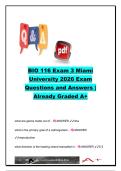
BIO 116 Exam 3 Miami
University 2026 Exam
Questions and Answers |
Already Graded A+


what are genes made out of - ANSWER ✔✔dna


what is the primary goal of a cell/organism - ANSWER

✔✔reproduction


what direction is the leading strand transalted in - ANSWER ✔✔5-3

,what direction is the lagging strand translated in, how is this -

ANSWER ✔✔3-5, but since DNA polymerase only works in 5-3, it has

to do sections in the 5-3 direction and then connect them.

what is characteristic of prokaryotic chromosomes, and wheres the

origin?


Eukaryotic? - ANSWER ✔✔pro: circular, with 1 origin


eukaryote: linear, multiple origins


what does topoisomerase do - ANSWER ✔✔corrects "overwinding"

ahead of replication forks by breaking, swiveling, and rejoining DNA

strands


what does helicase do? - ANSWER ✔✔Unzips DNA in order to be

read


what is the split that is created in DNA called - ANSWER

✔✔replication fork


what are the components of DNA strucutre - ANSWER ✔✔phosphate

group, sugar backbone, and nitrogenous base

, when constructing DNA, the 3rd sugar attaches to what, - ANSWER

✔✔a phosphate group, which is then attached to the 5 sugar of the

previous sugar


what is the orientation that DNA is found in called - ANSWER

✔✔antiparrallel


what type of replication is DNA, which results in a ___strand, and a

______ strand in the new cell. - ANSWER ✔✔semi-conservative,

new, old


how do we begin replication - ANSWER ✔✔a bubble forms in a

chromosome, in prokaryotes, this is called the origin of replication.

(eukaryotes have multiple replication bubbles)


helicase breaks what - ANSWER ✔✔th hydrogen bonds between the

2 DNA strands

what binds to the DNA to prevent them from reclosing after helicase

goes through - ANSWER ✔✔single strand DNA-binding proteins


what does topoisomerase do - ANSWER ✔✔it is just ahead of the

replication fork, and is relieveing pressure from the DNA being opened

and twisted up


COPYRIGHT©JOSHCLAY 2025/2026. YEAR PUBLISHED 2026. COMPANY REGISTRATION NUMBER: 619652435. TERMS OF USE. PRIVACY
STATEMENT. ALL RIGHTS RESERVED
3


Información del documento

Subido en
8 de junio de 2026
Número de páginas
18
Escrito en
2025/2026
Tipo
Examen
Contiene
Preguntas y respuestas
$18.99

¿Documento equivocado? Cámbialo gratis Dentro de los 14 días posteriores a la compra y antes de descargarlo, puedes elegir otro documento. Puedes gastar el importe de nuevo.
Escrito por estudiantes que aprobaron
Inmediatamente disponible después del pago
Leer en línea o como PDF

Seller avatar
Los indicadores de reputación están sujetos a la cantidad de artículos vendidos por una tarifa y las reseñas que ha recibido por esos documentos. Hay tres niveles: Bronce, Plata y Oro. Cuanto mayor reputación, más podrás confiar en la calidad del trabajo del vendedor.
NinjaNerd
3.4
(76)
Vendido
406
Seguidores
6
Artículos
15556
Última venta
3 días hace


Por qué los estudiantes eligen Stuvia

Creado por compañeros estudiantes, verificado por reseñas

Calidad en la que puedes confiar: escrito por estudiantes que aprobaron y evaluado por otros que han usado estos resúmenes.

¿No estás satisfecho? Elige otro documento

¡No te preocupes! Puedes elegir directamente otro documento que se ajuste mejor a lo que buscas.

Paga como quieras, empieza a estudiar al instante

Sin suscripción, sin compromisos. Paga como estés acostumbrado con tarjeta de crédito y descarga tu documento PDF inmediatamente.

Student with book image

“Comprado, descargado y aprobado. Así de fácil puede ser.”

Alisha Student

Preguntas frecuentes