

Escrito por estudiantes que aprobaron Inmediatamente disponible después del pago Leer en línea o como PDF ¿Documento equivocado? Cámbialo gratis 4,6 TrustPilot
logo-home
Document preview thumbnail
Vista previa 2 fuera de 13 páginas
Examen

BIO 116 Exam 1 Questions and Answers (80+ Verified Q&A) | Anatomy, Physiology, Cell Structure, Genetics, Metabolism & Enzymes

Document preview thumbnail
Vista previa 2 fuera de 13 páginas

This comprehensive BIO 116 Exam 1 Questions and Answers study guide contains more than 80 exam-focused questions with detailed answers covering the foundational principles of human biology, anatomy, physiology, cellular biology, genetics, metabolism, and homeostatic regulation. The material is organized in a concise question-and-answer format designed to support active recall, knowledge retention, exam revision, and mastery of core biological concepts commonly assessed in introductory university-level biology courses. The document begins with essential biological foundations, including anatomy and physiology, levels of biological organization, atoms, molecules, macromolecules, cells, tissues, organs, organ systems, and the mechanisms responsible for maintaining homeostasis. Students will gain a strong understanding of feedback mechanisms, responsiveness, body cavities, and the structure and function of major human organ systems including the skeletal, muscular, integumentary, nervous, endocrine, cardiovascular, lymphatic, digestive, and urinary systems. Additional sections focus on chemistry for life sciences, covering atomic structure, protons, neutrons, electrons, ionic and covalent bonding, hydrogen bonding, polarity, pH regulation, acids and bases, monomers, polymers, and the biological importance of carbohydrates, lipids, proteins, and nucleic acids. The guide also explores ATP production, cellular energy transfer, hydrophilic and hydrophobic interactions, membrane structure, diffusion, osmosis, tonicity, active transport, facilitated diffusion, endocytosis, and exocytosis. The resource further examines cell biology and genetics, including organelle structure and function, vesicular transport, the endomembrane system, chromatin, chromosomes, DNA organization, transcription, translation, genes, codons, and the complete cell cycle. Detailed coverage of mitosis, checkpoints, telomeres, chromosome separation, and genetic information flow helps students understand the molecular basis of inheritance and cellular reproduction. Metabolism and bioenergetics topics include catabolism, anabolism, aerobic and anaerobic respiration, enzyme function, metabolic regulation, ATP generation, and the role of enzymes in cellular reactions. These concepts align closely with the learning outcomes typically found in introductory biology, anatomy and physiology, health sciences, nursing, and pre-medical curricula. The content is consistent with concepts presented in leading undergraduate biology references, including Campbell Biology (Urry et al., Pearson), Human Anatomy & Physiology (Marieb & Hoehn, Pearson), Biology 2e (OpenStax), Molecular Biology of the Cell (Alberts et al., Garland Science), and Principles of Anatomy and Physiology (Tortora & Derrickson, Wiley). These texts serve as foundational resources across universities worldwide and support the accuracy and academic relevance of the topics reviewed in this study guide. Relevant Students: Biology Students Anatomy and Physiology Students Pre-Med Students Nursing Students Health Science Students Biomedical Science Students Pharmacy Students Medical Laboratory Science Students Exercise Science Students Kinesiology Students Allied Health Students Healthcare Program Students University Freshman Biology Students College Biology Students Exam Preparation Candidates Keywords anatomy, physiology, biology exam 1, BIO 116, cell biology, human biology, homeostasis, negative feedback, positive feedback, body cavities, skeletal system, muscular system, nervous system, endocrine system, cardiovascular system, lymphatic system, digestive system, urinary system, atoms, molecules, macromolecules, cells, tissues, organs, organ systems, protons, neutrons, electrons, ionic bonds, covalent bonds, hydrogen bonds, pH scale, acids and bases, monomers, polymers, carbohydrates, lipids, proteins, nucleic acids, ATP, cell membrane, cytoplasm, nucleus, diffusion, facilitated diffusion, osmosis, tonicity, active transport, endocytosis, exocytosis, vesicles, mitochondria, ribosomes, endoplasmic reticulum, chromatin, chromosomes, cell cycle, mitosis, interphase, prophase, metaphase, anaphase, telophase, genes, codons, transcription, translation, metabolism, catabolism, anabolism, enzymes, aerobic respiration, anaerobic respiration, university biology study guide, biology questions and answers, exam revision, nursing biology, pre med biology

Vista previa del contenido

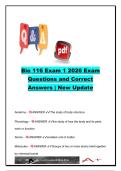
Bio 116 Exam 1 2026 Exam
Questions and Correct
Answers | New Update


Anatomy - ANSWER ✔✔The study of body structure


Physiology - ANSWER ✔✔the study of how the body and its parts

work or function


Atoms - ANSWER ✔✔smallest unit of matter


Molecules - ANSWER ✔✔Groups of two or more atoms held together

by chemical bonds

, Macromolecules - ANSWER ✔✔A very large organic molecule

composed of many smaller molecules


cells - ANSWER ✔✔The basic unit of structure and function in all

living things


Tissues - ANSWER ✔✔Groups of cells with a common structure and

function.


Organs - ANSWER ✔✔Groups of tissues that work together to

perform a specialized function or related functions


Organ systems - ANSWER ✔✔A group of two or more organs

working together for a specific job; e.g. the digestive system


organisms - ANSWER ✔✔organ systems functioning together


Homeostasis - ANSWER ✔✔When factors in the


external environment

(the outside world)

change, conditions in the

internal environment

(the fluid around

the body cells) must remain stable.

Información del documento

Subido en
8 de junio de 2026
Número de páginas
13
Escrito en
2025/2026
Tipo
Examen
Contiene
Preguntas y respuestas
$18.99

¿Documento equivocado? Cámbialo gratis Dentro de los 14 días posteriores a la compra y antes de descargarlo, puedes elegir otro documento. Puedes gastar el importe de nuevo.
Escrito por estudiantes que aprobaron
Inmediatamente disponible después del pago
Leer en línea o como PDF

Seller avatar
Los indicadores de reputación están sujetos a la cantidad de artículos vendidos por una tarifa y las reseñas que ha recibido por esos documentos. Hay tres niveles: Bronce, Plata y Oro. Cuanto mayor reputación, más podrás confiar en la calidad del trabajo del vendedor.
NinjaNerd
3.4
(76)
Vendido
406
Seguidores
6
Artículos
15556
Última venta
3 días hace


Por qué los estudiantes eligen Stuvia

Creado por compañeros estudiantes, verificado por reseñas

Calidad en la que puedes confiar: escrito por estudiantes que aprobaron y evaluado por otros que han usado estos resúmenes.

¿No estás satisfecho? Elige otro documento

¡No te preocupes! Puedes elegir directamente otro documento que se ajuste mejor a lo que buscas.

Paga como quieras, empieza a estudiar al instante

Sin suscripción, sin compromisos. Paga como estés acostumbrado con tarjeta de crédito y descarga tu documento PDF inmediatamente.

Student with book image

“Comprado, descargado y aprobado. Así de fácil puede ser.”

Alisha Student

Preguntas frecuentes
