

Escrito por estudiantes que aprobaron Inmediatamente disponible después del pago Leer en línea o como PDF ¿Documento equivocado? Cámbialo gratis 4,6 TrustPilot
logo-home
Document preview thumbnail
Vista previa 2 fuera de 14 páginas
Examen

BIO 116 Exam 1 Questions and Answers (90+ Questions) | Cell Biology, Macromolecules, Enzymes & Cell Signaling

Document preview thumbnail
Vista previa 2 fuera de 14 páginas

This comprehensive BIO 116 Exam 1 study guide contains more than 90 carefully organized questions and verified answers covering the fundamental concepts typically assessed in introductory biology courses. The material reviews the chemistry of life, biological molecules, cell structure and function, membrane transport, metabolism, enzymes, thermodynamics, cellular respiration, and cell communication pathways, making it an effective resource for exam preparation and concept reinforcement. Key topics include covalent, ionic, and hydrogen bonding, water properties, pH and buffers, carbon chemistry, carbohydrates, lipids, proteins, nucleic acids, amino acid structure, protein folding, membrane fluidity, passive and active transport, endocytosis and exocytosis, mitochondria, chloroplasts, ATP coupling, enzyme regulation, feedback inhibition, and signal transduction mechanisms. The document also covers anabolic and catabolic pathways, phosphorylation cascades, second messengers, and the major principles governing cellular communication. The content aligns closely with foundational concepts presented in widely adopted undergraduate biology textbooks, including Campbell Biology (Urry et al., Pearson), Molecular Biology of the Cell (Alberts et al., Garland Science), and Biology 2e (OpenStax). These references are commonly used in introductory biology and pre-health science curricula, making this study guide highly relevant for students preparing for course examinations, quizzes, cumulative assessments, and standardized health science entrance examinations. This resource is particularly useful for Biology majors, Pre-Med students, Nursing students, Allied Health students, Health Science students, Biomedical Science students, Exercise Science students, Pharmacy students, and any undergraduate learners enrolled in introductory cell biology or general biology courses. The question-and-answer format promotes active recall, improves retention of core concepts, and helps students identify areas requiring further review before examinations. Keywords biology exam 1, cell biology, chemistry of life, biological molecules, macromolecules, carbohydrates, lipids, proteins, nucleic acids, amino acids, protein structure, protein folding, DNA, RNA, cell membrane, phospholipids, membrane transport, diffusion, facilitated diffusion, active transport, osmosis, hypotonic solution, hypertonic solution, isotonic solution, endocytosis, exocytosis, mitochondria, chloroplasts, ATP, cellular respiration, metabolism, thermodynamics, entropy, enzymes, enzyme inhibitors, cofactors, coenzymes, feedback inhibition, cell signaling, signal transduction, phosphorylation cascade, second messenger, biology questions and answers, exam preparation, study guide, university biology, pre med biology, nursing biology, introductory biology

Vista previa del contenido

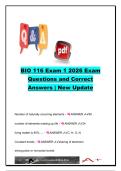
BIO 116 Exam 1 2026 Exam
Questions and Correct
Answers | New Update


Number of naturally occurring elements - ANSWER ✔✔90


number of elements making up life - ANSWER ✔✔24


living matter is 95%..... - ANSWER ✔✔C, H, O, N


Covalent bonds - ANSWER ✔✔sharing of electrons


strong polar or non-polar bonds

, require energy to break


ionic bonds - ANSWER ✔✔transfer of electrons


"ions" (+ or -)

attraction (weak- break apart in H2O)


hydrogen bonds - ANSWER ✔✔Very weak bond created by the

attraction of a slightly positive hydrogen atom to a slightly negative

portion of another molecule


typical: H2O and NH3


Hydrophililc - ANSWER ✔✔polar (water loving)


Hydrophobic - ANSWER ✔✔non-polar (water resisting)


amphipathic - ANSWER ✔✔A molecule that has both a hydrophilic

region and a hydrophobic region.


most dense form of water - ANSWER ✔✔liquid


polymers made by extracting water - ANSWER ✔✔dehydration


polymers broken by adding water - ANSWER ✔✔hydrolysis


neutral pH - ANSWER ✔✔7

Información del documento

Subido en
8 de junio de 2026
Número de páginas
14
Escrito en
2025/2026
Tipo
Examen
Contiene
Preguntas y respuestas
$18.99

¿Documento equivocado? Cámbialo gratis Dentro de los 14 días posteriores a la compra y antes de descargarlo, puedes elegir otro documento. Puedes gastar el importe de nuevo.
Escrito por estudiantes que aprobaron
Inmediatamente disponible después del pago
Leer en línea o como PDF

Seller avatar
Los indicadores de reputación están sujetos a la cantidad de artículos vendidos por una tarifa y las reseñas que ha recibido por esos documentos. Hay tres niveles: Bronce, Plata y Oro. Cuanto mayor reputación, más podrás confiar en la calidad del trabajo del vendedor.
NinjaNerd
3.4
(76)
Vendido
406
Seguidores
6
Artículos
15556
Última venta
2 días hace


Por qué los estudiantes eligen Stuvia

Creado por compañeros estudiantes, verificado por reseñas

Calidad en la que puedes confiar: escrito por estudiantes que aprobaron y evaluado por otros que han usado estos resúmenes.

¿No estás satisfecho? Elige otro documento

¡No te preocupes! Puedes elegir directamente otro documento que se ajuste mejor a lo que buscas.

Paga como quieras, empieza a estudiar al instante

Sin suscripción, sin compromisos. Paga como estés acostumbrado con tarjeta de crédito y descarga tu documento PDF inmediatamente.

Student with book image

“Comprado, descargado y aprobado. Así de fácil puede ser.”

Alisha Student

Preguntas frecuentes
