

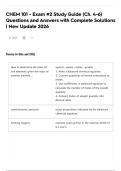
CHEM 101 - Exam #2 Study Guide (Ch. 4-6)
Questions and Answers with Complete Solutions
| New Update 2026
Save
Terms in this set (90)
How to determine the mass of (grams→moles→moles→grams)
one elements given the mass of 1. Write a balanced chemical equation.
another element... 2. Convert quantities of known substances to
moles.
3. Use coefficients in balanced equation to
calculate the number of moles of the sought
quantity
4. Convert moles of sought quantity into
desired units.
stoichiometric amounts exact proportions indicated by the balanced
chemical equation
limiting reagent reactant used up first in the reaction (think of
G.I. Joe's)
, theoretical yield the amount of product that would result if all
the limiting reagent reacted (a.k.a. the
maximum obtainable result
actual yield the amount of product actually obtained from
a reaction
equations for percent yield % yield = (actual yield / theoretical yield) *
100%
concentration the amount of solute present in a given
quantity of solvent or solution
equations for concentration of a molarity = M = moles of solute / liters of
solution solution
dilution the procedure for preparing a less
concentrated solution from a more
concentrated solution
equation for concentration- (initial molarity) * (initial volume) = (final
volume proportionality (only molarity) * (final volume)
applicable for dilutions)
equation of pH pH = -log [H⁺]
if [H⁺]=[OH⁻]... solution is neutral
--at 25°C, [H⁺] = 1.0x10⁻⁷
--pH = 7
Questions and Answers with Complete Solutions
| New Update 2026
Save
Terms in this set (90)
How to determine the mass of (grams→moles→moles→grams)
one elements given the mass of 1. Write a balanced chemical equation.
another element... 2. Convert quantities of known substances to
moles.
3. Use coefficients in balanced equation to
calculate the number of moles of the sought
quantity
4. Convert moles of sought quantity into
desired units.
stoichiometric amounts exact proportions indicated by the balanced
chemical equation
limiting reagent reactant used up first in the reaction (think of
G.I. Joe's)
, theoretical yield the amount of product that would result if all
the limiting reagent reacted (a.k.a. the
maximum obtainable result
actual yield the amount of product actually obtained from
a reaction
equations for percent yield % yield = (actual yield / theoretical yield) *
100%
concentration the amount of solute present in a given
quantity of solvent or solution
equations for concentration of a molarity = M = moles of solute / liters of
solution solution
dilution the procedure for preparing a less
concentrated solution from a more
concentrated solution
equation for concentration- (initial molarity) * (initial volume) = (final
volume proportionality (only molarity) * (final volume)
applicable for dilutions)
equation of pH pH = -log [H⁺]
if [H⁺]=[OH⁻]... solution is neutral
--at 25°C, [H⁺] = 1.0x10⁻⁷
--pH = 7

