THERMODYNAMICS
Chapter 1: Units, Dimensions & Problem Solving
SI Units, Dimensional Analysis & Engineering Calculations
10 Questions | Easy · Medium · Hard | Full Worked Solutions
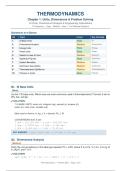
Questions at a Glance
Q# Topic Level Key Concept
1 SI Base Units Easy SI
2 Dimensional Analysis Medium Dimensional
3 Energy Units Easy Energy
4 Power Units Easy Power
5 Newton's Laws & Force Medium Newton's
6 Significant Figures Easy Significant
7 System Boundary Medium System
8 Continuum Assumption Medium Continuum
9 Thermodynamic Equilibrium Medium Thermodynamic
10 Process vs Cycle Easy Process
Q1. SI Base Units
[Easy]
List the 7 SI base units. Which ones are most commonly used in thermodynamics? Convert 5 atm to
kPa, bar, and psi.
✔ SOLUTION
7 SI BASE UNITS: metre (m), kilogram (kg), second (s), ampere (A),
kelvin (K), mole (mol), candela (cd)
Most used in thermo: m, kg, s, K + derived: Pa, J, W
CONVERSIONS from 5 atm:
1 atm = 101.325 kPa → 5 atm = 506.625 kPa
1 atm = 1.01325 bar → 5 atm = 5.066 bar
1 atm = 14.696 psi → 5 atm = 73.48 psi
KEY ANSWER: 5 atm = 506.6 kPa = 5.07 bar = 73.5 psi
Q2. Dimensional Analysis
[Medium]
Verify the unit consistency of the ideal gas equation PV = mRT, where P is in Pa, V in m³, m in kg, R
in J/kg·K, and T in K.
✔ SOLUTION
Left side: P × V = Pa × m³ = (N/m²) × m³ = N·m = J
Thermodynamics — Practice Q&A | Page 1 of 6
, Right side: m × R × T = kg × (J/kg·K) × K = J
Both sides have units of JOULES (J) = N·m = kg·m²/s²
Therefore PV = mRT is dimensionally consistent. ✓
NOTE: This is why R has units J/kg·K (or kJ/kg·K in engineering).
Universal gas constant: R_u = 8.314 J/mol·K
Specific: R = R_u/M where M = molar mass (kg/kmol)
KEY ANSWER: Both sides = J (joules): dimensional consistency verified ✓
Q3. Energy Units
[Easy]
Convert the following: (a) 1 kWh to kJ and MJ, (b) 1 BTU to kJ, (c) 500 kcal to kJ.
✔ SOLUTION
Part (a) – 1 kWh:
1 kWh = 1 kW × 3600 s = 3600 kJ = 3.6 MJ
Part (b) – 1 BTU (British Thermal Unit):
1 BTU = 1.05506 kJ ≈ 1.055 kJ
1000 BTU = 1.055 MJ
Part (c) – 500 kcal:
1 kcal = 4.187 kJ (exact: 4186.8 J)
500 kcal = 500 × 4.187 = 2093.5 kJ
QUICK REFERENCE:
1 kWh = 3600 kJ | 1 BTU = 1.055 kJ | 1 kcal = 4.187 kJ
1 MJ = 0.278 kWh = 948 BTU = 239 kcal
KEY ANSWER: 1 kWh = 3600 kJ | 1 BTU = 1.055 kJ | 500 kcal = 2093.5 kJ
Q4. Power Units
[Easy]
A car engine produces 150 kW. Convert to (a) hp, (b) BTU/hr, (c) ft·lbf/s. Also, if the engine runs for
2 hours, how much energy in MJ?
✔ SOLUTION
CONVERSIONS:
1 kW = 1.341 hp | 1 kW = 3412 BTU/hr | 1 kW = 737.6 ft·lbf/s
Part (a): 150 kW × 1.341 = 201.2 hp
Part (b): 150 kW × 3412 = 511,800 BTU/hr ≈ 512 MBTU/hr
Part (c): 150 kW × 737.6 = 110,640 ft·lbf/s
Energy in 2 hours:
E = P × t = 150 kW × 2 hr = 300 kWh
Thermodynamics — Practice Q&A | Page 2 of 6