

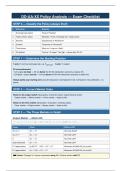
DD-AA-XX Policy Analysis — Exam Checklist
STEP 0 — Classify the Policy (always first!)
# Dimension Question
1 Exchange rate regime Fixed or Floating?
2 Type of shock / policy Monetary / Fiscal / Exchange rate / Output shock
3 Direction Expansionary or Restrictive?
4 Duration Temporary or Permanent?
5 Time horizon Short run / Long run / Both?
6 CA position Too low / On target / Too high → where does XX sit?
STEP 1 — Determine the Starting Position
Y-axis: E (nominal exchange rate, e.g. ELBP/USD) X-axis: Y (output)
XX curve placement:
• CA surplus too high → XX sits below the DD-AA intersection (economy is above XX)
• CA deficit / surplus too low → XX sits above the DD-AA intersection (economy is below XX)
Always justify your starting zone using the data given (unemployment rate, CA balance). No justification = no
points!
STEP 2 — Correct Market Order
Shock on the output market (fiscal policy, investment shock, export demand shock):
Output market → Money market → Forex market → (back to AA)
Shock on the forex market (devaluation, revaluation, monetary policy):
Forex market → Output market → Money market → (back to AA)
STEP 3 — The Three Markets in Detail
Output Market → affects DD
Y = D = C + I + G + EX - IM = C(Y-T) + I + G + CA(EP*/P, Y-T)
Cause Chain Effect on DD
G↑ or T↓ D↑ → Y↑ DD shifts RIGHT
G↓ or T↑ D↓ → Y↓ DD shifts LEFT
I↓ D↓ → Y↓ DD shifts LEFT
Export demand↓ D↓ → Y↓ DD shifts LEFT
E↑ (depreciation) q=EP*/P↑ → CA↑ → D↑ → Y↑ Movement ALONG DD (not a shift!)
E↓ (appreciation) q↓ → CA↓ → D↓ → Y↓ Movement ALONG DD (not a shift!)
■■ Critical: Changes in E cause movements along DD. All other shocks shift DD.
STEP 0 — Classify the Policy (always first!)
# Dimension Question
1 Exchange rate regime Fixed or Floating?
2 Type of shock / policy Monetary / Fiscal / Exchange rate / Output shock
3 Direction Expansionary or Restrictive?
4 Duration Temporary or Permanent?
5 Time horizon Short run / Long run / Both?
6 CA position Too low / On target / Too high → where does XX sit?
STEP 1 — Determine the Starting Position
Y-axis: E (nominal exchange rate, e.g. ELBP/USD) X-axis: Y (output)
XX curve placement:
• CA surplus too high → XX sits below the DD-AA intersection (economy is above XX)
• CA deficit / surplus too low → XX sits above the DD-AA intersection (economy is below XX)
Always justify your starting zone using the data given (unemployment rate, CA balance). No justification = no
points!
STEP 2 — Correct Market Order
Shock on the output market (fiscal policy, investment shock, export demand shock):
Output market → Money market → Forex market → (back to AA)
Shock on the forex market (devaluation, revaluation, monetary policy):
Forex market → Output market → Money market → (back to AA)
STEP 3 — The Three Markets in Detail
Output Market → affects DD
Y = D = C + I + G + EX - IM = C(Y-T) + I + G + CA(EP*/P, Y-T)
Cause Chain Effect on DD
G↑ or T↓ D↑ → Y↑ DD shifts RIGHT
G↓ or T↑ D↓ → Y↓ DD shifts LEFT
I↓ D↓ → Y↓ DD shifts LEFT
Export demand↓ D↓ → Y↓ DD shifts LEFT
E↑ (depreciation) q=EP*/P↑ → CA↑ → D↑ → Y↑ Movement ALONG DD (not a shift!)
E↓ (appreciation) q↓ → CA↓ → D↓ → Y↓ Movement ALONG DD (not a shift!)
■■ Critical: Changes in E cause movements along DD. All other shocks shift DD.

