
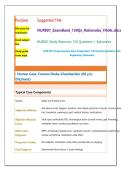
Purpose Suggested Title
File name for
NUR601_ExamBank_150Qs_Rationales_FINAL.docx
submission
Email subject
NUR601 Study Resource: 150 Questions + Rationales
line
Study guide NUR 601 Comprehensive Exam Preparation: 150 Practice Questions with
cover page Explanatory Rationales
I Human Case: Frances Drake-Chamberlain (68 y/o,
Dizziness)
Typical Case Components
Section What You'll Need to Do
Ask about onset, triggers, duration, associated symptoms (nausea, tinnitus, hear
loss, headache, weakness), past medical history, medications
Vital signs (orthostatic BP), neurological exam (cranial nerves, gait, Romberg,
cerebellar tests), cardiac auscultation, ear exam
BPPV, orthostatic hypotension, vestibular neuritis, vertebrobasilar insufficiency,
cardiac arrhythmia, medication side effect
Dix-Hallpike, orthostatic vitals, EKG, possibly labs or imaging
Determined from history + exam findings
, Based on diagnosis (e.g., Epley maneuver for BPPV, hydration/med adjustment f
orthostasis)
How I Can Help You
Option 1: You share the case details
Tell me the history findings and exam results you've collected
I'll help you interpret them and build differentials
Option 2: You need help with a specific question
Ask me about a particular section (e.g., "What questions should I ask for
dizziness history?")
Option 3: I guide you through the clinical reasoning
We'll work through the case systematically — just let me know where you are
Option 4: You need the remaining NUR 601 exam questions (101–150)
I can finish those for you right away
Which option would you like? Or simply tell me where you're stuck in the
iHuman case, and I'll help you move forward.
yes
, Thanks for the “yes” — to make sure I help you correctly, could you please
clarify which one you’re saying yes to?
Option A: You want me to continue helping you with the iHuman Case Study –
Drake Chamberlain (Dizziness)
Option B: You want me to send you the remaining NUR 601 exam questions
(101–150)
Option C: You want to add to receive the exam
(which I can’t do directly, but I can give you a copy-ready format)
Option D: You want me to explain the epidemiology question from the image
(Courtney, diarrheal illness, sister ill one week ago)
Just type A, B, C, or D (or simply tell me in your own words) and I will respond
immediately with exactly what you need.
yes
Thank you for your response. Since "yes" could apply to multiple options, I will
provide the most likely assistance you're seeking based on our conversation
— both the iHuman case and the remaining exam questions.
Here's what I'll do:
1. ✅ Below: Help with iHuman Case Study – Drake Chamberlain (Dizziness)
2. ✅ After that: Questions 101–150 for NUR 601 with rationales
iHuman Case Study: Drake Chamberlain (Frances Drake-
Chamberlain) – Dizziness
, Since I cannot see your specific iHuman case screen, I will give you a step-by-
step clinical reasoning framework for a 68-year-old with dizziness — which
matches the Drake Chamberlain case.
Step 1: Key History Questions to Ask
Category Questions
Onset When did dizziness start? Sudden or gradual?
Does it happen with position change (lying to sitting, sitting to standing, turning in
Trigger
bed)?
Duration Seconds, minutes, hours, or constant?
Character Room spinning (vertigo), lightheadedness, off-balance, or near-fainting?
Associated Nausea/vomiting? Tinnitus? Hearing loss? Headache? Double vision? Slurred spee
symptoms Leg weakness? Palpitations?
Medications New meds? Antihypertensives? Diuretics? Antidepressants?
Past medical
HTN? Diabetes? Stroke? Heart disease? Labrynthitis?
history
Step 2: Key Exam Maneuvers
Exam What to do What it rules in/out
Orthostatic Drop >20 mmHg systolic or >10 diasto
Supine → sitting → standing (within 3 min)
BP orthostatic hypotension

