
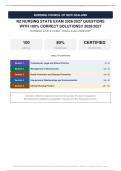
NZ NURSING STATE EXAM 2026/2027 QUESTIONS WITH 100% CORRECT SOLUTIONS!! 2026/2027 2026/2027 | Page 1 | Passing Score: 80%
NURSING COUNCIL OF NEW ZEALAND
NZ NURSING STATE EXAM 2026/2027 QUESTIONS
WITH 100% CORRECT SOLUTIONS!! 2026/2027
NURSING STATE EXAM - Official Exam 2026/2027
100 80% CERTIFIED
QUESTIONS PASSING SCORE RECERTIFICATION
TABLE OF CONTENTS
Section 1 Professional, Legal and Ethical Practice Q1-20
Section 2 Management of Nursing Care Q21-40
Section 3 Health Promotion and Disease Prevention Q41-60
Section 4 Interpersonal Relationships and Communication Q61-80
Section 5 Clinical Nursing Practice Q81-100
Instructions: Select the single best answer for each question. This exam is designed for
New Zealand Nursing State Exam preparation. Passing score: 80% (80 questions correct).
NZ NURSING STATE EXAM 2026/2027 QUESTIONS WITH 100% CORRECT SOLUTIONS!! 2026/2027 - 2026/2027 | Passing Score: 80% | Page 1
,SECTION 1 | Professional, Legal and Ethical Practice | Q1-Q20 | NZ NURSING STATE EXAM 2026/2027 QUESTIONS
WITH 100% CORRECT SOLUTIONS!! 2026/2027 2026/2027
Q1 Question 1 of 100
Q1. A 34-year-old registered nurse working in a surgical ward is asked by a patient's family member to disclose
the patient's diagnosis without the patient's consent. The nurse understands that under the Health Information
Privacy Code 2020, the most appropriate action is to:
A. Refuse to disclose the information and explain that patient consent is required before any health
information can be shared with third parties
B. Share the diagnosis because family members have an automatic right to know under New Zealand law
C. Disclose only a general summary of the condition to avoid violating privacy completely
D. Ask the charge nurse to decide whether the family should receive the information
Correct Answer: A
Rationale:
The Health Information Privacy Code 2020 prohibits disclosure of health information without the patient's informed
consent, except in specific statutory exceptions. Family members do not have automatic rights to a patient's health
information. Option B is incorrect because no such automatic right exists. Option C still constitutes unauthorized
disclosure, and Option D inappropriately delegates the nurse's professional responsibility.
Q2 Question 2 of 100
Q2. A 28-year-old nurse employed at a Christchurch hospital witnesses a colleague administering medication to
the wrong patient. The colleague asks the nurse not to report the incident, stating it was a minor error with no
harm caused. Under the Health Practitioners Competence Assurance Act 2003, the nurse's primary obligation is
to:
A. Respect the colleague's request since no patient harm resulted from the error
B. Report the incident through the appropriate internal and regulatory channels as required by
professional standards
C. Confront the colleague privately and ask them to self-report within 48 hours
D. Document the event in personal notes but take no further action unless harm becomes apparent
Correct Answer: B
Rationale:
Under the HPCAA 2003, nurses have a professional and legal duty to report safety concerns and practice issues,
regardless of whether harm occurred. Option A violates mandatory reporting obligations. Option C delays
appropriate reporting, and Option D fails to meet the threshold for professional accountability. The Nursing Council
expects prompt reporting of all adverse events.
NZ NURSING STATE EXAM 2026/2027 QUESTIONS WITH 100% CORRECT SOLUTIONS!! 2026/2027 - 2026/2027 | Passing Score: 80% | Page 2
, Q3 Question 3 of 100
Q3. A 45-year-old Maori patient with end-stage renal disease refuses dialysis, expressing a wish to return to
their whanau for palliative care. The nurse recognizes that respecting this decision aligns with the principles of
the Treaty of Waitangi, specifically the principle of:
A. Partnership, which requires the health system to work collaboratively with Maori in all clinical decisions
B. Protection, which obligates health professionals to override patient choices when health outcomes are at risk
C. Tino rangatiratanga, which supports Maori self-determination and the right to make autonomous
decisions about their own health and wellbeing
D. Good faith, which means the patient must follow medical recommendations while being treated respectfully
Correct Answer: C
Rationale:
Tino rangatiratanga (self-determination) underpins the right of Maori to make autonomous health decisions, including
refusing treatment. Option A describes partnership but misapplies it to individual clinical decisions. Option C distorts
the principle of protection, which does not override autonomy. Option D misinterprets good faith as requiring
compliance with medical advice.
Q4 Question 4 of 100
Q4. A 52-year-old nurse practitioner is reviewing a patient's chart and notices that a colleague has documented
an assessment that was never actually performed. According to the Nursing Council of New Zealand Code of
Conduct, the most appropriate first step is to:
A. Report the colleague directly to the Nursing Council for professional misconduct without further investigation
B. Ignore the discrepancy since it may have been an honest documentation mistake with no patient impact
C. Delete the inaccurate entry from the chart and replace it with the correct documentation
D. Discuss the discrepancy with the colleague first to clarify whether an error or miscommunication
occurred before escalating
Correct Answer: D
Rationale:
The NCNZ Code of Conduct advises addressing concerns through professional dialogue first, allowing for
clarification before formal escalation. Option A skips the appropriate preliminary step of discussion. Option C
constitutes tampering with records and is professionally unethical. Option D neglects the nurse's duty to ensure
documentation accuracy and patient safety.
NZ NURSING STATE EXAM 2026/2027 QUESTIONS WITH 100% CORRECT SOLUTIONS!! 2026/2027 - 2026/2027 | Passing Score: 80% | Page 3
, Q5 Question 5 of 100
Q5. A 30-year-old nurse is caring for a patient who discloses they are experiencing domestic violence but begs
the nurse not to tell anyone. Under New Zealand privacy legislation and the Family Violence Act 2018, the
nurse should:
A. Respect the patient's wishes but provide information about available support services and resources
B. Maintain absolute confidentiality and take no action since the patient has explicitly requested privacy
C. Immediately report the disclosure to the New Zealand Police without the patient's consent
D. Contact the patient's family members to arrange a safety plan on the patient's behalf
Correct Answer: A
Rationale:
While maintaining confidentiality is important, the nurse should provide the patient with support resources and
empower them to make informed decisions. Option A fails to offer necessary support. Option C breaches patient
trust and is not required unless there is imminent danger. Option D violates patient privacy and could escalate the
risk of violence.
Q6 Question 6 of 100
Q6. A 40-year-old nurse working in a mental health unit is preparing to administer compulsory treatment under
the Mental Health (Compulsory Assessment and Treatment) Act 1992. Before proceeding, the nurse must verify
that:
A. The patient has been given at least 72 hours to consider voluntary treatment options before compulsion is
applied
B. A valid compulsory treatment order is in place and the patient has been informed of their legal rights
including the right to legal representation
C. At least two family members have consented to the compulsory treatment on the patient's behalf
D. The treating psychiatrist has personally observed the patient within the last 12 hours before the order is
executed
Correct Answer: B
Rationale:
The Mental Health Act requires a valid compulsory treatment order and that the patient is informed of their rights,
including legal representation. Option A is not a requirement under the Act. Option C is incorrect because family
consent does not replace a legal order. Option D describes a clinical preference but is not a statutory requirement.
NZ NURSING STATE EXAM 2026/2027 QUESTIONS WITH 100% CORRECT SOLUTIONS!! 2026/2027 - 2026/2027 | Passing Score: 80% | Page 4
NURSING COUNCIL OF NEW ZEALAND
NZ NURSING STATE EXAM 2026/2027 QUESTIONS
WITH 100% CORRECT SOLUTIONS!! 2026/2027
NURSING STATE EXAM - Official Exam 2026/2027
100 80% CERTIFIED
QUESTIONS PASSING SCORE RECERTIFICATION
TABLE OF CONTENTS
Section 1 Professional, Legal and Ethical Practice Q1-20
Section 2 Management of Nursing Care Q21-40
Section 3 Health Promotion and Disease Prevention Q41-60
Section 4 Interpersonal Relationships and Communication Q61-80
Section 5 Clinical Nursing Practice Q81-100
Instructions: Select the single best answer for each question. This exam is designed for
New Zealand Nursing State Exam preparation. Passing score: 80% (80 questions correct).
NZ NURSING STATE EXAM 2026/2027 QUESTIONS WITH 100% CORRECT SOLUTIONS!! 2026/2027 - 2026/2027 | Passing Score: 80% | Page 1
,SECTION 1 | Professional, Legal and Ethical Practice | Q1-Q20 | NZ NURSING STATE EXAM 2026/2027 QUESTIONS
WITH 100% CORRECT SOLUTIONS!! 2026/2027 2026/2027
Q1 Question 1 of 100
Q1. A 34-year-old registered nurse working in a surgical ward is asked by a patient's family member to disclose
the patient's diagnosis without the patient's consent. The nurse understands that under the Health Information
Privacy Code 2020, the most appropriate action is to:
A. Refuse to disclose the information and explain that patient consent is required before any health
information can be shared with third parties
B. Share the diagnosis because family members have an automatic right to know under New Zealand law
C. Disclose only a general summary of the condition to avoid violating privacy completely
D. Ask the charge nurse to decide whether the family should receive the information
Correct Answer: A
Rationale:
The Health Information Privacy Code 2020 prohibits disclosure of health information without the patient's informed
consent, except in specific statutory exceptions. Family members do not have automatic rights to a patient's health
information. Option B is incorrect because no such automatic right exists. Option C still constitutes unauthorized
disclosure, and Option D inappropriately delegates the nurse's professional responsibility.
Q2 Question 2 of 100
Q2. A 28-year-old nurse employed at a Christchurch hospital witnesses a colleague administering medication to
the wrong patient. The colleague asks the nurse not to report the incident, stating it was a minor error with no
harm caused. Under the Health Practitioners Competence Assurance Act 2003, the nurse's primary obligation is
to:
A. Respect the colleague's request since no patient harm resulted from the error
B. Report the incident through the appropriate internal and regulatory channels as required by
professional standards
C. Confront the colleague privately and ask them to self-report within 48 hours
D. Document the event in personal notes but take no further action unless harm becomes apparent
Correct Answer: B
Rationale:
Under the HPCAA 2003, nurses have a professional and legal duty to report safety concerns and practice issues,
regardless of whether harm occurred. Option A violates mandatory reporting obligations. Option C delays
appropriate reporting, and Option D fails to meet the threshold for professional accountability. The Nursing Council
expects prompt reporting of all adverse events.
NZ NURSING STATE EXAM 2026/2027 QUESTIONS WITH 100% CORRECT SOLUTIONS!! 2026/2027 - 2026/2027 | Passing Score: 80% | Page 2
, Q3 Question 3 of 100
Q3. A 45-year-old Maori patient with end-stage renal disease refuses dialysis, expressing a wish to return to
their whanau for palliative care. The nurse recognizes that respecting this decision aligns with the principles of
the Treaty of Waitangi, specifically the principle of:
A. Partnership, which requires the health system to work collaboratively with Maori in all clinical decisions
B. Protection, which obligates health professionals to override patient choices when health outcomes are at risk
C. Tino rangatiratanga, which supports Maori self-determination and the right to make autonomous
decisions about their own health and wellbeing
D. Good faith, which means the patient must follow medical recommendations while being treated respectfully
Correct Answer: C
Rationale:
Tino rangatiratanga (self-determination) underpins the right of Maori to make autonomous health decisions, including
refusing treatment. Option A describes partnership but misapplies it to individual clinical decisions. Option C distorts
the principle of protection, which does not override autonomy. Option D misinterprets good faith as requiring
compliance with medical advice.
Q4 Question 4 of 100
Q4. A 52-year-old nurse practitioner is reviewing a patient's chart and notices that a colleague has documented
an assessment that was never actually performed. According to the Nursing Council of New Zealand Code of
Conduct, the most appropriate first step is to:
A. Report the colleague directly to the Nursing Council for professional misconduct without further investigation
B. Ignore the discrepancy since it may have been an honest documentation mistake with no patient impact
C. Delete the inaccurate entry from the chart and replace it with the correct documentation
D. Discuss the discrepancy with the colleague first to clarify whether an error or miscommunication
occurred before escalating
Correct Answer: D
Rationale:
The NCNZ Code of Conduct advises addressing concerns through professional dialogue first, allowing for
clarification before formal escalation. Option A skips the appropriate preliminary step of discussion. Option C
constitutes tampering with records and is professionally unethical. Option D neglects the nurse's duty to ensure
documentation accuracy and patient safety.
NZ NURSING STATE EXAM 2026/2027 QUESTIONS WITH 100% CORRECT SOLUTIONS!! 2026/2027 - 2026/2027 | Passing Score: 80% | Page 3
, Q5 Question 5 of 100
Q5. A 30-year-old nurse is caring for a patient who discloses they are experiencing domestic violence but begs
the nurse not to tell anyone. Under New Zealand privacy legislation and the Family Violence Act 2018, the
nurse should:
A. Respect the patient's wishes but provide information about available support services and resources
B. Maintain absolute confidentiality and take no action since the patient has explicitly requested privacy
C. Immediately report the disclosure to the New Zealand Police without the patient's consent
D. Contact the patient's family members to arrange a safety plan on the patient's behalf
Correct Answer: A
Rationale:
While maintaining confidentiality is important, the nurse should provide the patient with support resources and
empower them to make informed decisions. Option A fails to offer necessary support. Option C breaches patient
trust and is not required unless there is imminent danger. Option D violates patient privacy and could escalate the
risk of violence.
Q6 Question 6 of 100
Q6. A 40-year-old nurse working in a mental health unit is preparing to administer compulsory treatment under
the Mental Health (Compulsory Assessment and Treatment) Act 1992. Before proceeding, the nurse must verify
that:
A. The patient has been given at least 72 hours to consider voluntary treatment options before compulsion is
applied
B. A valid compulsory treatment order is in place and the patient has been informed of their legal rights
including the right to legal representation
C. At least two family members have consented to the compulsory treatment on the patient's behalf
D. The treating psychiatrist has personally observed the patient within the last 12 hours before the order is
executed
Correct Answer: B
Rationale:
The Mental Health Act requires a valid compulsory treatment order and that the patient is informed of their rights,
including legal representation. Option A is not a requirement under the Act. Option C is incorrect because family
consent does not replace a legal order. Option D describes a clinical preference but is not a statutory requirement.
NZ NURSING STATE EXAM 2026/2027 QUESTIONS WITH 100% CORRECT SOLUTIONS!! 2026/2027 - 2026/2027 | Passing Score: 80% | Page 4

