

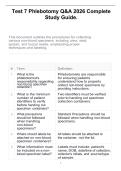
Test 7 Phlebotomy Q&A 2026 Complete
Study Guide.
This document outlines the procedures for collecting
various non-blood specimens, including urine, stool,
sputum, and buccal swabs, emphasizing proper
techniques and labeling.
# Term Definition
1 What is the Phlebotomists are responsible
phlebotomist's for ensuring patients
responsibility regarding understand how to properly
non-blood specimen collect non-blood specimens by
collection?
providing instructions.
2 What is the minimum Two identifiers must be verified
number of patient prior to handing out specimen
identifiers to verify collection containers.
before handing out
specimen containers?
3 What precautions Standard Precautions should be
should be followed followed when handling non-blood
when handling specimens.
non-blood
specimens?
4 Where should labels be All labels should be attached to
attached on non-blood the container, not the lid.
specimen containers?
5 What information must Labels must include: patient's
be included on a non- name, DOB, date/time of collection,
blood specimen label? collector's initials, and source/type
of sample.
1
, 6 What is a routine A routine urinalysis is an
urinalysis? examination of urine for
appearance, color, odor, pH,
specific gravity, and the presence
of components like protein,
glucose, and hemoglobin.
7 What is the most The most common method for urine
common collection tests is the "Midstream Clean
method for urine tests? Catch Technique".
8 What is a midstream It requires collecting the middle
clean catch urine volume of urine after cleansing
specimen collection? the urinary meatus.
9 What is the purpose of a A urine culture checks for bacteria
urine culture test? in the urine, often diagnosing a
urinary tract infection.
10 How should urine culture Keep urine culture tubes at
tubes be stored if not room temperature for up to 72
transferred hours; otherwise, refrigerate if
immediately? there is a delay in transfer.
2
Study Guide.
This document outlines the procedures for collecting
various non-blood specimens, including urine, stool,
sputum, and buccal swabs, emphasizing proper
techniques and labeling.
# Term Definition
1 What is the Phlebotomists are responsible
phlebotomist's for ensuring patients
responsibility regarding understand how to properly
non-blood specimen collect non-blood specimens by
collection?
providing instructions.
2 What is the minimum Two identifiers must be verified
number of patient prior to handing out specimen
identifiers to verify collection containers.
before handing out
specimen containers?
3 What precautions Standard Precautions should be
should be followed followed when handling non-blood
when handling specimens.
non-blood
specimens?
4 Where should labels be All labels should be attached to
attached on non-blood the container, not the lid.
specimen containers?
5 What information must Labels must include: patient's
be included on a non- name, DOB, date/time of collection,
blood specimen label? collector's initials, and source/type
of sample.
1
, 6 What is a routine A routine urinalysis is an
urinalysis? examination of urine for
appearance, color, odor, pH,
specific gravity, and the presence
of components like protein,
glucose, and hemoglobin.
7 What is the most The most common method for urine
common collection tests is the "Midstream Clean
method for urine tests? Catch Technique".
8 What is a midstream It requires collecting the middle
clean catch urine volume of urine after cleansing
specimen collection? the urinary meatus.
9 What is the purpose of a A urine culture checks for bacteria
urine culture test? in the urine, often diagnosing a
urinary tract infection.
10 How should urine culture Keep urine culture tubes at
tubes be stored if not room temperature for up to 72
transferred hours; otherwise, refrigerate if
immediately? there is a delay in transfer.
2

