THERMODYNAMICS
Chapter 3: First Law of Thermodynamics – Closed Systems
Internal Energy, Heat, Work & Energy Balance
10 Questions | Easy · Medium · Hard | Full Worked Solutions
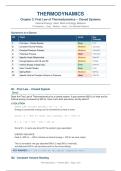
Questions at a Glance
Q# Topic Level Key
Concept
1 First Law – Closed System Easy First
2 Constant Volume Heating Medium Constant
3 Constant Pressure Process Medium Constant
4 Polytropic Process Hard Polytropic
5 Specific Heats Relationship Medium Specific
6 Energy Balance with KE and PE Medium Energy
7 Internal Energy of Ideal Gas Easy Internal
8 Heat Transfer Modes Easy Heat
9 Spring Work Medium Spring
10 Specific Heat at Constant Volume vs Pressure Hard Specific
Q1. First Law – Closed System
[Easy]
State the First Law of Thermodynamics for a closed system. A gas receives 800 kJ of heat and its
internal energy increases by 500 kJ. How much work was done, and by whom?
✔ SOLUTION
FIRST LAW (Closed System): ΔU = Q – W
Energy is conserved; energy can be transferred as heat or work.
Given: Q = +800 kJ (heat into system), ΔU = +500 kJ
W = Q – ΔU = 800 – 500 = 300 kJ
Since W > 0, work was done BY the system (gas expanded).
ENERGY BALANCE:
Heat in: 800 kJ → 500 kJ stored as internal energy + 300 kJ as work output
This is consistent: the gas absorbed 800 kJ, kept 500 kJ internally,
and delivered 300 kJ as boundary work to the surroundings.
KEY ANSWER: W = 300 kJ done BY the system (expansion work)
Q2. Constant Volume Heating
Thermodynamics — Practice Q&A | Page 1 of 6
, [Medium]
2 kg of air (cv = 0.718 kJ/kg·K) is heated in a rigid tank from 25°C to 200°C. (a) Find ΔU and Q. (b)
How much work is done? Explain physically.
✔ SOLUTION
Part (a):
ΔU = m × cv × ΔT = 2 × 0.718 × (200 – 25)
ΔU = 2 × 0.718 × 175
ΔU = 251.3 kJ
For a rigid tank (constant volume), W_boundary = 0
Therefore by First Law: Q = ΔU + W = 251.3 + 0 = 251.3 kJ
All heat input goes directly into internal energy (molecular KE).
Part (b) – Work done:
W = ∫P dV = 0 (rigid tank, dV = 0)
PHYSICAL EXPLANATION:
In a rigid container, no boundary moves, so no boundary (PdV) work is possible.
The heat supplied raises the temperature and internal energy directly.
If it were a piston-cylinder instead, some energy would go to expansion work.
KEY ANSWER: ΔU = Q = 251.3 kJ | W = 0 (rigid tank, no boundary work)
Q3. Constant Pressure Process
[Medium]
1.5 kg of steam is heated at constant pressure of 500 kPa from saturated vapor (h_g = 2748.7
kJ/kg) to 300°C (h = 3064.2 kJ/kg). Find Q, W_boundary, and ΔU.
✔ SOLUTION
At constant pressure, Q = ΔH = m × (h₂ – h₁ )
Q = 1.5 × (3064.2 – 2748.7)
Q = 1.5 × 315.5
Q = 473.3 kJ
From steam tables at 500 kPa:
v₁ = v_g(500 kPa) = 0.3749 m³/kg
v₂ at 500 kPa, 300°C = 0.5226 m³/kg
Boundary work:
W_b = m × P × (v₂ – v₁ ) = 1.5 × 500 × (0.5226 – 0.3749)
W_b = 750 × 0.1477 = 110.8 kJ
Change in internal energy:
ΔU = Q – W_b = 473.3 – 110.8 = 362.5 kJ
VERIFICATION: ΔU = m(u₂ – u₁ ); matches when using u values from steam
tables.
KEY ANSWER: Q = 473.3 kJ | W_b = 110.8 kJ | ΔU = 362.5 kJ
Thermodynamics — Practice Q&A | Page 2 of 6